
 English
 Français
 Deutsch
 Nederlands
 Polski
 Español
Dropshipping Supplier vs. Private Agent: Which Is Right For You In 2026?
Dropshipping Supplier vs. Private Agent: What is the difference? Discover which partner offers faster shipping, lower prices, and custom branding for your business in
Underwear dropshipping is one of the most profitable niches in 2026 — and one of the most punishing if you get the basics wrong. Most “how to dropship underwear” guides online were written in 2023 or 2024, before the US ended de minimis, before TikTok Shop’s intimate content rules tightened, and before customers learned to expect Skims-level quality from every new brand. This guide is built for 2026 reality — every step is current, including the parts about tariffs that most older guides still pretend don’t exist.
This guide is for you if you’re new to underwear dropshipping or evaluating whether to enter the niche. If you’ve already decided on underwear as your category and just need to pick a supplier, our Best Underwear Dropshipping Suppliers in 2026 comparison will be more useful. If you’re already running a store and want to understand DailyFulfill’s specific fulfillment model, contact us right now.
Below is a 2026-current playbook for launching an underwear dropshipping store in 8 steps. We’ll cover sub-category selection, demand validation, supplier sourcing, store setup, sample testing, branding (white label vs private label), pricing with real tariff math, and launching on TikTok and Meta without getting your ad account flagged. Total reading time: roughly 25-30 minutes. Total implementation time: 6-10 weeks depending on your sub-category and budget.
Before we get into the 8 steps, the most important question new sellers ask in 2026: is underwear dropshipping still profitable after the tariff changes? The short answer is yes — but only with the right strategy.
Whether underwear is worth your time in 2026 comes down to four things: market size, margin economics, the tariff math no one wants to discuss, and the strategic adjustments that have replaced 2023 playbooks.
The global lingerie and intimates market is on track to nearly double by 2032 — fueled by rising disposable income, social media discovery, and entirely new product categories that did not exist a decade ago. The most disruptive growth is happening in three sub-categories: period underwear (Knix sold for $400M; Modibodi acquired for $140M), shapewear and sculpting bodysuits (Skims hit a $4B+ valuation building this single category), and seamless wireless bras (Skims and Aerie pioneered the segment that now dominates TikTok and Instagram intimate content). Underwear is also one of the few apparel categories where TikTok Shop has not yet reached saturation — most established brands are still figuring out the platform, leaving real space for new dropshippers to build audiences. The opportunity is real. The execution is harder than it was in 2023.
The margin math on underwear is one of the best in dropshipping when you source from the right factory cluster. A typical seamless bralette costs $2-$4 at the supplier level and retails for $25-$35 on TikTok Shop or Shopify. A 3-pack of period underwear costs roughly $9-$15 at supplier prices and retails for $45-$60. International shipping for items under 200 grams runs $3-$5 worldwide. Even with the higher landed costs introduced by 2025 tariff changes (covered below), gross margins on underwear typically land between 55% and 70% — higher than most apparel categories. The second economic advantage is repeat purchase rate. Underwear is a consumable; customers replace it 2-3 times per year. One happy customer can produce 4-6 orders over 18 months, which transforms the customer acquisition math compared to one-shot product categories.
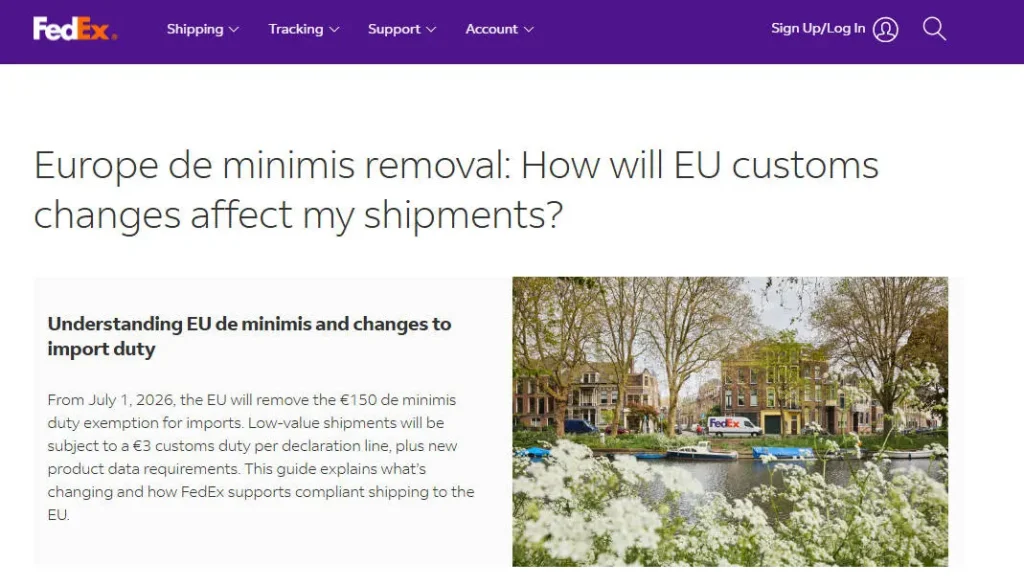
The single biggest change for dropshipping since 2023 is the end of the US de minimis duty-free exemption. The original $800 threshold was eliminated for China and Hong Kong imports on May 2, 2025, then suspended globally on August 29, 2025. As of 2026, every package entering the United States — regardless of value — requires formal customs entry and duty payment.
For China-origin underwear specifically, current rates run approximately 54% for shipments through the international postal network and around 30% for shipments via commercial carriers like FedEx, UPS, and DHL. The EU has also moved to eliminate its low-value duty exemption with a fixed-duty regime starting in July 2026. The UK retains a £135 duty-free threshold, but plans to remove it by 2029.
This sounds catastrophic on first read. In practice, it is not — it just changes the strategy. Sellers using DDP (Delivered Duty Paid) shipping through a competent fulfillment partner can absorb duties at landed-cost pricing and pass them through at retail. Sellers who try to ignore tariffs or have suppliers mislabel shipments now risk seized packages, CBP penalties, and frozen merchant accounts.
Yes — underwear dropshipping is still profitable in 2026, but the strategy that worked in 2023 will quietly bankrupt you now. Three adjustments separate profitable sellers from struggling ones in the current environment:
The 8 steps that follow are built around these three adjustments. They are also the difference between a $0 store and one doing $30,000-$50,000 a month within 12 months.
Trying to launch with “underwear” as your category is the most common new-seller mistake. The technical requirements, marketing angles, and customer expectations for period underwear, sports bras, and shapewear are completely different. Your supplier needs a different factory cluster. Your TikTok content needs a different hook. Your sizing chart looks different. Pick one sub-category for launch — you can expand later, but the stores that scale fastest are the ones that win one sub-category before adding the next.
1. Seamless Bralettes & Wireless Bras — Beginner-friendly. The largest single segment online. Skims/Aerie audience. Low construction complexity, high TikTok demand. Retail $22-35. Best starting choice for most new sellers.
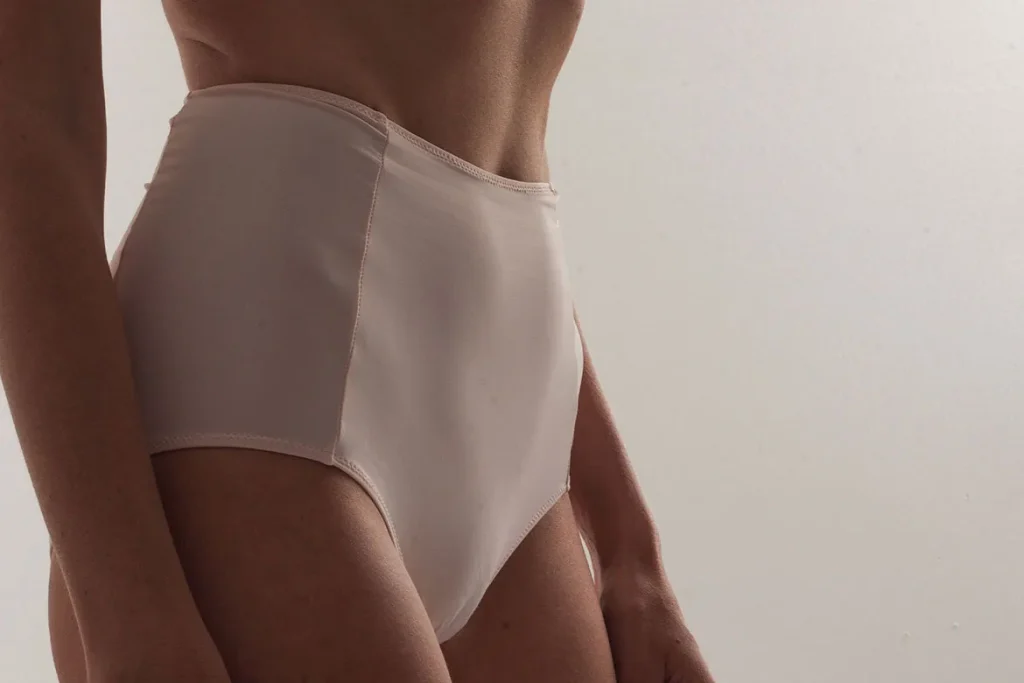
2. Period & Leakproof Underwear — Intermediate. Fastest-growing TikTok niche of the last 18 months. 3-pack bundles push AOV to $45-60. Loyal customers reorder every 3 months. Suppliers in this niche are clearly identifiable from generalists.
3. Shapewear & Sculpting Bodysuits — Intermediate. The Skims category. Strong impulse-buy energy on social media. Retail $35-80. Higher return rate than other categories due to sizing complexity — QC matters more than usual.
4. Sports Bras & Activewear Sets — Intermediate. Athleisure overlap drives growth. Pair-with-leggings sets push AOV up 40-60%. Engineering bar is high (impact-grade support, precision bonding).
5. Men’s Performance Underwear — Beginner-friendly. Underserved by women-focused stores. Anti-bacterial fabrics, cooling materials, modal/bamboo blends. 15%+ annual growth. Lowest marketing competition.
6. Basic Bras & Everyday Lingerie — Advanced. Most saturated and most competitive segment. Avoid as a starting niche unless you have a clear angle (size-inclusive, sustainable materials, plus-size focus, etc.).
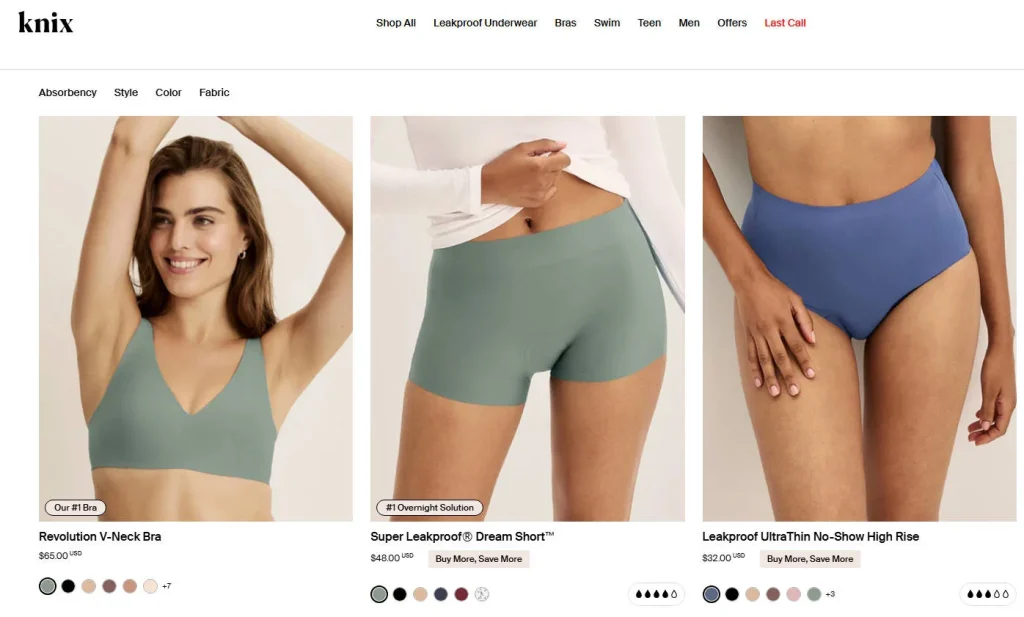
If you’re still unsure, the four questions below will narrow your choice in under five minutes:
1. What’s your starting budget? Under $2K → seamless bralettes or men’s underwear (lowest entry cost, white label viable). $2K-$8K → period underwear, shapewear, or sports bras (private label affordable). Above $8K → any category, including premium lingerie launches.
2. Who’s your audience? Gen Z women → period underwear, seamless bralettes, shapewear. Millennial women → sports bras, sculpting bodysuits. Men 25-45 → performance underwear (lowest marketing competition of any sub-category).
3. What’s your primary marketing channel? TikTok Shop → period underwear, shapewear, seamless. Meta + Shopify → sports bras, men’s underwear. Influencer-led → shapewear, premium lingerie.
4. How fast do you need first sales? Under 2 months → seamless or men’s underwear. 2-4 months → period underwear, sports bras. 4+ months → premium shapewear and lingerie launches.
If you’re feeling stuck, the safest first launch in 2026 is seamless bralettes for a women’s audience or men’s performance underwear for a men’s audience. Both have low construction complexity, low supplier MOQs, clear TikTok content angles, and the lowest learning curve. You can graduate to period underwear or shapewear in your second SKU cycle.
Picking a sub-category is one decision. Validating that customers actually want to buy that sub-category — at the price you need to charge — is a different decision. Most new sellers skip validation and discover demand problems after committing $2,000+ to inventory. The five fast validation methods below catch demand problems before they cost you money. The total time investment is roughly 4-6 hours; the total cash investment is $50-$100.
Search the sub-category hashtag and a few variants (for period underwear: #periodundies, #leakproofunderwear, #periodpanties). Three signals to read: total view count on the hashtag, posting frequency in the past 7 days, and engagement on the top 5 videos. Hashtags with 100M+ views and daily new posts are proven niches with active demand. Between 10M and 100M views with steady weekly posting is the best entry timing — proven but not saturated. Under 10M views means either the niche is dead or your search term is wrong — try category-adjacent hashtags before giving up.
Search the sub-category on Amazon, sort by “Best Sellers,” and look at the top 20 listings. Three signals matter: how many top-20 listings come from unknown sellers (not Calvin Klein, Hanes, Fruit of the Loom) — a high count means the niche has room for new entrants; what price points dominate the top performers — that’s your retail anchor; and review velocity on the top 5 — a product accumulating 50+ new reviews per month signals current demand, not historical sales. If unknown sellers control more than half of the top 20, the niche is winnable for a new brand.
Run the sub-category through Google Trends in three time windows: 5 years, 12 months, and 90 days. The 5-year view tells you whether the niche is structurally growing, flat, or declining — declining niches are not worth entering. The 12-month view reveals seasonality (some categories spike around back-to-school, gym resolutions, summer, or holidays). The 90-day view shows whether you are catching momentum or fighting a downward trend. Healthy niches show flat or upward direction across all three windows.
The first three methods test demand. This one tests supply. Order 1-3 samples from your shortlist supplier (use our Best Underwear Dropshipping Suppliers in 2026 post to pick candidates). When samples arrive, run the basic checks: fabric quality against the supplier’s claims, stitching at high-stress points, packaging discretion, and total time from order to delivery. Cost: typically $15-50. Skipping this step is how new sellers discover quality problems through customer complaints instead of their own inbox.
This is the final validation before committing inventory or branding budget. Use the supplier’s product photos (or AI-generated mockups) to run $20-50 of TikTok Spark Ads or Meta ads to a broad targeting set. Watch two metrics: click-through rate above 1.5% means the product has hook potential, and save/share rate above 1% means the product has organic virality potential beyond paid reach. The comments are even more useful than the metrics — they tell you exactly what your future customers actually care about. A sub-category that fails this test for $50 saves you from a 4-figure inventory mistake.
Run all five tests before placing your first real order. A sub-category that passes 4 out of 5 is a strong launch candidate. One that fails 2 or more is telling you to either pick a different sub-category or change your angle on the current one — both fixes are cheaper to make now than after committing inventory budget.
Supplier selection is the single highest-leverage decision in this entire guide. Pick well and the next 8 weeks run smoothly. Pick poorly and every problem in those 8 weeks traces back to here. We’ve written a full 6,000-word comparison of the 8 best underwear dropshipping suppliers in 2026 — including evaluation criteria, side-by-side scoring, and sub-category recommendations. This step gives you the condensed version. For the full analysis, follow the link.
1. China Sourcing Agents (DailyFulfill, HyperSKU) — Pay-per-order, private label support, dedicated account manager, China-based fulfillment plus some US warehousing. Best for: serious underwear-focused sellers ready to scale.
2. Aggregator Platforms (CJDropshipping, Spocket, Modalyst, Trendsi) — Self-service catalogs with mixed quality and varying branding support. Best for: multi-niche stores or fashion-first stores adding underwear as one of many categories.
3. Supplier Directories (SaleHoo) — Paid membership for vetted supplier lists; you handle every step of the relationship yourself. Best for: dropshippers wanting direct factory relationships without middleman fees.
Plus: AliExpress + DSers as a floor option — useful for validation only, not for scaling a real underwear store.
The fastest way to pick a supplier in 2026: read our Best Underwear Dropshipping Suppliers in 2026 comparison and shortlist 3 candidates that fit your sub-category and budget. Order samples from all 3 (Step 5 covers sample testing in detail). Choose based on actual product quality and communication speed — not marketing pages, not pricing alone. For underwear-focused stores ready to scale, DailyFulfill is the only supplier on the list built specifically for the underwear niche, with cluster-specific sourcing, OEKO-TEX as baseline, and 800-piece MOQ private label production.
Skipping or rushing this step is the most common cause of store failure. Invest the 1-2 weeks it takes to choose well — every other step in this guide depends on it.
Once you have a sub-category, a supplier shortlist, and validation evidence, set up your store before placing your first real order. Trying to handle inventory while figuring out platform settings is how most launches stall in week one. This step takes 5-10 days end-to-end depending on platform choice. Five components must be in place before you go live.
Three platforms dominate underwear dropshipping in 2026. Shopify is the strongest choice for brand building — clean templates, deep app ecosystem, native integration with every supplier on this list. Monthly cost runs $39-$399. TikTok Shop is where the underwear audience actually buys — Skims, Knix, and most period underwear brands now treat TikTok Shop as their primary sales channel. It is free to set up but requires US business entity verification. WooCommerce is the budget option for sellers with technical skills — under $20/month in hosting, but expect 20+ hours of setup time. The cleanest 2026 setup for most underwear sellers: Shopify as your brand home plus TikTok Shop as your live-commerce engine.
Start with 4-6 SKUs in one sub-category — not 20. New sellers commonly think a fuller catalog signals legitimacy. It does the opposite. A tight 4-SKU catalog with variant colors (e.g., one bralette style in 4 colors) converts dramatically better than a sprawling catalog because customers feel curation rather than overwhelm. Organize your homepage around one hero product. Use collection pages to group SKUs by use case (“Everyday Bralettes” / “Lounge Sets” / “Workout”) rather than by raw SKU type. Add an “About” page that tells your brand story — sourcing, sustainability, sizing philosophy — in plain language.
Every underwear listing needs five elements. First: 5-8 product photos including at least 2 lifestyle shots on a real model in real lighting — not stock factory photos. Second: fabric composition stated explicitly (e.g., “92% cotton, 8% spandex,” not “soft fabric blend”). Third: a measurement-based size chart with waist and hip measurements in both inches and cm — not generic S/M/L conversions. Fourth: care instructions written in your customer’s voice, not factory tag-style “wash 30°C.” Fifth: at minimum 5 verified reviews per SKU before scaling ads to it. Listings missing any one of these elements convert at roughly half the rate of complete listings.
Four legal pages are non-negotiable for an underwear store. Returns Policy — underwear returns are complicated by hygiene; most brands accept returns only on unopened/unworn items within 14-30 days. Shipping Policy — explicitly state expected delivery times by region and, in 2026, clearly state who covers customs duties (DDP-handled pricing recommended). Sizing Exchange Policy — offering one free exchange dramatically reduces negative reviews and is the single highest-leverage policy decision for underwear. Privacy Policy — required for legal compliance in most jurisdictions and for payment processors. Generic policy templates work; customize the company name and add your specific terms.
Both TikTok Shop and Meta enforce stricter content policies for intimate products than for other categories. Product images cannot show the product worn in ways that reveal too much skin or focus excessively on the body. Lifestyle photography is fine; lingerie-pose underwear shots are not. TikTok Shop has also banned certain product types entirely (extreme thongs, see-through styles, fetish-positioned items) regardless of photo angle. Before launching, read TikTok Shop’s Prohibited and Restricted Goods policy and Meta’s Adult Content policy in full. Assuming the rules are the same as for general apparel is the fastest way to get your ad account banned in this niche.
A clean store setup is invisible when it works and catastrophic when it doesn’t. Don’t skip the compliance review — getting your TikTok Shop or Meta account flagged in week one is the most preventable launch disaster in this niche.
Samples are how you discover quality problems on your own dime instead of through customer refunds. Every underwear supplier — including DailyFulfill — gets a sample order before you place any real inventory order. The five-step test from our listicle is the comprehensive version. The version below is the condensed checklist for sellers who have already shortlisted a supplier and want a fast quality check before scaling.
Order 3-5 sample pieces across different fabric types and sizes from one supplier. Cost should land between $15-$50 depending on the supplier and chosen products. Sample shipping typically takes 7-14 days. Mix the order strategically: one cotton or cotton-blend piece, one modal or bamboo piece, one polyester-spandex blend, in both your two most likely size extremes (typically S and L). This combination tests the supplier’s range, sizing consistency, and shipping process in a single order — rather than 3 separate orders spread over a month.
Five quick tests when samples arrive:
A supplier failing 2 or more of these fails the round. Move to the next candidate on your shortlist.
The five checks above are the fast version designed for sellers who have already vetted a supplier through other channels. For the comprehensive 5-step supplier testing process — including OEKO-TEX verification, 10-piece sizing trials, and discreet packaging testing shipped to a third address — see Section 6 of our Best Underwear Dropshipping Suppliers in 2026 post. Use the comprehensive version for first-time supplier evaluation; use the version above for ongoing quality checks once you have a working relationship.
A sample that smells like chemicals, shrinks 10% in the first wash, ships in factory-branded packaging, or arrives after a 7-day communication delay is telling you everything you need to know. Move on to the next supplier on your shortlist before placing a real order.
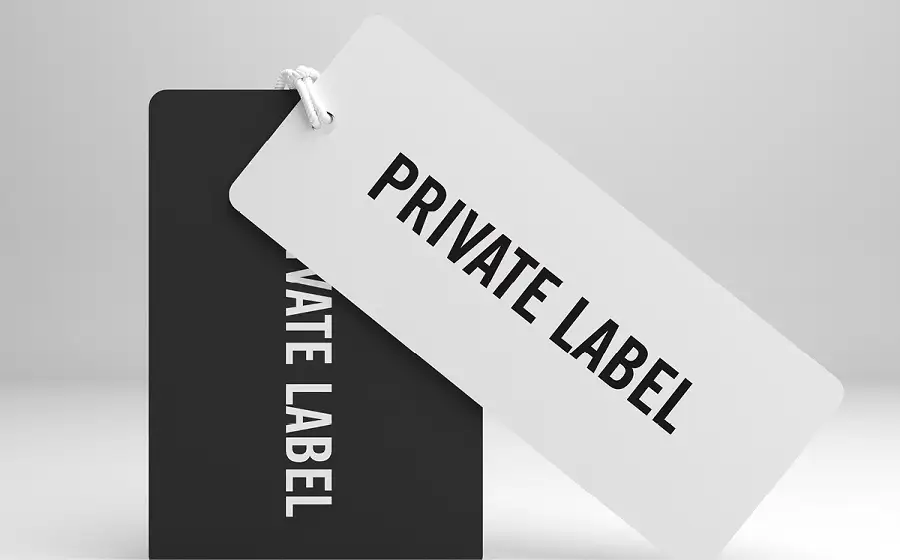
Branding decides whether your store gets repeat customers or one-time buyers. But trying to brand everything from day one is expensive and slow. The right approach is a two-stage strategy: white label first (fast, cheap, validates SKUs), private label second (after specific SKUs prove themselves). Both stages can run through the same supplier — DailyFulfill, for example, handles both — but the cost structure, MOQ, and customer perception change significantly between stages.
White label means using the supplier’s existing SKUs and adding your brand only at the packaging level — branded poly mailer, thank-you card, brand insert — but not modifying the garment itself. No custom woven labels, no custom hangtags, no logo on the elastic band. The advantage: zero MOQ (you can order 5 pieces at a time), fast shipping (1-3 days handling), and minimal upfront cost. White label is the right starting stage because it validates which specific SKUs actually sell before you invest in branded production. Most new sellers should run white label for the first 3-4 months and the first $5,000-$10,000 of revenue.
Private label means custom-branded production: your woven neck label sewn into every piece, your hangtag attached to each unit, your logo on the elastic waistband (the “Calvin Klein effect”), and your custom retail boxes for multi-pack SKUs. The garment becomes a branded product, not a generic one in branded packaging. MOQs for underwear private label start at 800 pieces per color per style — far lower than traditional factories at 3,000-5,000 minimums. Lead times run 25-45 days from order confirmation to ready-to-ship. Budget $2,500-$8,000 for your first private label production cycle, depending on category and the number of styles you launch. See our Private Label Dropshipping service page for operational details.
The transition from white label to private label is about specific SKU performance, not months on the calendar. Move to private label when:
Upgrading earlier locks budget into unproven products. Upgrading later leaves brand equity on the table because white label has a thinner brand moat than private label.
When you upgrade to private label, four touchpoints carry your brand:
The first two are non-negotiable. The third and fourth differentiate you from competitors who only brand the package.
White label gets you to first revenue. Private label gets you to repeat revenue. Both stages exist for a reason — sellers who try to skip white label burn cash on unvalidated products, and sellers who never upgrade leave brand equity on the table.
Pricing is where most underwear dropshipping stores quietly die in 2026. The seller assumes the same 3x markup that worked in 2023, ignores duty math, and discovers two months in that they are losing $5 on every order. This section gives you the actual 2026 pricing framework: landed cost formula, current duty rates by shipping method, markup multiples that work for underwear specifically, and how to handle pricing across regions with different tariff structures.
The biggest pricing mistake new sellers make in 2026 is confusing product cost with landed cost. Your real cost per delivered unit is:
Product cost + International shipping + Customs duties + Payment processing fee = Landed cost
A $3 seamless bralette from a verified factory does not cost you $3 once it reaches your customer. Realistic 2026 math: $3 product + $4 worldwide shipping + ~$2.10 duties (30% commercial carrier rate for China-origin) + ~$0.50 payment processing (3% on a $20 sale) = $9.60 landed cost. That is the number you use for retail pricing math — not the $3 product cost the supplier quotes you. Generic 2023 advice ignores duties and assumes 3x markup; that math no longer works.
Three rates determine your duty cost depending on shipping method and origin:
The practical implication: commercial carrier shipping (FedEx, UPS, DHL) is now the right default for China-origin underwear despite higher per-package shipping fees, because the duty rate advantage offsets the difference. Postal shipping — the 2023 dropshipping default — is now the most expensive option. Confirm your supplier ships via commercial, not postal, and handles HTS classification correctly.
General dropshipping advice prescribes 3x markup over product cost. That math is broken in 2026 because it ignores duties. The right multiple for underwear is 4-6x over landed cost (not over product cost). At a $9.60 landed cost, a 4x markup gives you $38 retail; a 6x markup gives you $58. Underwear customers in 2026 expect to pay $25-$60 for a quality bralette and $45-$80 for a 3-pack of period underwear — both ranges support 4-6x landed-cost markup. The premium tolerance is real because customers compare underwear pricing to Skims and Knix benchmarks, not to AliExpress prices.
Underwear customers in 2026 expect free shipping. Adding $5 shipping at checkout drops conversion rates 15-30% even when the total price is identical to a “free shipping” listing with shipping baked in. Bake shipping into your product price. Round retail to clean numbers ($39, $49, $59 — not $37.50). Show “Free Shipping” prominently on product pages and at checkout. Exception: large multi-pack orders where shipping cost exceeds $15 — use threshold pricing (“Free shipping on orders over $50”) instead of inflating per-piece prices unrealistically.
The same product cannot be priced identically across regions in 2026. US customers absorb 30-54% Chinese-origin duties; EU customers face VAT plus duties starting July 2026; UK customers under £135 still benefit from threshold relief through 2029. Three approaches: (1) global flat pricing — simplest, but you eat margin in high-duty regions; (2) regional pricing tiers via Shopify Markets or separate region stores — most profitable, most operationally complex; (3) DDP-only pricing where your supplier handles duties at point of sale and you receive landed-cost-inclusive billing — operationally cleanest for sellers running through dropshipping fulfillment agents like DailyFulfill.
Get the landed cost math right and your store survives the new tariff environment. Get it wrong and no amount of TikTok content fixes the margin bleed. Run the formula above on your actual product cost and shipping quote before you publish a single retail price.
The launch playbook for underwear in 2026 is different from other dropshipping categories — the rules are stricter, the content formats are narrower, and the channels that work for general apparel often fail for intimates. This step covers the underwear-specific launch playbook in compressed form. For deeper marketing tactics, supplement with dedicated marketing resources — DailyFulfill is a fulfillment partner, not a marketing agency.
TikTok Shop has become the dominant sales channel for underwear in 2026 because the format favors intimate products: short-form video lets you demonstrate fit, comfort, and use cases (period absorbency tests, seamless under clothes, sports bra impact tests) in ways static product photos cannot. Live shopping events drive impulse purchases on $25-$80 underwear sets that hesitate in cart on Shopify alone. Most underwear brands hitting $50K+ monthly revenue in 2026 are running TikTok Shop as their primary channel with Shopify as the catalog backup, not the other way around.
Three content formats outperform everything else for underwear in 2026:
Lifestyle aesthetic content (the polished Skims-style imagery) is necessary but does not drive sales alone — it signals brand quality. UGC and demo content drive the actual purchases. Your content calendar should split roughly 70% UGC/demo, 30% lifestyle.
Meta (Facebook + Instagram) is your warm-retargeting layer in 2026, not your cold-traffic engine for underwear. Cold prospecting on Meta with intimate products is brutal because ad creative gets flagged and rejected at high rates. Use Meta for: retargeting visitors from your TikTok organic content who didn’t convert, Lookalike Audiences built from your TikTok Shop customer list, and warm-audience prospecting once you have at least 1,000 customers in your CRM. Avoid Meta cold prospecting until your TikTok Shop is generating $10,000+/month — the CPM economics simply don’t work for new underwear brands until then.
Underwear is one of the highest-leverage categories for micro-influencer partnerships because intimate product recommendations require trust that polished ads cannot deliver. Target creators with 10K-100K followers in adjacent verticals (fitness, women’s wellness, body positivity, men’s lifestyle) — not generic fashion influencers. Offer free product plus 15-25% revenue share via TikTok Shop’s affiliate program. Avoid paying flat $500-$2,000 fees for single posts in the early stage; revenue-share aligns incentives and produces 3-5x better ROI in the underwear category specifically.
The fastest way to lose your launch is to violate TikTok Shop’s intimate content rules on day one. Re-read the compliance notes in Step 4 before publishing any ad creative. The three policy violations that kill new accounts most often: product shots focused on body parts rather than the product, suggestive modeling poses, and product copy implying explicit or fetish use cases. When in doubt, run creative through TikTok Shop’s pre-approval review before scheduling a campaign — costs nothing and saves a banned account.
A working underwear launch in 2026 looks like this: TikTok Shop as primary, Meta as warm retargeting, micro-influencers for affiliate-driven UGC, and ruthless compliance on creative. Master this stack and your store has a real chance. Skip any element and you are competing against brands that didn’t.
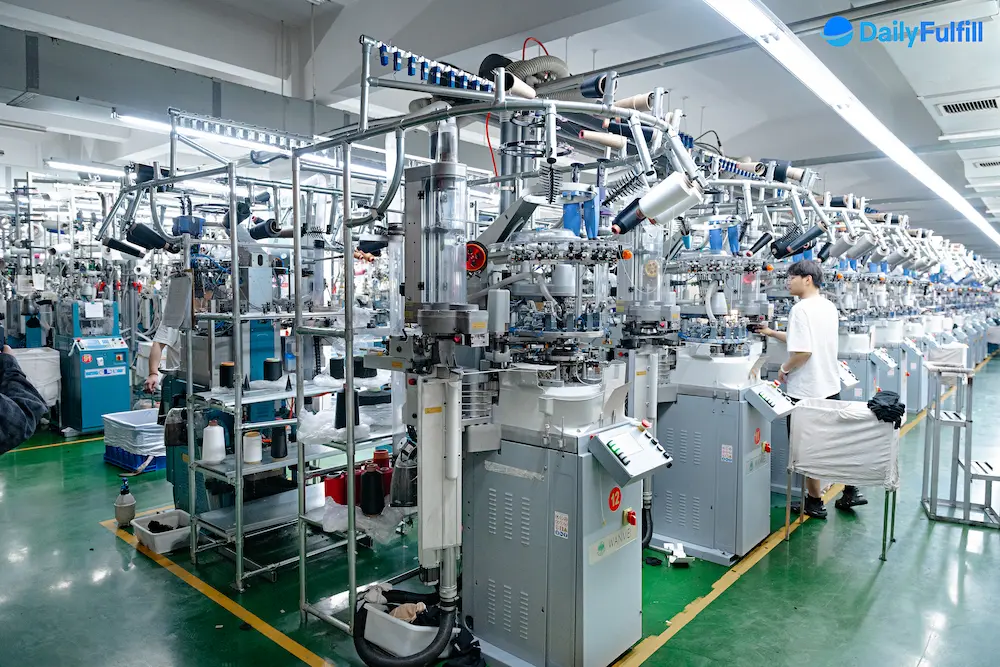
The 8 steps above contain a lot of detail, but the right launch path comes down to three principles. First, focus beats fullness: pick one sub-category and win it before adding the next. Second, validate before you commit: $50 in test ads and a $30 sample order can save you $2,000 in failed inventory. Third, plan for the 2026 tariff reality from day one: factor duties into landed cost and pick a supplier who handles DDP fulfillment cleanly. Sellers who get these three principles right scale. Sellers who skip them stall — usually around week 12 when the cash runs out.
If you’re ready to start, DailyFulfill is built specifically for underwear-focused dropshippers and supports both white-label and private-label production — with cluster-specific sourcing across Shantou, Yiwu, Jinjiang, and Foshan-Guangzhou, OEKO-TEX certified fabrics as a baseline, accurate US/EU sizing, discreet packaging, and DDP-compliant customs handling built for the 2026 tariff environment.
Stop researching and start sourcing. Get a Free Underwear Sourcing Quote from DailyFulfill and see real numbers — fabric content, sizing, MOQs, and lead times — for your specific sub-category.
Common questions from dropshippers evaluating underwear suppliers in 2026
A realistic timeline from “I want to start” to first sale is 6-10 weeks. Sub-category research and validation: 1-2 weeks. Supplier shortlisting and sample ordering (including 7-14 days of sample shipping): 2-3 weeks. Store setup (platform, listings, policies, compliance review): 1-2 weeks. Content creation and initial white-label inventory: 1-2 weeks. Launch and first ad spend: weeks 6-10. Sellers who try to compress this into 2-3 weeks usually skip validation or sample testing, then discover quality or demand problems after they have already burned $500-$1,500 on ads. The 6-10 week timeline is not slow; it is the timeline that prevents expensive mistakes.
For a white-label launch (recommended): plan for $1,500-$3,500 total across months 1-3. Breakdown: samples ($50-$100), validation mini-test ads ($50-$100), platform subscription (~$117 for 3 months of Shopify at $39/month), initial white-label inventory if you pre-stock instead of pure dropshipping ($200-$500), launch ad spend across TikTok and Meta ($500-$1,500), and reserve for product photography, branded packaging, and refunds ($500-$1,000). For a private-label launch from day one, plan for $5,000-$10,000 including the first 800-piece production cycle. Most new sellers should start with white-label and reinvest profits into private-label once a specific SKU proves itself. Trying to bootstrap on under $1,000 is possible but the failure rate is high.
For US-based sellers, you can technically start as a sole proprietor for testing and validation, but you should register a single-member LLC before scaling beyond ~$5,000/month in revenue. Three reasons: TikTok Shop requires business entity verification for sellers above certain volume thresholds; payment processors (Stripe, Shopify Payments) ask for business documentation as volume grows; and the LLC structure protects your personal assets from product liability claims — which matter more in intimates than in most categories due to potential skin reaction and sizing complaints. State filing fees run $50-$300. Sellers in the EU, UK, and Australia have similar but jurisdiction-specific registration requirements — verify local rules before launching ads.
Yes, but the economics are mixed. US-based wholesalers (accessible through Trendsi, Spocket, or direct relationships) ship from US warehouses with no import duties for US customers, but product costs typically run 2-3x what comparable China-origin products cost. Vietnam, India, and Bangladesh have growing underwear manufacturing capacity, but most non-China origins excel only at basic underwear categories (cotton briefs, basic bras) — not specialty constructions like period underwear, compression shapewear, or seamless bralettes, which remain China-cluster-dominated. The cleanest 2026 strategy for many sellers: source basic SKUs from US wholesalers for fast domestic shipping, and source specialty SKUs from China through a DDP-capable agent. The hybrid model captures both the speed advantage on basics and the cost advantage on specialty.
For most underwear stores, Dawn (Shopify’s free flagship theme) is the right starting choice — fast, mobile-first, and easy to customize. For premium positioning, Impulse and Symmetry (paid premium themes, roughly $200-$350) handle larger catalogs and lifestyle imagery better than free themes. Critical features any underwear theme must support: an integrated measurement-based size chart (not just generic S/M/L), color and style variant swatches on product cards, mobile-optimized product photography display, and fast load times under 3 seconds on mobile. Avoid generic boutique-fashion themes that treat underwear as a footnote — they often lack the size chart functionality that intimates specifically need to reduce sizing-related returns.
Learn dropshipping tips, sourcing strategies and fulfillment insights from DailyFulfill
Dropshipping Supplier vs. Private Agent: What is the difference? Discover which partner offers faster shipping, lower prices, and custom branding for your business in
Hitting 300+ orders a day on CJDropshipping? See when a private dropshipping agent saves more money, ships faster, and gives you real control in 2026.
CJ Dropshipping claims 7–15 day shipping to the US and EU. Real seller data tells a different story. See actual delivery times, delays, and faster options.