Underwear is one of the fastest-growing dropshipping categories in 2026. Brands like Skims, Knix, and Modibodi have shown that customers will spend $30-$60 on a single bralette or a 3-pack of period underwear bought straight from a TikTok ad — and they come back to reorder every few months. Margins are huge. Shipping is light. The demand is still growing.
But underwear is also the most punishing dropshipping category to get wrong. The wrong fabric causes skin rashes and refunds. The wrong sizing floods your inbox with returns. The wrong packaging gets your customer embarrassed in front of their roommates — and reviewed publicly online. One bad supplier batch can push your refund rate above the platform threshold and freeze your TikTok Shop ad account in under a week.
Most “best dropshipping suppliers” articles list generic platforms like AliExpress and Spocket without telling you which ones actually work for underwear specifically. In this guide, DailyFulfill compares the 8 best underwear dropshipping suppliers in 2026 — including pricing, MOQ, private label availability, sizing standards, and packaging discretion. You’ll also see which supplier is best for each underwear sub-category (seamless bras, period underwear, shapewear, men’s performance, and more), plus 5 common mistakes to avoid when choosing one.
Let’s get into the list — starting with the seven criteria you should use to evaluate any underwear supplier in 2026.
What To Look For In An Underwear Dropshipping Supplier
Before listing the 8 suppliers, you need a framework to evaluate them. Underwear is not a generic dropshipping category — the failure modes are specific, the customer expectations are higher, and the supply chain is more specialized than most. The following seven criteria are what separate a supplier you can scale on from a supplier who will quietly destroy your store. Run every option below — and any future supplier you consider — through these filters.
Lab-Verified Fabric Content & OEKO-TEX Certification
Underwear sits against skin for 12-16 hours a day. That makes fabric quality non-negotiable. Cheap suppliers routinely sell “cotton” that is actually 70% polyester, or use dyes that contain restricted chemicals like azo or formaldehyde. Both can cause rashes, itching, or worse — leading to refund spirals and angry public reviews. A serious underwear supplier verifies fiber content through lab testing and works with factories holding OEKO-TEX Standard 100 certification, the global benchmark for textile safety. Ask any prospective supplier for OEKO-TEX documentation before placing your first order.
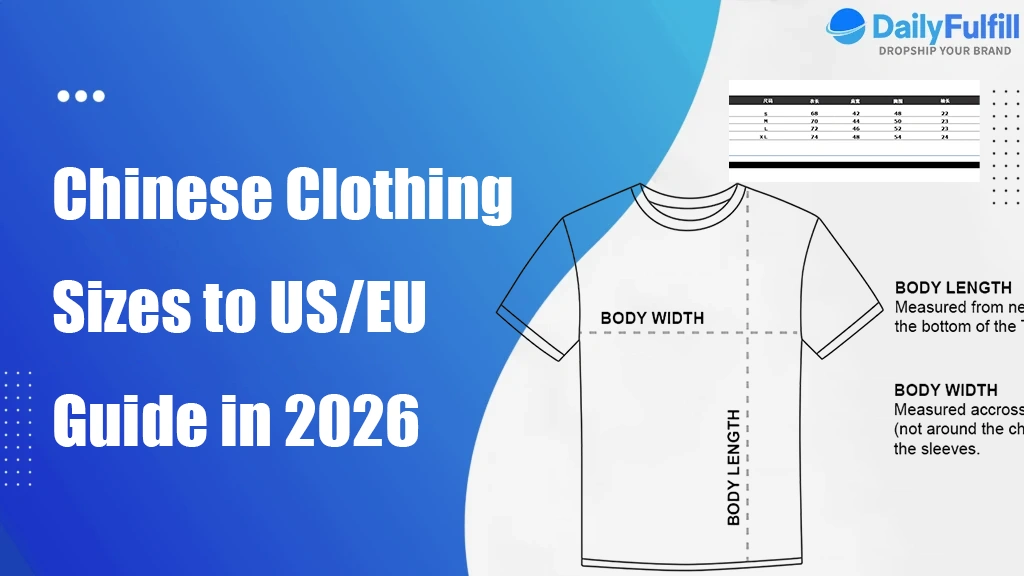
US/EU Sizing Accuracy (Not Asian Factory Sizing)
Chinese factories typically produce underwear using Asian sizing, which runs one to two sizes smaller than US or EU charts. A “Medium” off the factory floor is often closer to a US Small — and your customer ordered Medium. This is the single largest cause of returns for new underwear dropshipping stores. The right supplier measures every sample against the correct regional size chart, adjusts the production specs before approving the run, and provides accurate size guides for your product listings. Without sizing accuracy, even the best fabric will not save your refund rate.
Discreet, Brand-Neutral Packaging
Underwear is the only dropshipping category where packaging itself is a privacy issue. If your customer’s mailer screams “BRA INSIDE” or has a transparent window showing the product, they will not order from you again. They might also leave a 1-star review describing the embarrassment. The right supplier ships in plain brown poly mailers — or your custom-branded mailers — with zero factory markings, zero product descriptions, and zero indication of contents on the outside. This is a baseline requirement, not a premium upgrade.
Private Label & Low MOQ Availability
Underwear is one of the highest private-label penetration categories in dropshipping. Customers expect a real brand experience — a woven neck label, branded hangtag, custom packaging — not a generic factory product in a plastic bag. But traditional underwear factories require minimum orders of 3,000-5,000 pieces per style, which prices new dropshippers out completely. The right supplier offers private label production starting from 800-1,000 pieces per color, per style — small enough for a new brand to test a style without burning capital, but real enough to feel like a launched product.
Specific Underwear Category Expertise (Not Generic Apparel)
Underwear is not just “small clothing.” Seamless bras require specialized circular knitting machines. Period underwear requires multi-layer waterproof construction. Sports bras need precision bonding and high-stress stitching. Shapewear demands compression-grade fabrics. A general apparel supplier who happens to also stock underwear cannot match a supplier whose factory network specializes in these exact constructions. China’s underwear industry is regionally concentrated in specific clusters — Shantou for bras, Yiwu for seamless, Jinjiang for men’s, Foshan-Guangzhou for premium. The right supplier sources from the right cluster for the category you sell.
Clear Lead Times for In-Stock and Custom Production
A good underwear supplier separates two lead times clearly: in-stock dropshipping (where they hold ready inventory) and custom private label production (where you order branded goods made to spec). In-stock orders should ship within 1-3 days of payment, with global delivery in 7-12 days. Custom private label production runs 25-45 days from order confirmation to ready-to-ship. Vague answers like “around one month” usually mean delays. Demand specific numbers and confirm them in writing before your first order.
Underwear-Specific Quality Control
Generic apparel QC checks color and stitching. Underwear QC requires four additional inspection points: elasticity recovery (does the elastic band return to shape after stretching?), color fastness (does the dye bleed when washed with white fabric?), seam integrity at high-stress points (gussets, underwire channels, waistband attachments), and hygiene (no contamination during the factory pack process). Suppliers without this depth ship products that look fine in the listing photo but fail on the customer’s body. Ask any supplier specifically how they QC each of these four points before shipment.
With these seven criteria in mind, here are the 8 best underwear dropshipping suppliers in 2026 — starting with the most established options on the market.
The 8 Best Underwear Dropshipping Suppliers in 2026
The list below ranks 8 underwear dropshipping suppliers from the most established mainstream options to the most niche-focused specialists. Each entry covers the same six points so you can compare them directly: positioning, who it’s best for, pricing, strengths, underwear-specific limitations, and category coverage.
CJDropshipping — Best All-Purpose Platform with Underwear Selection
One-line positioning: The biggest name in general-purpose dropshipping fulfillment, with a workable but non-specialized underwear catalog.
Best for: Beginner-to-intermediate dropshippers running multi-niche stores who want a single platform handling underwear alongside other categories like phone cases, home decor, or beauty. Not the right choice if underwear is your only or main category.
Pricing model: Free signup with no monthly subscription. You pay per order — product cost plus shipping plus a small processing fee. Custom branding and private label production are available at additional cost depending on the specific factory chosen.
Strengths: Massive product catalog with millions of items, including basic underwear, bras, and men’s briefs. Multiple warehouse locations — including a US warehouse — for faster domestic shipping in key markets. Solid integrations with Shopify, TikTok Shop, WooCommerce, and most major ecommerce platforms. 24/7 English customer support and a familiar dashboard most dropshippers already know how to navigate.
Limitations for underwear: CJDropshipping is a generalist platform, not a specialized underwear supplier. Quality varies significantly by individual listing — since CJ aggregates from many factories, you must vet each product page yourself. Sizing follows Asian standards by default with no automatic US/EU conversion built in. OEKO-TEX certification is not guaranteed across the catalog and has to be verified per product. Generic packaging is the default unless you specifically request and pay extra for custom packaging — meaning no built-in discreet packaging standard. QC checks color and stitching but not underwear-specific points like elasticity recovery or color fastness testing.
Underwear category coverage: Strong on basic underwear (men’s briefs, women’s panties). Decent on entry-level bras. Light on seamless, shapewear, period underwear, and men’s performance categories — these specialty constructions require dedicated factory networks that CJDropshipping does not focus on.
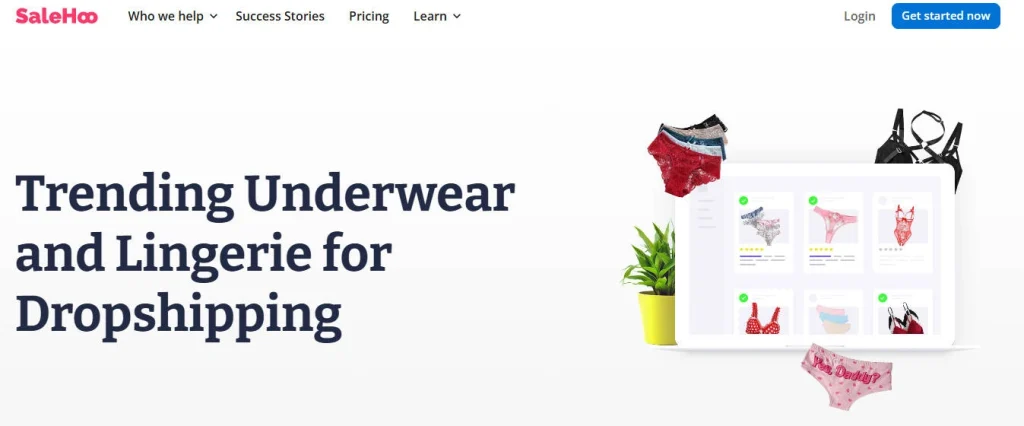
SaleHoo — Best Supplier Directory for Self-Sourced Underwear
One-line positioning: A long-running paid directory of vetted suppliers — useful for research, but requires you to build every supplier relationship from scratch yourself.
Best for: Dropshippers who want to find and contract directly with wholesale or dropshipping suppliers without paying recurring per-order middleman fees, and who are willing to invest the time in vetting and negotiating with each supplier individually.
Pricing model: Subscription-based. Annual access to the supplier directory, with a separate lifetime access option available. SaleHoo also offers a paid product called SaleHoo Dropship for Shopify integration. Current pricing is published on their official site and changes periodically.
Strengths: A vetted directory of 8,000+ suppliers across many categories, saving you weeks of cold-searching dubious sources on AliExpress or generic supplier search results. Strong focus on US, UK, Australia, and Canada based suppliers — a real advantage if you want faster domestic shipping in those markets. Helpful educational resources for new dropshippers and a 60-day money-back guarantee make it relatively low-risk to evaluate.
Limitations for underwear: SaleHoo is a directory, not a supplier. You handle every step yourself: contacting each supplier, negotiating terms, placing orders, arranging fulfillment, and managing quality control. Many of the “suppliers” listed are wholesalers, not true dropshippers — meaning you may need to purchase inventory upfront and store it. Underwear-specific coverage is thin compared to general apparel and consumer goods. There is no per-order private label coordination, no built-in OEKO-TEX verification, and no discreet packaging guarantee — all of which depend on whichever individual supplier you eventually choose.
Underwear category coverage: Limited and inconsistent. The directory includes some basic underwear and lingerie wholesalers, mostly US and EU based, but very few specialists in seamless, shapewear, period underwear, or men’s performance categories. Best used as a research starting point, not a primary underwear sourcing solution.
DailyFulfill — Best for Private Label and Specialized Underwear Sourcing
One-line positioning: A China-based dropshipping fulfillment agent operating a network of 9 specialized underwear suppliers, each matched to specific product categories — built around lab-verified fabrics, accurate US/EU sizing, and discreet packaging as baseline standards.
Best for: Dropshippers serious about underwear as a primary or major category, especially those ready to move beyond AliExpress-quality basic products into private label or branded inventory. Particularly strong fit for TikTok Shop and Shopify sellers in seamless, period, shapewear, sports, and men’s performance categories — where category-specific factory expertise actually matters.
Pricing model: Free signup with no monthly subscription. You pay per order — product cost plus shipping. Private label production (custom woven neck labels, branded hangtags, custom mailers) starts at 800 pieces per color, per style. Lead times run 1-3 days handling for in-stock items, and 25-45 days for full custom private label runs.
Strengths: DailyFulfill sources from the right Chinese underwear cluster for every category — Shantou for bras, Yiwu for seamless, Jinjiang for men’s, Foshan-Guangzhou for premium shapewear and athleisure. That regional specialization is what separates a “China underwear supplier” from a sourcing partner whose factory network actually understands the construction requirements of each product type. Fabric content is lab-verified, with OEKO-TEX certified options across core lines. Sizing is measured against US and EU charts before approval, not shipped as Asian factory defaults. Every order ships in plain brown poly mailers — or your custom-branded mailers — with zero factory markings on the outside, keeping customer privacy intact. 4.9-star Trustpilot rating across 450+ verified reviews. Warehouses in Yiwu and Guangzhou with global shipping to 50+ countries.
Limitations for underwear: DailyFulfill is an agent-based service, not a self-service platform — every order goes through a dedicated account manager rather than an automated catalog. This works well for serious sellers but means slower onboarding if you just want to test a single product instantly. The 800-piece MOQ on private label production, while low compared to traditional underwear factories, is still too high for dropshippers wanting to test only 10-50 pieces before committing. There is no large pre-stocked browsable catalog like CJDropshipping — you submit a sourcing request and receive a custom quote, which adds friction for casual exploration. Finally, fulfillment is China-based; if your brand specifically requires US or EU origin warehouses, you would need to combine DailyFulfill with a regional 3PL.
Underwear category coverage: Strong across all major underwear sub-categories. Bras and lingerie (Shantou cluster). Seamless underwear, bralettes, and shapewear (Yiwu cluster). Men’s performance and sports underwear (Jinjiang cluster). Premium private-label production for compression shapewear and athleisure-grade sets (Foshan-Guangzhou corridor). The 9-supplier network spans men’s, women’s, period and maternity, sports bras, seamless, shapewear, and thermal — designed so each product category maps to a factory partner with that exact construction expertise. Standard dropshipping and full private label production both supported.
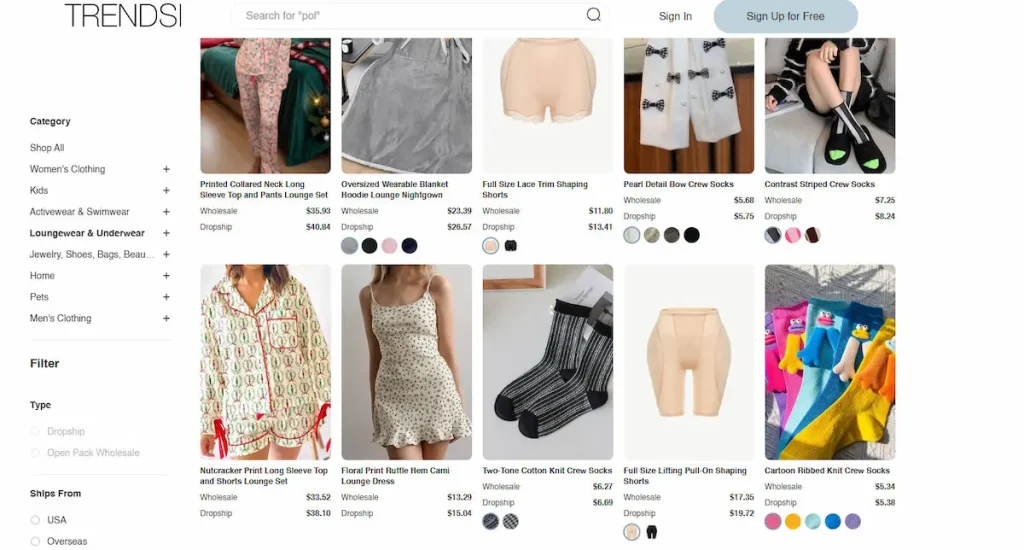
Trendsi — Best for Fashion-First Stores Adding Intimates
One-line positioning: A US-warehoused fashion dropshipping platform with a curated loungewear and intimates category, built for Shopify and TikTok Shop boutiques that primarily sell fashion.
Best for: US-based boutique stores already selling fashion or accessories who want to add bras, bralettes, and loungewear without building a separate supplier relationship. Strong fit for sellers prioritizing fast US domestic shipping over private-label customization or category specialization.
Pricing model: Free plan with up to 500 listed products and no monthly subscription — you pay product cost plus shipping per order. Pro and Enterprise tiers unlock private labeling and custom branding. Made-to-order private label MOQs start around 60 pieces; open-pack wholesale starts at 6 pieces per style.
Strengths: US warehouse fulfillment delivers in 2-5 business days within the US — significantly faster than China-based competitors. Dedicated “Loungewear & Intimates” category with curated products and ready-to-import images and descriptions. Native integrations with Shopify, TikTok Shop, CommentSold, Facebook, and Instagram. Free starter plan covers up to 500 listed products, so you can test the platform with no upfront cost. Quality inspection happens at the US warehouse before products ship to your customers.
Limitations for underwear: Trendsi is a fashion generalist, not an underwear specialist — intimates are a small portion of a much larger apparel catalog dominated by US wholesale brand partnerships (Judy Blue, Risen, Zenana). Depth in technical categories like period underwear, compression shapewear, and men’s performance is thin. Critically, all swimwear, bodysuits, and intimates are explicitly designated final sale and non-refundable — meaning if a customer reports sizing or fabric issues with an intimate item, you absorb the loss without supplier recourse. Private labeling is locked to paid Pro and Enterprise tiers.
Underwear category coverage: Decent on bralettes, basic underwear sets, and loungewear. Limited on technical categories like period underwear, support-grade sports bras, compression shapewear, and men’s underwear. Best as a complementary supplier for fashion stores adding light intimates, not as a primary source for an underwear-focused brand.
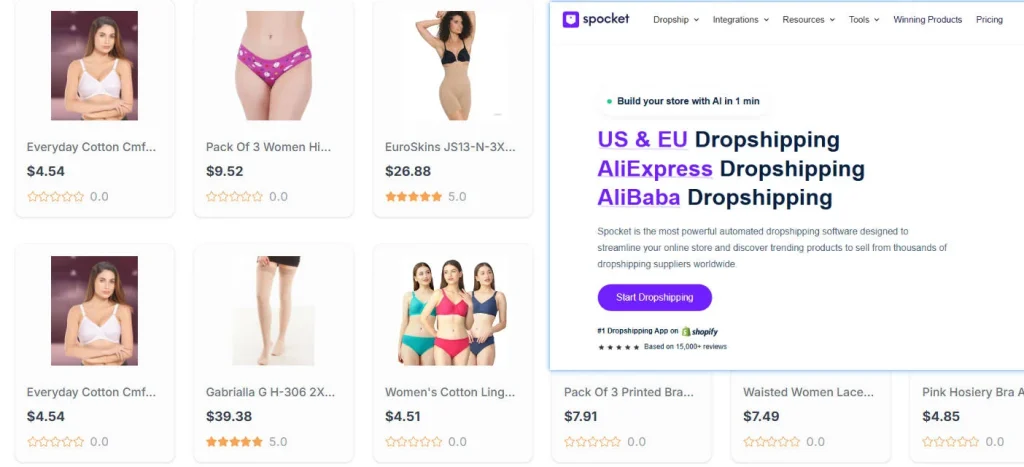
Spocket — Best for US/EU Suppliers (Premium Positioning)
One-line positioning: A curated dropshipping marketplace focused on US and EU based suppliers — premium positioning with faster domestic shipping but limited depth in underwear specialization.
Best for: US and EU based stores targeting customers in those same regions, where 2-5 day domestic shipping is a real competitive advantage. Good fit for boutiques positioning intimates as premium, sustainable, or “shop local,” and willing to absorb higher product costs for faster fulfillment.
Pricing model: Tiered subscription model. Free starter plan with a small product limit (around 25 items). Paid plans run from approximately $19/month up to $89+/month for higher tiers, unlocking more product slots, branded invoicing, and premium support. You also pay wholesale item costs plus a small transaction fee on each order.
Strengths: Strong US and EU supplier network with 2-5 day domestic shipping in those regions — meaningfully faster than China-shipped alternatives. Curated “Women’s Clothing Lingerie Underwear” category with bralettes, cotton padded bras, sleepwear sets, and specialty lingerie. Native integrations with Shopify, Wix, WooCommerce, and other major platforms. Higher average product quality than open marketplaces like AliExpress, because each supplier is vetted before joining the platform. Branded invoice option supports a more premium unboxing experience.
Limitations for underwear: Spocket’s underwear catalog is small compared to its full fashion offering, and few of its suppliers specialize in intimates. The US/EU supplier focus means higher product costs than China-based competitors, which compresses your margin on price-sensitive segments. Private label customization is limited (mostly branded invoices, not custom woven neck labels or fully branded packaging). No category-specific underwear QC like elasticity recovery or color fastness testing. And the monthly subscription model means you pay regardless of order volume — a real cost for new dropshippers still testing the niche.
Underwear category coverage: Reasonable on bralettes, cotton underwear sets, and basic sleepwear. Some specialty lingerie via boutique US/EU brands. Limited on period underwear, men’s performance, technical sports bras, and compression shapewear. Best for stores targeting domestic-only audiences with a “buy local, ship fast” positioning rather than for full underwear category coverage.
Modalyst — Best for Wix Stores Selling Intimates
One-line positioning: A Wix-owned curated dropshipping marketplace with US, EU, UK, Canada, and Australia based suppliers — the natural choice if your store runs on Wix.
Best for: Wix-based store owners building a fashion or intimates brand who want native platform integration without learning a new dashboard. Strong fit for sellers prioritizing curated quality over the chaotic catalog volume of AliExpress-style marketplaces.
Pricing model: Tiered subscription model with a free starter plan and paid plans that unlock more product slots, faster shipping, and brand customization features. You pay wholesale product costs plus shipping per order, with suppliers setting their own shipping rates. Higher tiers grant access to name-brand inventory through partnerships.
Strengths: Owned by Wix, which gives Modalyst the smoothest integration on the Wix platform — real-time inventory sync, native dashboard management, zero technical setup. Curated supplier network across the US, UK, EU, Canada, and Australia. Access to overstock inventory from recognized fashion and lifestyle brands at higher tiers. Branded invoicing and packaging options. 14-day return window from suppliers — better than most pure China marketplaces.
Limitations for underwear: Modalyst is a fashion-focused generalist, not an underwear specialist. The “Bras, Underwear, and Intimates” category exists but is shallow compared to dedicated intimates platforms — most listings come from boutique fashion brands carrying limited underwear SKUs rather than from real underwear manufacturers. Margins are tighter than China-sourced alternatives because US/EU supplier costs are higher. Private label customization is limited (branded invoice and packaging, not custom woven neck labels). And if your store runs on Shopify rather than Wix, you lose Modalyst’s single biggest structural advantage — the native Wix integration.
Underwear category coverage: Light to moderate. Basic underwear and bralettes from US and EU boutique brands. Some access to name-brand intimates via premium tiers. Very limited on seamless construction, period underwear, men’s performance, and compression shapewear. Best for Wix store owners wanting curated intimates SKUs alongside other fashion items.
HyperSKU — Best Alternative China Sourcing Agent
One-line positioning: A China-based dropshipping fulfillment agent with US warehouse capabilities and strong general-purpose sourcing — but without underwear-specific specialization.
Best for: Established dropshippers looking for a general-purpose Chinese fulfillment partner with a Shopify-friendly platform and dedicated account manager service. Particularly suited to multi-product stores or those expanding into categories beyond underwear.
Pricing model: Pay-as-you-go with no monthly subscription on the core service tier. You pay product cost plus shipping per order. Premium plans available for higher store limits and additional features. Custom branding services priced per add-on — for example, thank-you cards around $0.08 per order (minimum 200) and stickers around $0.10 per order (minimum 500).
Strengths: China-based sourcing combined with a US (California) warehouse — enabling 2-4 day domestic shipping in the US and 5-12 day global delivery via optimized logistics lines. Catalog of 1M+ products across 10+ categories. Dedicated account manager model: every account gets a real person handling sourcing, custom packaging design, and order issues. Handles tricky categories most platforms refuse, like batteries and liquids. Native integrations with Shopify, WooCommerce, and BigCommerce. 4.9-star Shopify App Store rating across thousands of reviews.
Limitations for underwear: HyperSKU is a general-purpose sourcing agent, not an underwear specialist. Their factory network is built around fast-moving consumer goods and trending TikTok products — strong on speed, weaker on underwear construction expertise. No published cluster-level specialization: the platform does not differentiate between Shantou-grade bra factories, Yiwu-grade seamless factories, or Jinjiang-grade men’s underwear factories — you receive whichever factory their team assigns to your sourcing request. OEKO-TEX certification, US and EU sizing accuracy, and underwear-specific QC (elasticity recovery, color fastness, hygiene) are not advertised as baseline service standards.
Underwear category coverage: Workable as a general supplier but not category-specialized. Basic underwear, bralettes, and men’s briefs are available through their catalog or via sourcing request, but depth in period underwear, compression shapewear, technical sports bras, and seamless construction is limited. Best treated as a horizontal multi-product fulfillment partner that handles some underwear, not as a primary underwear sourcing channel.
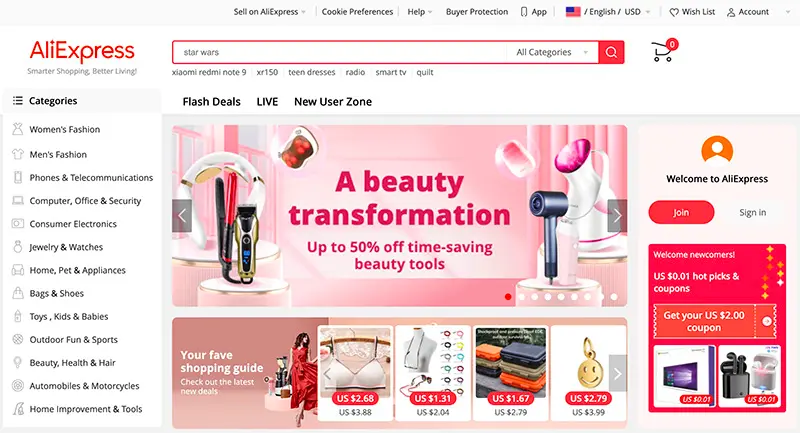
AliExpress (via DSers) — Best for Beginners Testing the Niche
One-line positioning: A massive marketplace of individual Chinese sellers connected to your Shopify store via DSers — the cheapest way to test underwear demand, and the riskiest way to scale.
Best for: Complete beginners running a $0 budget validation phase — where the goal is testing whether an underwear product or ad creative generates any clicks before investing in a real supplier. Not appropriate once you have proven demand and need to actually scale a store.
Pricing model: AliExpress is free to browse and order from. DSers offers a free plan covering up to 3 stores and around 3,000 products, with paid plans starting around $19.90/month for advanced features. You pay AliExpress sellers per order — typically $1-$5 for basic underwear items — plus the seller’s shipping costs.
Strengths: Lowest cost of entry in the entire dropshipping space — most underwear items are $1-$5, no MOQ, no commitment. Massive product variety: hundreds of thousands of underwear listings across every conceivable style and price point. DSers automates the AliExpress order placement process and is the official Shopify-approved AliExpress dropshipping tool. Free to start, free to test, free to fail fast.
Limitations for underwear: This is the highest-risk supplier path for an underwear category, and the limitations stack quickly. Every “supplier” is an independent seller you have never spoken to, with no accountability for fabric quality, sizing, or finishing. There is no QC layer between the seller and your customer — products ship from factory floors in plastic packaging that often reveals what’s inside. Sizing follows Asian factory defaults with zero conversion to US or EU charts. Shipping typically runs 15-30 days even with AliExpress Standard. OEKO-TEX certification, fabric content verification, discreet packaging, custom branding, and underwear-specific QC are essentially impossible to guarantee at scale across hundreds of independent sellers. Cross-border returns are functionally impossible — every refund comes out of your pocket.
Underwear category coverage: Technically covers everything, practically covers nothing reliably. You can find listings in every underwear category, but the inconsistency across sellers means two orders from two sellers in the same category can deliver radically different experiences for your customer. Treat AliExpress + DSers as a validation tool for testing concepts, not a fulfillment partner for scaling a real underwear brand.
Underwear Dropshipping Suppliers Comparison Table
The comparison below scores each supplier against the seven evaluation criteria from earlier in this guide. ✓ means the criterion is explicitly built into the supplier’s standard service. Partial means it’s available but not a baseline guarantee — usually as a paid add-on or supplier-dependent feature. ✗ means the criterion is not addressed at the platform level. Read across each row for a holistic view of one supplier; read down each column to see which suppliers reliably deliver on a specific criterion.
| Supplier | OEKO-TEX Verified | US/EU Sizing | Discreet Packaging | Private Label / Low MOQ | Category Expertise | Stated Lead Times | Underwear QC | Best Use Case |
|---|
| CJDropshipping | ✗ | ✗ | Partial | Partial | ✗ | ✓ | ✗ | Multi-niche stores |
| SaleHoo | ✗ | Partial | ✗ | ✗ | ✗ | ✗ | ✗ | Self-sourcing research |
| DailyFulfill | ✓ | ✓ | ✓ | ✓ | ✓ | ✓ | ✓ | Private label underwear brands |
| Trendsi | ✗ | ✓ | Partial | Partial | ✗ | ✓ | ✗ | Fashion-first US stores |
| Spocket | ✗ | ✓ | Partial | ✗ | ✗ | ✓ | ✗ | Premium US/EU positioning |
| Modalyst | ✗ | ✓ | Partial | ✗ | ✗ | ✓ | ✗ | Wix-based stores |
| HyperSKU | ✗ | ✗ | Partial | ✓ | ✗ | ✓ | ✗ | Multi-product China sourcing |
| AliExpress (DSers) | ✗ | ✗ | ✗ | ✗ | ✗ | ✗ | ✗ | $0 niche testing |
Reading note (place this immediately below the table):
The result reflects what each platform was built for. DailyFulfill, the only underwear-specialist on this list, scores ✓ across all seven criteria because each criterion maps to a built-in service standard rather than an optional add-on. The other seven options are generalists, directories, or marketplaces that handle some underwear among many product types — and the scoring reflects that focus split. If your store is genuinely underwear-focused, the right primary supplier should now be obvious. If you’re testing the niche or running a multi-category store, the trade-offs between fast domestic shipping (Trendsi, Spocket, Modalyst), broad multi-product catalog (CJDropshipping, HyperSKU), and lowest cost-to-test (AliExpress) all become legitimate secondary considerations.
Best Underwear Supplier for Each Sub-Category
The best supplier for “underwear” depends entirely on which underwear category you’re selling. A factory built for cotton briefs cannot produce a quality period underwear. A bra factory cannot make compression shapewear. Below is the right sub-category match — and why the underlying factory cluster matters more than the supplier’s brand name on the order confirmation.
Best for Seamless Wireless Bras & Bralettes
Seamless bras require circular knitting machines that knit the entire garment as a single tube — a fundamentally different construction process from cut-and-sew bras. Yiwu in Zhejiang Province operates the world’s densest concentration of seamless knitting machines, with over 5,000 units producing about 80% of China’s seamless underwear output. DailyFulfill sources its seamless and wireless bralette inventory from this cluster, which means access to factories that have spent decades optimizing this specific construction — not retrofitted cut-and-sew bra factories trying to fake the seamless look with hidden seams that fail after a few washes.
Best for Period & Leakproof Underwear
Period underwear is the hardest underwear category to produce well. It requires a four-layer construction — moisture-wicking inner, absorbent core, leakproof barrier, and outer fabric — bonded together so the layers don’t separate after repeated washing. Few underwear factories have invested in this specialized production line. DailyFulfill sources its period underwear from factories that specifically produce for the leakproof segment, applying the same four-layer construction standard that defines the brands leading this category (Knix, Modibodi, Thinx). Each piece is tested for absorption capacity and leak resistance before approval — not a category to source from a generic underwear factory.
Best for Shapewear & Sculpting Bodysuits
Shapewear depends on compression-grade elastane fabrics with precise tension specifications — too loose and the garment fails to actually shape, too tight and it causes circulation problems and 1-star reviews. The Foshan-Guangzhou corridor in Guangdong is home to the world’s largest underwear contract manufacturers, including the factories that produce shapewear and sculpting bodysuits for premium global brands. DailyFulfill routes shapewear orders through this corridor, which means access to factories whose compression fabric specs, seam placement, and bonding techniques are calibrated for high-end DTC standards — not generic stretch-fabric guesses sold as “shapewear.”
Best for Sports Bras & Activewear Sets
Sports bras have the highest engineering bar in underwear — they must deliver impact-graded support across cup sizes while remaining breathable and durable through hundreds of high-stress wash cycles. The Foshan-Guangzhou corridor handles this through factories also used by global athleisure brands, with experience in precision bonding (replacing stitches at high-stress points) and moisture-wicking fabric construction. DailyFulfill can pair sports bras with matching leggings or biker shorts as activewear sets, which typically lifts your average order value 40-60% versus selling pieces individually — and unlocks higher CPC tolerance on TikTok and Meta ads.
Best for Men's Performance Underwear
Men’s underwear is its own specialty. The performance segment — anti-bacterial fabrics, cooling materials, modal and bamboo blends, ergonomic pouch construction — is one of the fastest-growing sub-categories in apparel, with 15%+ annual growth. Jinjiang in Fujian Province is the largest men’s underwear production region in China, with annual output exceeding 1 billion pieces per year. Its tight integration with the regional sportswear and athleisure supply chain gives DailyFulfill access to the same cooling and moisture-wicking fabric innovations that flow into men’s activewear — at men’s-underwear price points.
Best for Bras & Basic Lingerie
Cut-and-sew bras — the everyday category covering t-shirt bras, padded bras, push-ups, and basic lingerie sets — are the volume backbone of the underwear industry. Shantou in Guangdong is known as China’s underwear capital, home to 4,000+ underwear factories producing roughly 60% of all bras made in the country. The cluster has the deepest bra-making expertise in the world — particularly on the cup molding, underwire channel, and band construction details that determine whether a $5 bra feels like a $5 bra or like a $25 brand piece. DailyFulfill sources its bra inventory from this cluster as the default.
How To Test an Underwear Supplier Before Committing
Before you commit to any supplier in this list — including DailyFulfill — run them through the five-step test below. Each step is designed to catch a different failure mode that only surfaces after you’ve placed real customer orders. Skipping these tests is the single biggest reason new underwear dropshippers blow up their store inside the first 90 days.
Step 1: Order 3 Sample Products Across Different Fabrics
Don’t test one product — test the supplier’s range. Order three samples covering different fabric types: one cotton or cotton blend, one modal or bamboo, one polyester-spandex blend. Total cost should land between $15 and $40 across all three. When samples arrive, smell test them first (chemical odor = bad dyes), then wash each once and check for shrinkage, color bleed, and elastic recovery. A supplier who passes one fabric but fails another is a single-product supplier, not a category partner.
Step 1: Order 3 Sample Products Across Different Fabrics
Don’t test one product — test the supplier’s range. Order three samples covering different fabric types: one cotton or cotton blend, one modal or bamboo, one polyester-spandex blend. Total cost should land between $15 and $40 across all three. When samples arrive, smell test them first (chemical odor = bad dyes), then wash each once and check for shrinkage, color bleed, and elastic recovery. A supplier who passes one fabric but fails another is a single-product supplier, not a category partner.
Step 2: Verify OEKO-TEX Certification
Ask the supplier for an OEKO-TEX Standard 100 certificate PDF. A serious underwear supplier will send it within a day, with a valid certification number you can verify directly at oeko-tex.com. A supplier who hesitates, claims they “can’t find it right now,” or insists their factory “doesn’t need certification” is telling you everything you need to know. OEKO-TEX is the global benchmark for textile safety — there is no legitimate reason for an underwear supplier in 2026 to lack it on core fabric lines.
Step 3: Run a 10-Piece Trial Order With Sizing Tape
After samples pass, run a 10-piece trial with multiple sizes (S, M, L, XL). When the order arrives, get out a sizing tape and measure each piece against the US or EU size chart you intend to list — waistband, hip width, cup band, depending on the item. Acceptable variation is 0.5 to 1 inch. Beyond that, your customers will receive inconsistent fits and your returns rate will not survive contact with reality. This step catches what samples cannot: factory production consistency at scale.
Step 4: Test Packaging Discretion
This is the test almost no dropshipper runs, and it is specifically critical for underwear. Have your trial order shipped to a friend or family member’s address — not yours, so you can see the package the way a stranger would. Ask them three questions: “Could you tell what was inside before opening?”, “Is there any factory marking or product description on the outside?”, “Is the mailer transparent or printed?” If any answer is yes, you have a privacy disaster waiting to happen at your customer’s doorstep.
Step 5: Test Communication Speed and Accuracy
Send the supplier two test inquiries — one routine, one urgent. Measure two things: time to first response (within 24 hours is acceptable; within 6 hours is excellent), and quality of the response itself. Can they handle technical questions about fabric composition, sizing differences, or production lead times without deflecting to “let me check and get back to you”? An underwear supplier’s English fluency and technical competence directly determines how fast you can resolve a customer complaint at scale.
Following all five steps takes roughly 4-6 weeks and costs under $100 — significantly less than the cost of one bad supplier discovered through customer complaint emails.
5 Common Mistakes When Choosing an Underwear Supplier
The five mistakes below cost more underwear dropshippers their stores than any other supplier-related issue combined. They aren’t exotic — they’re the predictable failure patterns that emerge from cutting corners on the testing process. Each one is fully preventable if you catch it before placing your first real customer order.
Mistake 1: Choosing the Cheapest AliExpress Supplier
The trap is psychological: you see a $0.80 underwear listing on AliExpress and the margin math looks irresistible. What you’re not seeing is that the same listing is often being fulfilled by a different micro-supplier every time the original seller runs out — meaning order #1 and order #50 are functionally different products with different sizing, different fabric, and different shipping speeds. Underwear has the lowest tolerance for inconsistency of any dropshipping category. Cheap is cheap because something else is being sacrificed, and with underwear, that something is always quality control.
Mistake 2: Ignoring Asian vs US/EU Sizing Differences
The behavior is universal: dropshippers copy-paste size labels straight from the supplier’s product page into their Shopify or TikTok Shop listings. The factory marks something “L” — the listing reads “L.” The customer who wears US L receives what is effectively a US M or smaller, because Asian factory sizing typically runs one to two sizes smaller than Western charts. This single mistake drives the largest single category of underwear returns. It is fully preventable by measuring samples against US or EU charts before going live, and adjusting either the production specs or the size labels accordingly.
Mistake 3: Trusting Fabric Content Claims Without Verification
The supplier’s product page says “100% cotton.” You copy it into your listing. Two weeks later a customer with sensitive skin reports a rash, requests a refund, and posts a 1-star review describing the chemical smell. Cheap suppliers routinely label polyester blends as cotton because cotton justifies a higher retail price. Without an OEKO-TEX certificate or independent fabric test, you have no way to know what your customer is actually receiving — and the legal and reputational liability sits with the storefront, not with the upstream supplier.
Mistake 4: Skipping the Discreet Packaging Test
You ask the supplier “do you ship in discreet packaging?” They say yes. You believe them and skip the verification step. Two months in, a customer reaches out furious that the mailer had a factory return address printed “Yiwu Underwear Factory,” or a customs declaration form labeled “WOMEN’S UNDERWEAR x 3 PCS” — visible to roommates, family, or the postal carrier before they ever opened it. Discretion claims are easy to make and easy to verify. Failing to verify is the single most preventable mistake on this list.
Mistake 5: Treating an Apparel Generalist as an Underwear Specialist
“They sell clothing, they probably do underwear fine.”This is the assumption that breaks scaling. General apparel platforms can list underwear SKUs, but they cannot match the construction requirements that define each underwear sub-category: four-layer bonding for period underwear, impact-grade engineering for sports bras, compression-grade fabrics for shapewear, ergonomic pouch construction for men’s performance. A generalist supplier carries the SKUs; a specialist supplier has factory partners who actually know how to make those SKUs work. The difference shows up in your reviews, not in your product photos.
Notice the pattern: all five mistakes stem from accepting a supplier’s claim without testing it. The five-step test in the previous section exists for exactly this reason — to catch these failures before your customers do.
The 8 suppliers above all have their place, but the right choice for your store comes down to three principles. First, category-fit matters more than brand recognition — the underlying factory cluster matters more than the supplier’s logo on your dashboard. Second, run the five-step test on any supplier you consider, regardless of reputation. Third, do not optimize for the cheapest sourcing option; underwear has the lowest tolerance for the kind of inconsistency that comes with $0.80 AliExpress listings, and every cent saved on product cost shows up later as a refund.
For underwear-focused stores ready to scale, DailyFulfill is the supplier on this list designed for exactly that purpose. Cluster-specific sourcing across Shantou, Yiwu, Jinjiang, and Foshan-Guangzhou. OEKO-TEX certified fabrics, US and EU sizing accuracy, discreet packaging, and 800-piece MOQ private label production — all as baseline service standards, not paid add-ons.
Stop guessing which supplier will work. Get a Free Underwear Sourcing Quote from DailyFulfill and see real numbers — fabric content, sizing, MOQs, lead times — for your specific product category.

 English
 Français
 Deutsch
 Nederlands
 Polski
 Español