If you spend more than a week reading about dropshipping in 2026, you’ll run into two words used almost interchangeably: supplier and agent. Most beginners assume they mean the same thing — someone in China who ships your product to your customer.
They don’t. And confusing the two is one of the most expensive mistakes you can make as your store starts to scale. A standard supplier and a private dropshipping agent operate on fundamentally different business models, charge in different ways, and produce wildly different customer experiences.
This guide pulls together everything you actually need to know: what a dropshipping agent is, how it’s different from a supplier you’d find on AliExpress or Zendrop, the five signals that tell you you’ve outgrown a supplier, the warning signs that separate real agents from scammers, and — honestly — when you should not use an agent at all.
We’re DailyFulfill, a China-based dropshipping agent. We’ve shipped roughly 20,000 orders per day across 6,000+ stores since 2017, so a lot of the patterns below come from things we’ve seen go wrong (and right) at scale. We’re naturally biased toward the “private agent” model, but we’ll be straight with you about when it doesn’t fit.
(If you already know you’ve outgrown your supplier and want a quote, you can get a free quote here — otherwise, keep reading.)
What Exactly Is A Dropshipping Agent?
A private dropshipping agent is a small team based in China that operates as your dedicated sourcing, quality control, and fulfillment partner. You hand them a product link or a description; they handle everything from finding the factory to delivering the package to your customer’s door.
In practice, a real agent does four things that most public dropshipping platforms don’t:
Factory sourcing in Chinese. You send a product photo, a TikTok video, an AliExpress link, or even a 1688 page. Your agent — who actually speaks Mandarin and lives in China — finds the real factory making it and negotiates a price that isn’t padded with three layers of middlemen.
Per-order quality control. A real human opens the box, checks for visible defects, tests electronics when relevant, and either approves the unit or sends it back to the factory. Most agents target AQL-standard inspection rates (the same sampling method used by Walmart and Target), not the “ship and pray” approach of marketplace suppliers.
Custom branding and packaging. Logo printing on the product, custom mailer bags, thank-you cards, branded boxes with inserts. No grey poly bags. No Chinese customs paperwork visible to your customer. Low MOQs (typically 100–200 pieces for cards, 500 for boxes) instead of the 1,000+ minimums factories ask for directly.
Dedicated shipping lines. Agents don’t use the slow postal services that suppliers default to. They route orders through dedicated air lines like YunExpress, CNE, and 4PX, with realistic 5–8 day delivery to EU and 6–12 day delivery to US.
The key word in all of this is dedicated. An agent works for you specifically — not for the millions of other dropshippers using the same marketplace platform.
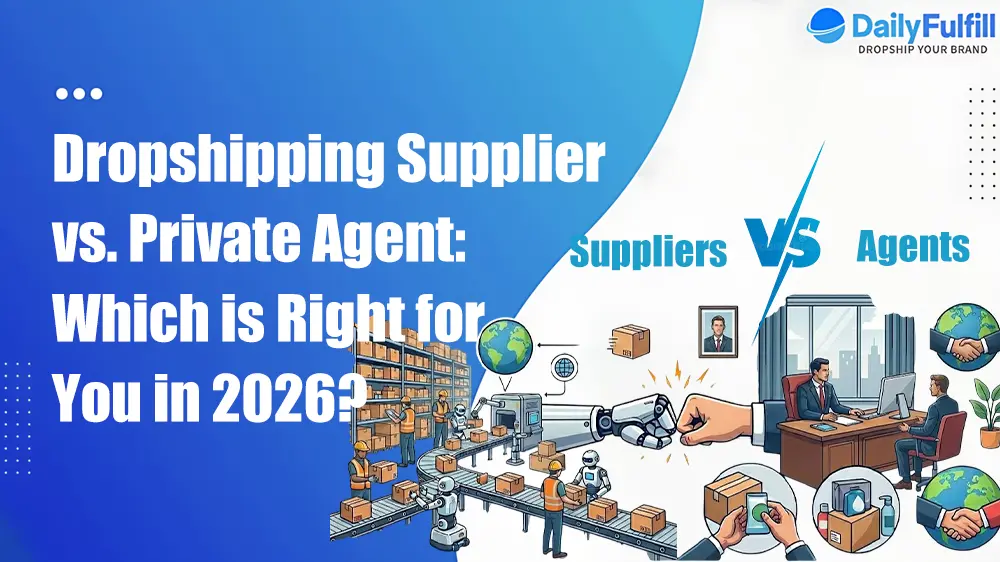
Dropshipping Supplier vs. Private Agent
Most of the confusion comes from the fact that both suppliers and agents technically “ship products for dropshippers.” That’s where the similarity ends.
What a standard dropshipping supplier actually is
A standard supplier — anyone selling on AliExpress, CJdropshipping, Spocket, or Zendrop — operates more like a wholesaler with a public catalog. They stock products they’ve chosen, list them at a marked-up wholesale price, and sell them to anyone who wants to dropship them.
That model has real strengths for beginners. You can browse a catalog, click a button, and have 50 products on your Shopify store in an afternoon. There’s no minimum commitment, no relationship to build, and you can test new products instantly. For someone with zero sales who’s still figuring out what their niche is, this is the right tool.
The trade-off is that everything about the operation is built for scale across millions of sellers, not for your store specifically:
- The same products are being sold by tens of thousands of other dropshippers
- Prices are retail wholesale, not factory direct (you’re paying for the marketplace’s margin)
- Packaging is standardized — usually a plain poly bag with a paper invoice in Chinese
- Quality is whatever the factory chose to ship that day; the marketplace doesn’t inspect
- Customer support is templated, often slow, and rarely knows your store’s context
For one or two orders a day, none of that matters much. At twenty or fifty orders a day, all of it starts costing you real money.
What a private dropshipping agent does differently
A private agent doesn’t have a public catalog. They don’t sell anything off the shelf. Instead, they act as your buying and operations team on the ground in China.
You bring the product. They bring the infrastructure — factory relationships, warehouse space, quality control staff, branded packaging, shipping line accounts, and a person (usually on WhatsApp) whose job is to know your store specifically.
Because they’re not running a marketplace, they make their money differently: a small per-order service fee plus the actual factory cost and shipping, instead of a fat retail markup on every product. At volume, this almost always costs less than buying retail from a supplier, even after the service fee.
The honest comparison
| Dimension | Standard Supplier | Private Agent |
|---|
| Pricing model | Retail wholesale (marked up) | Factory direct + per-order service fee |
| Product sourcing | Pick from catalog only | Custom sourcing for any product |
| Quality control | Generally none on a per-order basis | Per-order inspection, often AQL-standard |
| Packaging | Standard poly bag, paper invoice | Custom branding, logo, inserts available |
| Shipping | Cheapest available line (slow) | Dedicated air lines (5–12 days global) |
| Support | Ticketing system, templated replies | 1-on-1 dedicated person, WhatsApp |
| Setup time | Instant (click a button) | 3–7 days (account setup, integration) |
| Best for | Product testing, <10 orders/day | Scaling brands, 10+ orders/day |
| Monthly fee | $0–$79 (subscription apps) | None (agents charge per order) |
5 Signs You've Outgrown Your Supplier
You don’t need an agent on day one. If you’re testing your first three product ideas and don’t have consistent daily sales yet, an AliExpress supplier or CJdropshipping is genuinely the right tool. But there’s a point — usually somewhere between 10 and 30 orders a day — where the supplier model starts actively hurting your business. Here’s how to know you’ve hit it.
1. Refunds and “where is my order” emails are eating your time.
When 10–15% of your customers are messaging you about late deliveries or defective products, the problem is no longer your customer service — it’s your supply chain. Quality control on every order and 6–9 day shipping typically cut these complaints by more than half.
2. Your supplier takes more than 24 hours to reply.
At 20+ orders per day, you’ll have product questions, stock issues, sizing problems, and tracking disputes happening daily. A supplier whose support team takes two days to respond to “is this in stock” will cost you real revenue. Real agents respond in under 30 minutes during business hours, often inside 30 minutes 24/7.
3. Product prices keep creeping up.
Marketplace suppliers regularly adjust prices based on demand, supplier mood, and seasonal cost changes. If your winning product just went from $5 to $7 without warning, your margins are exposed. Agents typically lock in factory prices for 30–90 days at a time, so you can run ads without worrying about cost shocks.
4. You’re spending hours manually placing orders.
If you’re copy-pasting addresses into AliExpress every morning, or downloading CSVs to send to a supplier, you’ve crossed into manual labor that should be automated. A proper agent has an app or API that syncs your Shopify/TikTok Shop orders automatically, complete with tracking sync back to your store.
5. You want to build a brand.
This is the soft signal, but it’s the most important one. If you’re shipping branded products under a brand name you actually own — and your packaging is a generic grey bag with a Chinese invoice inside — your customer experience is fighting against your marketing budget. Branded boxes, thank-you cards, and logo printing aren’t aesthetic upgrades; they’re conversion drivers for repeat purchases.
A useful order-volume heuristic: under 5 orders/day, stick with a supplier. 5–30 orders/day, you can go either way depending on your product margins. Above 30 orders/day on consistent products, the math almost always favors an agent.
When You Should NOT Use an Agent
We’d be lying if we said agents are right for everyone. There are situations where a marketplace supplier or a software platform is genuinely the better choice.
You’re still product-testing. If you’re spinning up new product pages weekly trying to find a winner, the friction of onboarding to an agent (3–7 days, sample orders, packaging design) doesn’t make sense. Use CJdropshipping or Zendrop until you have 1–2 products consistently selling.
You ship under 5 orders per day. Most agents have a soft minimum because the per-order service fee structure only works at some volume. Below 5 orders a day, you’ll feel like you’re paying for capacity you don’t need.
Your business is purely print-on-demand. Agents can do simple POD (printing on t-shirts, mugs, posters), but specialized POD providers like Printful, Printify, or Gelato have better integration, broader product catalogs, and US-side printing for faster shipping. If POD is your entire model, use a POD specialist.
You’re not committed to a brand identity yet. The biggest reason to use an agent is custom branding. If you’re still using a generic store name with a generic logo and you’re not sure if you’ll keep it for 12+ months, paying for custom packaging is premature.
You need 1–2 day US shipping as a core offer. Agents with US warehouses can do 2–5 day domestic delivery, but the inventory has to be pre-stocked there, which means you need stable enough product demand to justify the upfront stocking. If you’re constantly changing products, a US-based 3PL or platform with US warehouses (Zendrop, CJ) is a better fit.
Being honest about these scenarios is part of why we tell sellers “wait until 10+ daily orders” — agents are a scaling tool, not a starting tool.
The "Public App" Trap — Why Apps Are Not Agents
There’s a category of services that markets itself with words that overlap with agents, but operates more like a public supplier with extra software. Zendrop, CJdropshipping, AutoDS, Spocket, Dropshipman — these are software platforms with supplier networks attached. They’re not private agents, regardless of how they’re branded.
A few things to know before signing up:
Most charge monthly subscription fees.
Zendrop’s paid plans run $49–$79/month. AutoDS is around $19.90/month at the entry level and scales up. CJdropshipping is free at the platform layer but charges through product markup. These fees apply whether you ship one order or one thousand — so at low volume they eat your profit, and at high volume they don’t scale down on a per-order basis.
Quality control is platform-wide, not per-order.
CJ inspects randomly across their warehouse, not your specific orders. AutoDS never physically touches your products at all (it’s a software middleware). Defects that would get caught by a per-order agent inspection regularly ship through.
Support is templated and shared.
You’re one of hundreds of thousands of accounts. The “personal agent” some of these platforms advertise is usually a low-tier sourcing rep handling 50+ accounts simultaneously, replying via ticket system. It’s nothing like the dedicated 1-on-1 relationship a real agent provides.
Custom branding is available but limited.
Most public apps technically offer custom packaging, but with high MOQs (often 100+ pre-pay units), long setup times, and per-piece costs that erase the “free platform” advantage.
When public apps make sense: you’re testing 5+ products at once, you’re under 50 orders/day, or you specifically need a feature like AutoDS’s multi-supplier automation. When they don’t: you’re scaling a single product line, you want true branded fulfillment, or you’re tired of being one account in a sea of accounts.
How to Find a Trustworthy Dropshipping Agent
Finding an agent is easy. Finding one that won’t disappear with your money or ship you junk takes some filtering. Here are the four places people typically look — ranked by danger level.
1. Facebook groups (high risk)
Post “I need a dropshipping agent” in any active Shopify Facebook group and you’ll get 30+ DMs in an hour. The vast majority are individual freelancers or scammers running a side hustle from a phone in Guangzhou.
The red flags: no website, no team page, no Trustpilot or independent reviews, prices that seem too good (“$2 product, 4-day shipping, no fees”), insistence on PayPal Friends & Family payments, and a sense of urgency to “lock in” before another seller takes the slot.
A scam pattern we see regularly: the “agent” takes your first $500 order, ships it correctly to build trust, then takes a $5,000 order and disappears. By the time you realize, they’ve moved to a new WhatsApp number.
2. Upwork / Fiverr (medium risk)
You can find legitimate solo sourcing agents on freelance platforms. The platform itself provides some accountability — escrow, disputes, reviews.
The risk is operational scale. A solo agent who has 5 happy clients can handle them. When you grow to 100 orders a day, they can’t. They can’t process that many orders by themselves, they don’t have warehouse space, and they don’t have shipping accounts with carriers at volume rates. Eventually they either drop you or quality collapses.
Use solo agents for genuinely small operations (under 30 orders/day) or for sourcing-only relationships. Don’t use them as your scaling partner.
3. Google search + Trustpilot (lowest risk if you filter right)
The safest path is to search for real companies, then verify them through independent sources. Things to look for:
- Real website with a team page showing actual people with names and titles
- Real warehouse address in China (not just a virtual office)
- Shopify App listed in the official App Store with 100+ reviews
- Trustpilot rating of 4.5+ with at least 100 verified reviews, including some 1- and 2-star reviews (a 100% 5-star profile is suspicious — real businesses have some unhappy customers)
- Multi-year history — companies that have been operating for 3+ years have survived more than one TikTok-trend cycle
- Transparent pricing — agents that explain their fee structure upfront, with no “send us your business details first” gating
- Real case studies with named clients you can verify on LinkedIn or Instagram
4. Referrals from sellers you trust (best signal)
If you know other dropshippers running stores at your volume level, ask them directly. Real-world referrals beat any search result. The catch is that you need to be in serious dropshipper communities (paid masterminds, real Discord servers, in-person events) to get useful referrals — generic Facebook groups don’t count.
What to Expect When Working With a Real Agent
The onboarding process and ongoing experience varies between agents, but here’s what a competent setup looks like in 2026 so you have something to benchmark against.
Initial quote (first 24–48 hours). You send a product link or description plus your expected daily volume. The agent comes back with a written quote covering product cost, per-order service fee, packaging cost (if you want custom), and shipping costs by destination. The quote should be a document or itemized breakdown, not just a WhatsApp number.
Store integration (3–5 days). Either through an official app (Shopify App Store, WooCommerce plugin) or API connection. Once connected, orders flow from your store to the agent’s system automatically, and tracking numbers flow back to your store and customer.
First test order (week 1–2). Most agents will encourage a test order before you fully commit. This shows you the actual product quality, packaging, and shipping speed. Don’t skip this — and don’t pick the easiest product. Pick the one you’re worried about.
Ongoing relationship. You’ll have a dedicated person (or small team) on WhatsApp. They should know your store name without checking notes. Average response time during business hours should be under 30 minutes. You’ll get notifications for stock issues, factory delays, or shipping disruptions before they affect customers, not after.
Pricing transparency. Real agents don’t surprise you with fees. The agreed price list holds for 30–90 days minimum. If shipping costs change (which happens — fuel surcharges, peak season), you should get notified in advance with the new rates, not a surprise invoice after the fact.
Conclusion
Standard suppliers built the dropshipping industry. They’re cheap, they’re flexible, and they’re the right answer for the first 100 orders of any new product. But the model they’re built on — public catalog, public shipping, public quality — actively breaks down once you’re shipping at brand-scale.
A private agent isn’t a fancier supplier. It’s a different operating model: dedicated sourcing, per-order quality control, custom branding, dedicated shipping lines, and a person who knows your business by name. It costs more on the surface, costs less in practice once you’re past the testing phase, and gives you the brand control that survives in the current e-commerce environment.
If you’ve crossed into consistent daily volume and you’re tired of fighting your supply chain, it’s time.
Stop Treating Your Supply Chain Like a Test
The realistic comparison at 20 orders per day:
With a standard supplier: $5–7 product cost (with retail markup), 15–25 day shipping in a plain bag, ~10% refund rate from quality and delay issues, your customer’s first impression of your brand is a grey plastic envelope with a Chinese return address on it.
With a private agent like DailyFulfill: $3.50–5 factory cost (no middleman markup) plus a per-order service fee, 5–8 day shipping via dedicated lines, under 2% refund rate from per-order inspection, your customer opens a branded box with your logo and a thank-you card.
The agent model adds operational cost. It saves more than it costs once you’re scaling.
Get Your Free Agent Quote →

 English
 Français
 Deutsch
 Nederlands
 Polski
 Español