Dropshipping Supplier vs. Private Agent: Which Is Right For You In 2026?
Dropshipping Supplier vs. Private Agent: What is the difference? Discover which partner offers faster shipping, lower prices, and custom branding for your business in
Your first few orders went well.
The product matched expectations. Defect rates were manageable. The supplier delivered on time.
Then the product started selling.
You increased the order from a few hundred units to a few thousand. Soon, small problems appeared. Materials felt different. Workmanship became less consistent. Packaging changed between batches. Production took longer, and customer complaints increased.
The natural reaction is:
“This supplier used to be good. What happened?”
Sometimes the supplier really has lowered the standard.
But sometimes your order simply became larger than the production system that handled the earlier batches.
More volume can mean more workers, more production lines, multiple material lots, tighter schedules, outsourced processes, and a heavier workload for the same QC team.
A bigger order is not always the same process with a bigger number attached.
A supplier that can make your product is not automatically a supplier that can scale your product.
When an order grows from 500 units to 5,000, something inside the production system often has to change.
| When volume grows | What may change |
|---|---|
| More units | More workers, shifts, or production hours |
| Existing capacity is full | Additional machines or production lines |
| More material is needed | Multiple raw-material lots or suppliers |
| Lead time stays aggressive | Faster production and less buffer time |
| Internal capacity runs out | Some processes may be subcontracted |
| Output increases | QC workload increases too |
None of these changes automatically mean quality will fall. But every new variable creates another place where consistency can be lost.
A smaller order may be handled by the same experienced operators each time. A larger run may require temporary workers, another shift, or another production line with different machines and supervisors.
That is why:
“Can you make 5,000 units?”
is less useful than:
“How will you make 5,000 units compared with the 500 units you made last time?”
A small run may use one lot of fabric, plastic, coating, dye, or components. A large run may require several.
Even when the specification is unchanged, lot-to-lot differences can affect color, thickness, texture, flexibility, or finish.
Production may increase fivefold while the factory keeps roughly the same inspection team and routine.
The factory has scaled output.
Its quality-control capacity may not have scaled with it.
The same principle appears downstream in fulfillment. Order spikes require enough stock, staff, processing capacity, packaging, and QC to maintain the same service level. DailyFulfill’s Fulfillment Solutions page explains how those workflows are planned around real order volume.
So when quality changes after a large volume increase, ask:
“What had to change inside the factory to produce my larger order?”
That helps separate capacity stress from quality fade.
From the customer’s side, both can look similar: defects increase, delivery slows, and complaints rise.
But the cause matters.
Capacity stress happens when the supplier is still trying to make the original product, but its process is stretched.
Common signs include:
The result is often inconsistency. One carton is fine while another is not. One line performs better than another. Lead times slip as workmanship becomes less predictable.
This is mainly a capability and process-control problem. A good supplier may still fix it by stabilizing the line, improving staffing, controlling materials, or strengthening QC.
Quality fade is different.
The supplier gradually changes what goes into the product:
Our sourcing team has encountered this in real footwear work.
A product became a strong seller and the factory was supplying several sales channels at increasingly competitive prices. The purchasing price appeared to keep improving.
But over time, lower- and higher-quality versions began getting mixed together. Problems such as glue failure, abnormal noises, weaker product protection, and poor after-sales cooperation appeared. The lower purchase price created another cost elsewhere: our QC team had to spend more effort separating acceptable products from bad ones before fulfillment.
The difference is simple:
Capacity stress creates inconsistency. Quality fade changes the standard itself.
The two can also happen together.
As volume grows, asking for a lower unit price is normal.
Larger orders can reduce setup cost per unit, improve material purchasing, and use capacity more efficiently.
But those savings have limits.
Suppose the quotation moves from:
500 units at $6.00
2,000 units at $5.20
5,000 units at $4.60
There may be good reasons for those reductions.
But if the buyer keeps pushing toward $3.50 while expecting the same material, construction, packaging, lead time, and QC, another question matters more:
What changed to make this price possible?
Factories still pay for materials, labor, equipment, packaging, quality control, and overhead. Higher volume changes the economics; it does not make those costs disappear.
If the price becomes unsustainably low, the supplier may eventually protect margin through cheaper material, weaker packaging, less experienced labor, fewer QC steps, or faster production.
This does not mean buyers should stop negotiating.
It means lower unit cost is only a saving if the production standard stays intact.
If supplier comparison, cost, MOQ, sample validation, or factory capability is still uncertain, DailyFulfill’s Product Sourcing service focuses on more than the lowest quoted price.
A strong first order is a good reason to trust a supplier more.
It is not a good reason to stop controlling the product.
Early orders usually receive the most attention. Samples are reviewed carefully. Specifications and packaging are confirmed. Quality issues are watched closely.
Then the relationship becomes familiar:
“Same as last time.”
That may be efficient, but a repeat order is still a new production run. Materials, workers, lines, packaging suppliers, or order volume may have changed.
The risk is that trust gradually replaces verification.
Small changes also become easier to accept. The next batch is then compared with the previous batch rather than the original approved standard. Over time, the product can drift without one dramatic failure.
Repeat production should continue to reference the approved standard.
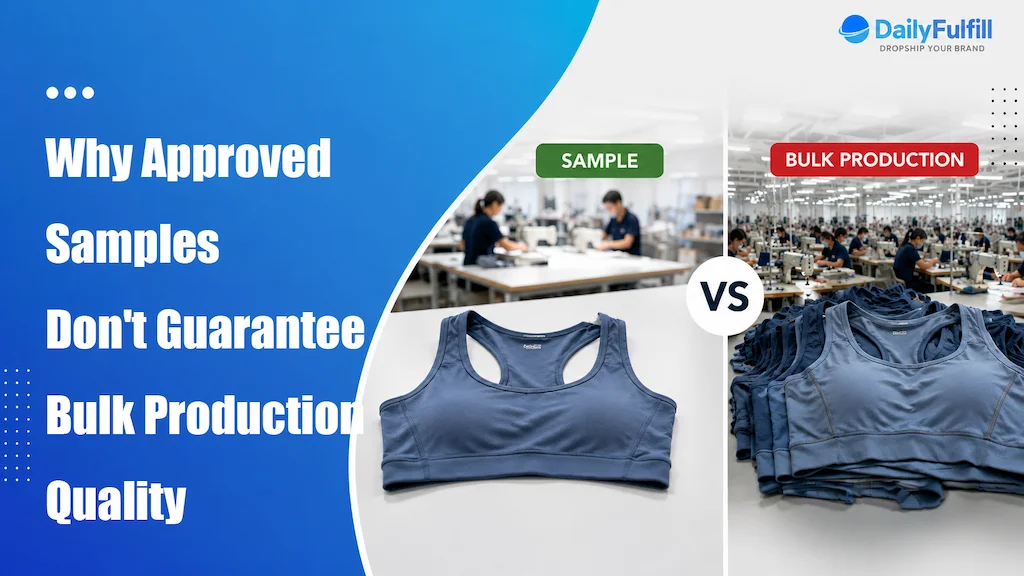
If your first bulk run is already different from the approved sample, see Why Approved Samples Don’t Guarantee Bulk Production Quality.
And when you expect a major sales increase, tell the supplier or sourcing team early. They may need to prepare materials, staffing, production lines, lead time, packaging, and QC differently.
Trust should reduce unnecessary checking. It should not remove the production standard.
Look for patterns rather than judging one bad unit or shipment.
| What you see | What it may suggest |
|---|---|
| Quality becomes inconsistent after a large volume jump | Capacity stress |
| Lead times slip while defects rise | Production bottleneck |
| Some cartons or colors are worse than others | Multiple lots, lines, shifts, or subcontracting |
| Material becomes consistently thinner or cheaper | Possible quality fade |
| Supplier cannot explain where production happened | Transparency or subcontracting risk |
| The same defect returns after being “fixed” | Weak corrective action |
| Specifications are repeatedly ignored | Supplier-control problem |
| Quality improves only after complaints, then falls again | Possible systemic quality fade |
If quality changed after you moved from 500 units to 5,000, ask:
A scaling problem can happen even with a good supplier.
What matters is whether the factory can explain the cause and control it.
A capable supplier should be able to show what changed, identify the affected batch or process, propose corrective action, and demonstrate improvement.
If every explanation is:
“Worker mistake.”
“This batch was unlucky.”
“Next time will be better.”
but the defect returns, the process is not under control.
A scaling problem is something a capable supplier should be able to stabilize. A supplier problem is when the factory cannot—or will not—control the process causing the failures.
More inspection can contain immediate risk. It cannot replace root-cause correction forever.
The best time to manage scaling risk is before the larger order reaches the line.
A staged increase gives both you and the supplier a chance to see where the process begins to strain.
If you know a major increase is coming, tell the supplier or sourcing team early rather than treating the larger run as a routine reorder.
Do not stop at capacity.
Ask what will change:
This distinguishes theoretical capacity from the supplier’s actual production plan.
Repeat orders should continue to reference the same approved material, dimensions, construction, packaging, workmanship, and other critical requirements.
Do not let “same as last time” slowly redefine the product.
If volume growth requires a new material source, line, production site, subcontractor, construction method, or packaging material, discuss it before production.
A useful rule is:
If the change could affect what the customer receives, the buyer should know before it becomes the new normal.
A bigger order does not automatically require 100% inspection.
But a major volume jump, new line, new material lot, tighter deadline, or previous defect creates additional risk and may justify earlier or higher-rate checks.
DailyFulfill’s Fulfillment Solutions distinguish standard order-level checks from batch sampling, product-specific tests, higher-rate inspection, and full inspection where needed.
Quality fade is often gradual:
1% defects → 2% → 3.5% → 6%.
Track defect types, recurring issues, rework, corrective actions, returns, and customer complaints.
A healthy scaling relationship should look like:
Volume grows → production adapts → quality standard stays fixed.
A supplier does not need to be perfect to remain worth working with.
Scaling can expose weaknesses that were invisible at lower volume. The question is whether the factory is improving the process or forcing you to manage the same failure repeatedly.
The relationship may be recoverable when the supplier:
In that situation, reducing the next order or slowing the ramp-up may be safer than replacing a supplier you already understand.
Extra inspection should be temporary containment, not the permanent solution.
Warning signs include:
At that point, the relationship may still look cheap on a unit-price basis while becoming expensive in inspection, rework, replacements, customer complaints, and management time.
If you need to replace the supplier without rebuilding the rest of your fulfillment setup, DailyFulfill’s Product Sourcing service can be used separately from fulfillment.
The decision point is simple:
Can this supplier demonstrate that the process is becoming more controlled as your business grows?
If yes, fixing the system may preserve a valuable relationship.
If the answer is repeatedly no, increasing inspection is no longer supplier management.
It is supplier babysitting.
Growth should not force you to choose between higher volume and lower quality.
But when an order grows, the production system behind it may need to change too.
That is why a supplier that can make your product is not automatically a supplier that can scale it.
The healthiest relationships follow a simple pattern:
Volume grows → production adapts → quality standard stays fixed.
When quality begins drifting, find out what changed. Separate capacity stress from true quality fade, and give a capable supplier the opportunity to correct the process.
But if the same problems return and your team has to inspect quality into every shipment, the relationship may no longer support the business you are building.
Scaling should make your supply chain stronger—not make acceptable quality harder to maintain.
Supplier quality fade is the gradual decline of product quality across repeat orders. It may involve lower-grade materials, weaker workmanship, reduced QC, packaging changes, or other deviations from the original standard.
Higher volume may require new workers, lines, material lots, shifts, or subcontractors. Margin pressure can also encourage cost-cutting, while repeat-order controls may become less disciplined over time.
Not necessarily with the same intensity. Inspection should reflect product risk, supplier history, order value, and what changed in production. A major volume increase or previous defect justifies more attention than a stable repeat run.
Often, but not indefinitely. Higher volume can reduce some costs, but materials, labor, packaging, QC, and overhead remain. If the price falls sharply, ask what operational saving made it possible.
Learn dropshipping tips, sourcing strategies and fulfillment insights from DailyFulfill

Dropshipping Supplier vs. Private Agent: What is the difference? Discover which partner offers faster shipping, lower prices, and custom branding for your business in

Hitting 300+ orders a day on CJDropshipping? See when a private dropshipping agent saves more money, ships faster, and gives you real control in 2026.

CJ Dropshipping claims 7–15 day shipping to the US and EU. Real seller data tells a different story. See actual delivery times, delays, and faster options.