
 English
 Français
 Deutsch
 Nederlands
 Polski
 Español
How to Switch Dropshipping Agents Without Disrupting Orders
Learn how to switch dropshipping agents without disrupting orders, inventory, suppliers, packaging, or store workflows with a phased migration plan.
The supplier looks professional.
Their Alibaba profile is complete. They have a Verified Supplier badge, respond quickly, and provide a competitive quotation. The product photos look good, and the sample price seems reasonable.
Now they are asking for a deposit.
This is the point where many buyers make a mistake. They ask only one question:
Is this supplier real?
A company can be legally registered and still be the wrong supplier for your order. It may be a trading company presenting itself as a factory. It may outsource production to a facility you have never seen. The sample may come from a different manufacturer. The company receiving your payment may also be different from the business shown on the Alibaba profile.
That does not automatically mean the supplier is dishonest. Chinese manufacturers often work with trading companies, export agents, Hong Kong entities, and subcontractors.
However, you need to understand the complete transaction before sending money.
You should know:
A supplier is not properly verified until these roles form a clear and traceable chain.
This guide explains how to check that chain before paying a sample fee, tooling charge, production deposit, or final balance. It will help you verify the company, assess its production capabilities, document your product requirements, and reduce the risk of quality or payment disputes.
Before paying an Alibaba supplier, collect its Chinese legal company name, business license, and Unified Social Credit Code. Check the company in China’s official business registry and compare the information with its Alibaba profile and supplier assessment report.
You should then confirm whether the supplier is a manufacturer, trading company, or export agent. Ask who will actually produce your goods and which parts of production will be outsourced.
Finally, compare the company names shown on the:
The names do not always need to be identical, but every difference must have a clear and verifiable explanation.
Before placing a larger order, approve a paid sample, document the exact product specifications, and arrange an inspection before releasing the final payment.
The objective is not simply to prove that the company exists. It is to confirm that the supplier can produce your product, that your order is properly documented, and that your money is going to the correct business.
Before checking factory videos, certificates, or customer reviews, identify the companies involved in the transaction.
An Alibaba supplier may use different entities for sales, manufacturing, exporting, and receiving international payments. This is common in China and does not automatically indicate a problem. However, each company’s role must be clear before you send money.
Collect and compare these five identities:
| Identity | What to check |
|---|---|
| Alibaba seller | The legal company operating the Alibaba account |
| Registered company | The Chinese name and Unified Social Credit Code on the business license |
| Contracting company | The company named in the purchase contract or Trade Assurance order |
| Payment beneficiary | The business or person receiving your payment |
| Production site | The factory that will actually manufacture the goods |
In the simplest arrangement, one company performs all five roles. In practice, a mainland factory may use a Hong Kong company or export agent to receive payments. A trading company may also manage the Alibaba store while production takes place at another factory.
These structures can be legitimate, but the supplier should explain them clearly and in writing.
The names do not always need to match exactly. What matters is that you can answer three questions:
Pause before paying when a new or unrelated company appears on the invoice or bank account and the supplier cannot provide a clear, verifiable explanation.
A supplier’s identity is not verified simply because the Alibaba store looks professional. The full legal, production, and payment chain must make sense together.
Alibaba verification badges are useful screening tools, but they are not approval to send payment.
A Verified Supplier has undergone an on-site assessment by an independent third party. Buyers can usually review an assessment report containing information about the company’s facilities and operational capabilities. Alibaba may also display verified photos or videos of the production site.
Open the report rather than relying on the badge alone. Check:
Pay particular attention to whether the report matches what the salesperson has told you. A supplier claiming to own a factory should not have an assessment report showing only trading operations or an unrelated product category.
The report also has limits. It describes the business and facilities reviewed by the inspection company at a particular time. It does not guarantee that your sample will match mass production, that every process will remain in-house, or that your order will meet specifications.
Use the badge to decide whether a supplier deserves further investigation—not whether it deserves your deposit.
The next step is to verify the company’s legal identity independently.
Do not rely on the English company name shown on Alibaba. English names are often translations created for international business and may not match the company’s registered legal identity.
Ask the supplier for:
A Chinese business license normally displays the company name, business type, legal representative, establishment date, registered address, business scope, and Unified Social Credit Code. The code serves as the company’s unique official identifier.
Compare the license with the Alibaba supplier profile. Pay attention to:
Small differences in English spelling are common. Differences in the Chinese legal name or Unified Social Credit Code are more important and require an explanation.
A business license proves that a company has been registered. It does not prove that the company owns a factory, manufactures your product, or can meet your quality requirements.
The next step is to confirm the license information through China’s official business registry.
A business license can be edited or outdated, so verify the information through China’s National Enterprise Credit Information Publicity System.
Search using the supplier’s:
The official system allows users to search registered businesses and view information submitted by market-regulation authorities and the companies themselves.
Compare the search result with the business license and Alibaba profile. Focus on:
A young company or broad business scope is not automatically a reason to reject a supplier. However, unexplained differences deserve further investigation.
For example, if the Alibaba profile claims 15 years of manufacturing experience but the registered company was established two years ago, ask whether an older factory, related company, or newly created export entity is involved.
The registry confirms that the legal company exists. The next step is to check whether the same company appears throughout your contract and payment documents.
Before paying, compare the company names shown across the transaction documents:
The simplest arrangement is when the same legal company appears everywhere. However, a supplier may use an affiliated Hong Kong company, export agent, or separate trading company to receive international payments.
That is not automatically a problem, but the relationship must be explained and documented.
For example, if the Alibaba account belongs to a Shenzhen manufacturer but the payment beneficiary is a Hong Kong company, ask:
Do not rely only on explanations given through a phone call or messaging app. Important company and payment details should appear in the order, contract, invoice, or Alibaba message history.
Pause the payment if:
A different company name may have a legitimate explanation. An undocumented payment chain does not.
Alibaba supplier profiles and assessment reports normally identify the business as a manufacturer, trading company, or both. Use this as a starting point, then compare it with the company’s business license and actual operations.
Signs that a supplier may manufacture the product include:
A trading company may offer products from several factories, handle exports, or combine multiple product categories into one order. Its sales team may need to consult the actual manufacturer before answering technical questions.
Do not assume that a factory is always better. A trading company can be useful for smaller orders, mixed-product sourcing, or coordinating several suppliers. Likewise, a manufacturer may still outsource packaging, surface treatment, components, or other production stages.
The important questions are:
The problem is not working with a middleman. The problem is paying factory-direct prices or accepting production claims without knowing who actually controls the manufacturing.
A supplier may be legitimate and still lack experience with your exact product.
Do not rely on statements such as “we can make it” or “no problem.” Ask questions that reveal whether the supplier understands the materials, production process, quality risks, and order requirements.
Confirm:
The quality of the answers matters. An experienced supplier should be able to explain where defects usually occur, which specifications increase cost, and what may cause delays.
Be cautious when the salesperson avoids technical questions, changes answers repeatedly, or agrees to every request without discussing feasibility.
For customized products, send a written specification sheet instead of relying only on photos or product links. Include the material, dimensions, color, logo, packaging, and any critical performance requirements.
The goal is not simply to confirm that the supplier sells similar products. It is to determine whether it understands the details that will decide whether your finished order is acceptable.
Factory photos on an Alibaba profile may be old, reused, or unrelated to your product. Ask for current evidence that connects the supplier to the production you are discussing.
Useful requests include:
The goal is not to prove that a building exists. It is to confirm that the supplier has access to the facility, understands the process, and can show production related to your product category.
During a live video call, ask the salesperson to move through different areas rather than showing only a prepared showroom. You can also ask simple technical questions about the equipment or production stage being shown.
Current production evidence still does not guarantee quality. A supplier may own a factory but lack the controls needed for consistent mass production.
Use these materials to support the information in the assessment report and business license. The next step is to test the supplier’s work through a paid sample.
Always test the supplier with a paid sample before placing a larger order.
The sample should match the product you actually plan to sell. A standard item from the supplier’s catalog is less useful if your order requires different materials, colors, branding, accessories, or packaging.
Check the sample against your written requirements:
Record any approved changes in writing. Do not rely on messages such as “make it like the sample,” because both sides may remember the details differently.
Once the final sample is accepted, treat it as the golden sample: the physical reference that mass production should match. Photograph it, label it clearly, and keep a copy of the approved specification sheet.
When possible, ask the supplier to keep an identical approved sample at the factory for production and quality-control teams.
A good sample is still not proof that the full order will be consistent. Suppliers can spend extra time producing one perfect unit, while mass production introduces variation in materials, workmanship, or packaging.
The sample confirms what the supplier can make. The specification sheet and pre-shipment inspection help confirm what it actually produces at scale.
A supplier may send certificates or test reports, but the documents are only useful if they apply to the product you are buying.
Check whether each document matches:
Be cautious when the report covers a similar product rather than your exact model, or when the company name belongs to an unrelated manufacturer.
For customized products, changing the battery, material, electronics, coating, or design may affect whether an existing report remains applicable. Ask the supplier to explain the connection between the tested product and your version.
Do not accept a CE, FCC, RoHS, or other logo on the packaging as proof by itself. Request the underlying documents and confirm what was actually tested.
The required compliance documents depend on the product and destination market. Before ordering regulated goods, confirm the requirements with a qualified testing laboratory or compliance professional.
Supplier verification tells you who you are dealing with. Product documentation helps confirm whether the goods can legally and safely enter your target market.
Trade Assurance can only assess a dispute against the terms documented in the order. A vague description such as “same as sample” or “high quality” leaves too much room for interpretation.
Include the key requirements directly in the Trade Assurance order or attach a final specification sheet covering:
Alibaba also recommends including product specifications, quantity, shipping information, and the correct Incoterm in the Trade Assurance contract. Supporting files should be uploaded to the order so they can be reviewed if a dispute occurs.
Review every field before paying. Do not assume that details discussed through WhatsApp, video calls, or informal messages have automatically become part of the protected order.
Where possible, keep important negotiations inside Alibaba’s messaging system and pay through the payment instructions provided by Alibaba. Trade Assurance protection depends on the order and payment being processed through the platform.
Trade Assurance is most useful when the order defines exactly what acceptable production looks like. It cannot replace clear specifications.
Do not release payments only because the supplier says production is progressing well.
Before placing the order, agree on what each payment unlocks and what evidence the supplier must provide before the next payment is due.
For example:
The exact payment structure depends on the product, order value, customization, and supplier relationship. The important principle is that later payments should be linked to verifiable progress.
Before paying the balance, confirm:
Be cautious when a supplier suddenly demands full payment before inspection or changes the agreed payment schedule after production begins.
Keep payment conditions inside the purchase contract or Trade Assurance order. Avoid relying on informal promises such as “we will fix any problems after shipment.”
Once the full balance has been paid and the goods have left the factory, your leverage becomes much weaker. Payment milestones should protect both sides by making expectations clear before production starts.
A good sample does not guarantee that the full production run will match it. Before releasing the final payment, inspect the finished goods.
A pre-shipment inspection should normally check:
The inspection should compare the goods with the approved specification sheet and golden sample, not with general descriptions such as “good quality.”
For larger orders, the inspector will usually examine a random sample rather than every unit. The report should clearly separate critical, major, and minor defects and include photos of any problems found.
If the inspection fails, agree in writing on the corrective action before paying the balance. This may include:
Do not accept promises to fix serious problems after shipment. Once the goods leave the factory, rework becomes slower, more expensive, and harder to control.
Inspection does not remove every risk, but it gives you evidence while you still have payment leverage. The final balance should be released only after the goods meet the written requirements or the remaining issues have been formally resolved.
Use this checklist before paying a sample fee, tooling charge, production deposit, or final balance.
A supplier does not need to have a perfect answer to every question immediately. However, it should be able to provide consistent information and reasonable supporting documents.
Do not send payment while important gaps remain in the company identity, production process, product specifications, or payment chain.
Supplier verification is not about finding a company with no risks. It is about identifying the risks before your money and inventory are committed.
Pause the transaction when the supplier:
One issue does not always mean the supplier is fraudulent. However, several inconsistencies usually indicate that the transaction is becoming difficult to verify or control.
| Result | What it means | What to do |
|---|---|---|
| Green light | The company, production, order, and payment information are consistent | Proceed with a documented order and agreed inspection |
| Yellow light | There is a mismatch, but the supplier provides a reasonable and verifiable explanation | Resolve it in writing before paying |
| Red light | The supplier cannot explain who manufactures the goods, signs the order, or receives the money | Do not send payment |
No. The badge indicates that certain company information and facilities have been assessed. It does not guarantee the quality of your specific product or production order.
Not necessarily. Trading companies can be useful for smaller orders, mixed-product sourcing, and export coordination. You simply need to understand their role and which factory will make the goods.
Ideally, yes. If it does not, ask for a documented explanation of the relationship between the companies before paying.
Trade Assurance provides a dispute framework based on the documented order. Its protection is much stronger when the product specifications, deadlines, inspection requirements, and supporting files are clearly included.
Release the balance only after the completed goods have been checked against the approved sample and written specifications, or after any inspection problems have been resolved.
Learn dropshipping tips, sourcing strategies and fulfillment insights from DailyFulfill
Learn how to switch dropshipping agents without disrupting orders, inventory, suppliers, packaging, or store workflows with a phased migration plan.
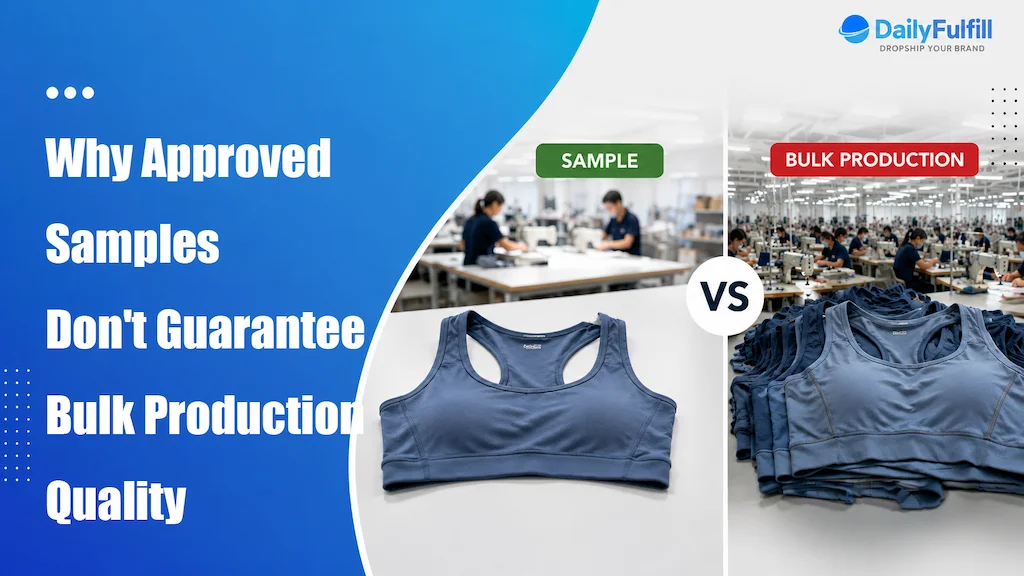
Learn why approved samples can differ from bulk production and how to control materials, tolerances, QC, packaging, and supplier changes.
Learn why supplier quality drops as orders scale, how to spot capacity stress vs quality fade, and how to keep repeat orders consistent.