Bulk Order Doesn’t Match the Sample? Why It Happens
Learn why approved samples can differ from bulk production and how to control materials, tolerances, QC, packaging, and supplier changes.
The sample looked exactly right.
The material felt good. The dimensions were correct. The logo was where it should be. The color matched your expectation, and even the packaging looked ready to sell.
So you approved it and placed the bulk order.
Then production finished—and something had changed.
The fabric feels slightly thinner. Measurements vary between units. The color is close, but not quite the same. Stitching is less consistent. The packaging feels cheaper than the version you approved.
That does not automatically mean the supplier cheated you.
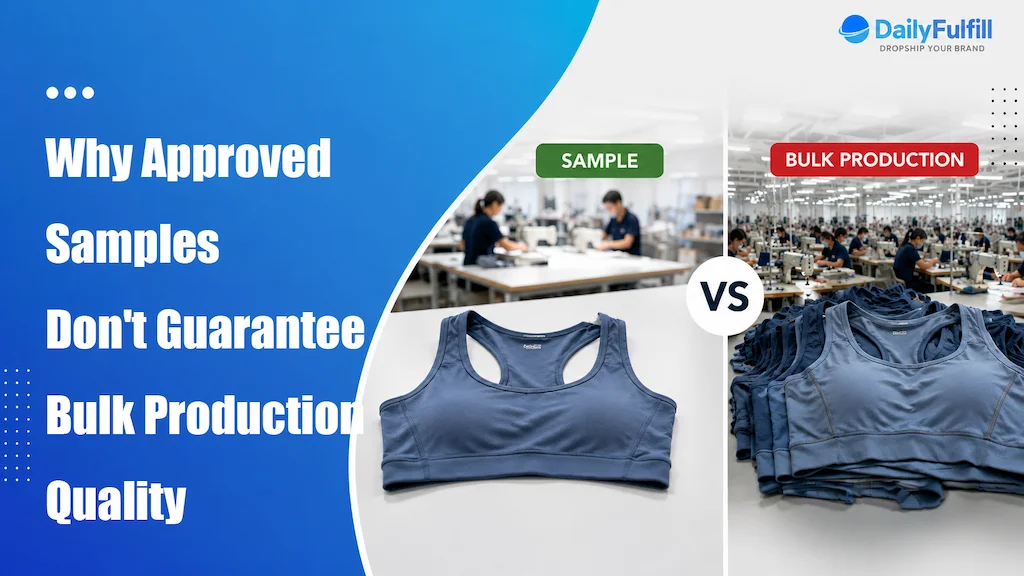
The more fundamental problem is that producing one good sample and reproducing the same standard across hundreds or thousands of units are two different manufacturing challenges.
A sample can show that a supplier is capable of making the product you want. It does not, by itself, prove that the same materials, dimensions, workmanship, appearance, and packaging can be repeated consistently under real production conditions.
A sample proves capability. Bulk production tests repeatability.
Understanding that difference is the first step toward preventing a successful sample from turning into a disappointing bulk order.
Before asking why a bulk order looks different from the sample, ask a more basic question:
Not every sample is made to prove the same thing.
A supplier may send a polished unit that confirms the product can look and function the way you want. But that does not necessarily mean it was made using the same materials, tooling, workers, production speed, or processes planned for the full order.
| Sample type | What it mainly tells you |
|---|---|
| Development or prototype sample | Whether the design can be made and what still needs to change |
| Customized sample | Whether your logo, color, material, size, or other customization can be achieved |
| Pre-production sample | Whether finalized specifications can be reproduced under conditions close to the planned production run |
| Production sample | What products coming from the actual production process look like |
An early prototype may be handmade, carefully finished by one technician, digitally printed, 3D printed, or produced with temporary tooling. It may be perfectly suitable for confirming a design while still being a poor predictor of what happens when the factory has to make 1,000 units efficiently.
Even a good pre-production sample remains a reference unit. It does not prove that every unit in the batch will stay within the same standard.
Sample approval should therefore answer:
“Is this the product and standard we want the factory to reproduce?”
It should not mean:
“The quality of the entire future production run is now guaranteed.”
Before approving a sample, understand how it was produced and how closely those conditions match the planned bulk-production process.
When a bulk order looks different from an approved sample, it is tempting to assume the supplier changed the product.
Sometimes that is exactly what happened.
But moving from one carefully prepared sample to full production also introduces material batches, equipment, workers, production speed, and process controls that may not have been present when the sample was made.
The useful question is:
Is this expected production variation, or has the product moved outside the standard we approved?
A development sample may be handmade or receive more manual finishing than a production unit. Printing may be done digitally for a small sample instead of using the final production method. A prototype may use 3D printing or temporary tooling before the production mold is ready.
The sample may have done exactly what it was supposed to do: prove that the design or customization was possible.
The problem begins when that sample is treated as proof that the same result will automatically repeat under a different production process.
A factory making one unit slowly is solving a different problem from a factory making 2,000 units efficiently.
Fabric, leather-like materials, plastics, wood, coatings, dyes, and other materials can vary between production lots.
Differences may appear in color, texture, thickness, weight, flexibility, or finish.
That does not mean every difference should be accepted. It means the buyer needs to define how much variation is acceptable instead of relying on “make it the same as the sample.”
A sample may be handled by one experienced technician. Mass production may involve multiple operators, machines, shifts, assembly stages, and sometimes outside processes.
The more times a specification must be reproduced, the more important process control becomes.
A supplier may make good units at low volume but struggle when the order becomes much larger or the deadline becomes tighter.
Production speed increases. More workers may be added. Another line may be used. Material may come from multiple lots.
That is why:
“They made a perfect sample” and “they can consistently manufacture this product at our required volume” are two different supplier capabilities.
Production variation does not justify every change.
Potential red flags include:
These are fundamentally different from small, controlled manufacturing variation.
The goal is not to demand that every production unit is microscopically identical to one sample. It is to make sure every acceptable unit stays within the product standard you actually agreed to.
That leads to the more important problem behind many sample-to-bulk disputes:
“Sample approved” is not, by itself, a production standard.
Many disputes begin with a conversation that looks perfectly normal:
“The sample looks good.”
“Approved. Please start production.”
The buyer believes this means:
Make the bulk order exactly to this standard.
The supplier may understand something closer to:
The overall product and appearance are approved.
Those interpretations can become very different once production starts.
An approved sample may not answer basic questions such as:
If these details exist only in someone’s memory of the sample, quality becomes subjective.
The buyer says, “This fabric feels thinner.”
The supplier says, “It is almost the same.”
Without a defined standard, both sides may genuinely believe they are right.
A physical sample is useful for characteristics that are difficult to describe—feel, finish, proportions, overall appearance. Written specifications capture what the sample cannot reliably communicate—materials, measurements, tolerances, construction, packaging, and acceptance criteria.
You need both.
Do not approve an impression. Approve a standard.
Once a sample is approved, turn it from “the one we liked” into a reference the supplier, buyer, and QC team can all identify.
The goal is not to document every microscopic detail. It is to remove ambiguity around details that matter if they change.
Identify the exact approved version.
Use a clear version or date, such as Sample V3 — Approved August 20, 2026.
Record material requirements.
Where relevant, document composition, grade, thickness, weight, finish, hardness, or other controllable properties.
Define dimensions and tolerances.
Critical measurements should include a target and an acceptable range where appropriate.
Document color and appearance.
Use useful references for color, surface finish, printing, logo position, and other visible details.
Define important workmanship.
Stitching, seams, printing alignment, assembly, glue marks, surface defects, and similar details should not rely on vague phrases such as “good quality.”
Include packaging.
Boxes, bags, labels, inserts, barcodes, hangtags, and protective materials can all affect the final customer experience.
Keep the evidence together.
Photos, measurements, specifications, written approvals, packaging references, and the physical sample—where practical—should point to the same approved version.
If sourcing or supplier comparison is still in progress, DailyFulfill’s Product Sourcing service covers supplier comparison, samples, specifications, MOQ, production lead time, and inspection scope before commitment. For products involving deeper customization, see our Private Label service.
The approved sample should become evidence, not a memory.
A common sourcing workflow looks like this:
Sample approved → deposit paid → production starts → wait for finished goods.
That leaves a large blind spot.
Once bulk production begins, the supplier is proving that it can reproduce the agreed standard consistently under real production conditions.
The right level of inspection depends on the product and risk. A simple repeat product from a proven supplier may need less intervention than a first production run involving custom materials, strict sizing, complex functions, or expensive branded packaging.
But the principle is the same:
Do not wait until the entire order is finished to discover that production drifted away from the approved reference.
For a new or customized product, early production units can reveal problems with:
For first-time production, deeply customized products, or suppliers with a history of inconsistency, finding the problem early is usually easier than reworking an entire finished batch.
Earlier checks may be worthwhile when:
The purpose is not simply to “inspect more.” It is to detect process drift while there is still time to correct it.
Finished production should still be checked against the approved reference and specifications.
Depending on the agreed scope, that may include quantity, appearance, workmanship, dimensions, function, labeling, packaging, and defect criteria.
A practical process becomes:
Sample approved
→ standard documented
→ real production verified
→ finished bulk inspected
→ shipment released
Sample approval should not mean:
“Quality control is finished.”
It should mean:
“We now have a standard that quality control can enforce.”
DailyFulfill’s Fulfillment Solutions distinguish order-level checks from separately agreed batch sampling, full inspection, functional tests, and product-specific QC, so the inspection scope can match the product and risk.
If production is already finished, turn “this isn’t what I approved” into something measurable before negotiating with the supplier.
Compare production with:
Identify exactly what changed rather than arguing only that something “feels worse” or “looks different.”
Acceptable variation: The difference remains within the agreed tolerance and does not materially affect function, appearance, compliance, or customer experience.
Correctable problem: The product can meet the required standard through sorting or rework.
Commercially unacceptable difference: The deviation changes the product in a way you cannot reasonably accept, such as wrong material, major dimensional errors, failed functionality, or serious safety concerns.
Three defective units do not prove all 1,000 units are defective. Three good units do not prove the opposite either.
Determine whether the problem is isolated, limited to a particular batch or variant, or repeated throughout the order. Depending on the issue, that may require sampling, targeted sorting, or full inspection.
Possible outcomes may include:
Where possible, resolve the problem before the goods leave the factory or warehouse.
A quality issue still sitting in China is inconvenient. The same issue distributed across hundreds of customer orders becomes returns, replacements, bad reviews, and support tickets.
Not every product carries the same risk.
Be especially cautious when:
The point is not to inspect every product as aggressively as possible.
It is to recognize when the cost of discovering a problem late is much higher than the cost of verifying production early.
The goal is not to eliminate every possible variation. It is to make sure that when production changes, you can identify what changed, decide whether it is acceptable, and act before the problem reaches customers.
A good sample is important, but it answers only one part of the sourcing question.
It shows that the supplier can make a product that meets your expectations once. Bulk production asks a harder question:
Can the supplier reproduce that standard consistently under real production conditions?
The safer process is:
Sample approved → standard documented → production verified → bulk inspected → shipment released.
Use the sample as a reference. Document the requirements that matter. Define acceptable variation. Increase quality control when the product or production run carries more risk.
And if the finished bulk order differs from the sample, compare it against evidence and agreed specifications before deciding whether the difference is acceptable, correctable, or a genuine quality failure.
A sample tells you what is possible. Quality control determines whether that result can be repeated.
No. It shows what the supplier is expected to reproduce, but materials, production methods, workers, tooling, and volume can still introduce variation. The sample becomes useful when it is tied to written specifications and followed by production quality checks.
A golden sample is an identified, approved reference used to represent the expected product standard. It should support—not replace—written specifications for dimensions, materials, tolerances, packaging, and other measurable requirements.
Ideally, yes, especially for customized products or details that are difficult to describe completely in writing. Both sides should also be able to identify exactly which sample version was approved.
It depends on risk. A proven repeat product may only need a defined pre-shipment check, while first production runs, heavily customized products, strict sizing requirements, large orders, or suppliers with previous quality issues may justify earlier inspection.
As of this writing, none of the eight suppliers covered in this article offer native Bol.com integration. Bol.com is the dominant Dutch marketplace (over €5 billion in annual GMV), but most dropshipping platforms are built Shopify-first, with Amazon and eBay as secondary integrations. Practical workarounds: use a cross-listing tool like ChannelEngine or EffectConnect that bridges Shopify catalogs to Bol.com, or coordinate Bol.com orders manually through your supplier’s agent. Expect this to be a gap to manage operationally rather than something a supplier solves for you.
Learn dropshipping tips, sourcing strategies and fulfillment insights from DailyFulfill

Learn why approved samples can differ from bulk production and how to control materials, tolerances, QC, packaging, and supplier changes.

Learn how to switch dropshipping agents without disrupting orders, inventory, suppliers, packaging, or store workflows with a phased migration plan.

Learn why supplier quality drops as orders scale, how to spot capacity stress vs quality fade, and how to keep repeat orders consistent.