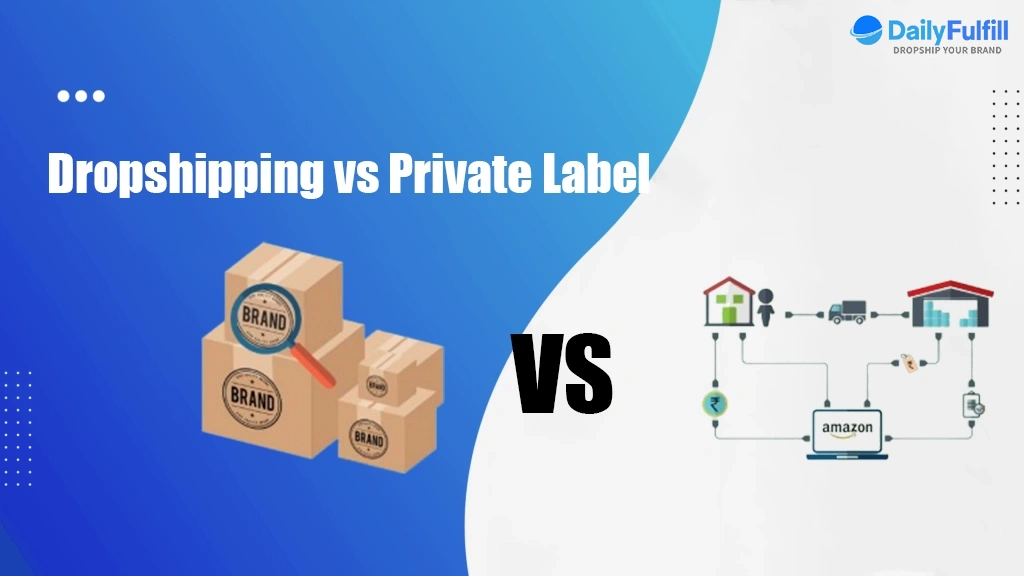
“Dropshipping” and “private label” get talked about as if you have to pick one — but they’re not really competitors. They’re different things: dropshipping is a fulfillment method, and private label is a sourcing model. You can do one, the other, or both at once. The confusion comes from not knowing what each term actually refers to, so this guide draws the line clearly — what each model is, how they differ on ownership and cost, and which one fits where you are.
This is the models explainer. We’re not arguing whether branding is worth it here — the profit comparison lives in is branded dropshipping better than traditional dropshipping — and if you want the bigger picture of branding overall, start with what is branded dropshipping. Here, we’re answering one precise question: what’s the difference between dropshipping and private label, and which should you use?
What dropshipping actually is (a fulfillment method)
Dropshipping describes how the order is fulfilled, not what the product is. You sell a product on your store without holding inventory; when a customer orders, a supplier ships it directly to them. That’s it. The defining trait is that you don’t own or stock the product — you’re moving someone else’s generic item.
Because the product is generic and unbranded, anyone can sell the identical item. You have no exclusivity and no control over the product itself — only over which products you list and how you market them. This is what makes dropshipping cheap and fast to start, and also what makes it hard to defend: there’s nothing stopping a hundred other stores from selling the exact same thing.
What private label actually is (a sourcing model)
Private label describes what the product is and who it belongs to, not how it ships. A private-label product is one that a manufacturer makes and brands exclusively for you — your name, your logo, often your spec — and agrees not to sell that branded version to anyone else. You’re not reselling a generic item; you’re selling your product, even though a factory makes it.
The defining trait here is ownership and exclusivity. Competitors might find the same factory and the same base product, but they can’t sell your branded version. That exclusivity is the whole point — it’s what lifts you out of the price war that generic dropshipping traps you in.
Here’s the part that resolves the “versus”: these two aren’t opposites. You can private label and dropship at the same time — have your privately-labelled product produced and fulfilled by an agent who ships it directly to customers, so you get exclusivity without holding a warehouse full of stock. That combination is what most people actually mean when they say “private label dropshipping,” and we’ll get to exactly how it works below. But first, there’s a term sitting between these two that causes most of the confusion: white label.
White label vs private label: the distinction most people miss
Between “plain dropshipping” and “private label” sits white label — and mixing it up with private label is the single most common confusion in this topic. They sound similar and both involve putting your brand on a product, but they differ on the thing that matters most: exclusivity.
White label means taking a generic, ready-made product that a factory already produces in bulk, and selling it under your own brand. The key word is ready-made — the product exists as a stock item, and the factory sells that same base product to many retailers, each of whom brands it as their own. You add your logo and packaging, but the product underneath is identical to what your competitors can also white-label. It’s fast, cheap, and low-MOQ, because you’re not asking the factory to make anything new — just to brand what they already make.
Private label means a product made and branded exclusively for you. The factory produces it under your name and agrees not to sell that branded version to anyone else, and you often customize more than just the logo — a spec, a formula, a colorway. The trade-off for that exclusivity is commitment: higher minimums, longer lead times, and more cost, because you’re now the only one selling that exact product.
The simplest way to hold the difference: white label is “brand a product anyone can also brand”; private label is “a product made to be exclusively yours.” White label buys you speed and low risk; private label buys you exclusivity and control. Neither is “better” — they sit at different points on a trade-off between how fast/cheap you start and how defensible your product is.
The four models, side by side
Put plain dropshipping, white label, private label, and custom manufacturing on one line and the spectrum is clear — each step adds exclusivity and control, and asks for more commitment in return:
| | Plain dropshipping | White label | Private label | Custom manufacturing |
|---|
| What it is | Resell a generic item | Brand a ready-made product | Exclusive product branded for you | Product built to your own design |
| The product is | Generic, shared by all | Stock item under your brand | Exclusively yours | Unique, doesn’t exist elsewhere |
| Exclusivity | None | None (same base sold to others) | Yes | Strongest |
| Customization | None | Logo + packaging | Logo on product + some spec | Full (material, shape, features) |
| MOQ / commitment | None (per order) | Low | Higher (varies by method) | Highest |
| Cost & lead time | Lowest, fastest | Low | Medium | Highest, slowest |
| Best for | Testing products | Fast branding of a winner | Committing to a proven winner | Established brands scaling a bestseller |
The pattern reads left to right: you trade speed and low risk for exclusivity and defensibility. Most stores moving from generic dropshipping into branding land on white label first — it’s the practical sweet spot, giving you your own brand on a product with low minimums and little risk. You step up to private label when a product is proven enough that exclusivity is worth the extra commitment, and only reach custom manufacturing once a bestseller justifies building something genuinely unique.
How private label works without a warehouse
Private label used to mean a real barrier: factories would tell you “yes, we’ll put your logo on it — but you have to order 2,000 units.” For a dropshipper, committing thousands of dollars to untested branded stock is exactly the risk you got into dropshipping to avoid. That MOQ wall is why people assumed private label and dropshipping couldn’t mix.
The thing that changed is the sourcing agent. Instead of you ordering a factory’s full minimum and storing it in your garage, an agent sources the product, applies your branding at a far lower minimum (often a few hundred units or less, depending on the method), holds it in their warehouse, and ships each order to your customer as it comes in. You get the exclusivity of private label with the no-inventory mechanics of dropshipping — which is what “private label dropshipping” really means. It’s the model we run at DailyFulfill, and it’s what makes the whole thing accessible without capital tied up in stock.
The ways your logo gets on the product
“Private label” isn’t one technique — how your brand goes onto the item depends on the product’s material, and each method has its own minimum and cost. Knowing them tells you how cheaply you can private-label a given product:
- Printed labels, stickers, and heat-transfer logos — the lowest barrier. Works on almost anything, very low minimums, low cost. This is how most stores start private labeling.
- Woven or printed neck/care labels — the standard for clothing. Your brand sewn or printed into the garment. Low-to-moderate minimums.
- Screen printing and pad printing — for putting a logo onto hard goods like bottles, gadgets, and accessories. Moderate minimums.
- Embossing and debossing — a pressed logo on leather, card, or packaging for a premium feel. Moderate.
- Laser engraving — a permanent mark on metal, wood, or glass. Ideal for jewelry, drinkware, and tools. Moderate.
- Custom molds and tooling — changing the product’s actual shape with your branding built in. This is the deepest end, with the highest minimums — and it shades into custom manufacturing rather than private label.
The practical takeaway: the lighter methods — labels, prints, woven tags — let you private-label at low minimums with almost no risk, which is why they’re where most stores begin. The heavier methods — molds and tooling — deliver the strongest differentiation but ask for real commitment. So when you hear “private label needs a huge MOQ,” that’s only true at the heavy end. At the light end, it’s well within reach of a dropshipper with one proven product.
Which model should you choose?
The right model isn’t a personality choice — it’s set by where a specific product is in its life. Match it to the stage, not to ambition:
- Still testing? Use plain dropshipping. If you don’t yet know the product sells, don’t brand it at all. Keep it generic, cheap, and disposable until it proves itself. Branding an unvalidated product is money you can’t recover.
- Found a winner and want to brand it fast? Use white label. This is the sweet spot for most stores making the jump. You get your own brand on a proven product with low minimums and little risk — the quickest, safest way to stop selling a generic item and start selling yours.
- Ready to commit to that winner? Step up to private label. When a product is clearly worth building around, private label buys you exclusivity and more control over the item itself. The higher commitment is justified because the product has earned it.
- Scaling an established bestseller? Consider custom manufacturing. Only once a brand is built and a product is undeniable does it make sense to invest in a genuinely unique version competitors can’t source at all.
Like the branding levels themselves, this is a progressive, per-product decision — you move up the spectrum as a product proves it deserves more investment, and you can run different products at different stages at the same time. The one thing this guide deliberately doesn’t settle is whether the jump from generic to branded pays off in profit terms — that’s a numbers question, answered in full in is branded dropshipping better than traditional dropshipping.
Picked a model? Here's where to go next
Choosing the model is the decision; executing it is a separate process. Once you know whether you’re white-labeling or private-labeling a product, the full launch sequence — picking what to brand first, choosing your method, and setting up your store and packaging — is laid out step by step in how to start branded dropshipping.
If you already know which model you want, these are the two services behind them: white label dropshipping for branding a ready-made product fast, and private label dropshipping for an exclusive product made for you. Both run on the same no-inventory, agent-fulfilled model.
If you’d rather hand it off, that’s what we do — we source your product, apply your white-label or private-label branding, store it for free, and ship it under your name for 6,000+ stores at a 4.9★ Trustpilot rating. Get a free quote and we’ll price your product across both models.

 English
 Français
 Deutsch
 Nederlands
 Polski
 Español