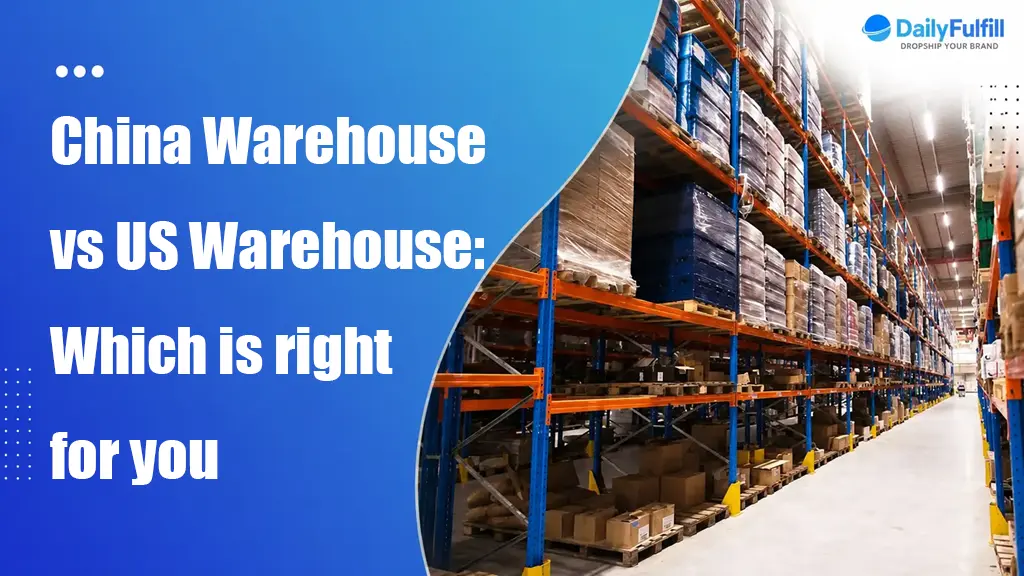
Your products are made in China, but your customers are mainly in the United States. Where should you keep the inventory?
A China warehouse keeps stock close to suppliers. It makes quality checks, custom packaging, product consolidation, and small inventory adjustments easier before the goods leave the country.
A US warehouse keeps stock close to customers. It supports faster domestic delivery, simpler returns, and a more predictable post-purchase experience.
The difficult part is that neither option is always cheaper or better.
Moving inventory to the US too early can tie up cash in products that may not sell. Keeping proven bestsellers in China for too long can increase per-order shipping costs and make delivery slower than customers expect.
The right decision depends on your sales markets, SKU performance, delivery promise, inventory budget, and total fulfillment cost—not monthly order volume alone.
Quick Answer: Should You Use a China or US Warehouse?
A China warehouse is usually better when you are testing products, managing many low-volume SKUs, selling to several countries, or regularly changing products and packaging.
A US warehouse or 3PL becomes more attractive when US demand is stable, a small number of products generate most orders, and faster local delivery can improve sales or customer retention.
Many growing brands eventually use both:
- Proven US bestsellers are stocked in a US warehouse.
- New products, long-tail SKUs, and international orders remain in China.
This guide compares the two models by total cost, delivery speed, inventory risk, quality control, returns, and operational flexibility so you can decide which setup fits your current stage.
China Warehouse vs US Warehouse at a Glance
The main difference is simple:
A China warehouse keeps inventory close to the supply chain. A US warehouse keeps inventory close to the customer.
That difference affects delivery speed, inventory risk, quality control, returns, and how easily you can change products or packaging.
| Factor |
China Warehouse |
US Warehouse |
| Main advantage |
Close to suppliers and production |
Close to US customers |
| Best for |
Product testing, global sales, long-tail SKUs |
Proven products with stable US demand |
| Inventory commitment |
More flexible |
Usually requires larger advance stock |
| US delivery speed |
Slower cross-border delivery |
Faster domestic delivery |
| Quality control |
Easier before export |
Problems are more expensive to fix locally |
| Custom packaging |
Easier to change near production |
Usually prepared before bulk shipping |
| Multi-supplier consolidation |
Easier |
Goods must be consolidated before import |
| Returns |
More difficult and costly |
Easier with a local return address |
| Overstock risk |
Lower commitment to one market |
Higher if demand is overestimated |
| Global fulfillment |
Flexible across several countries |
Best when orders are concentrated in the US |
A China warehouse is often the safer starting point when demand is still uncertain. You can store products near the factories, inspect incoming goods, combine items from different suppliers, and ship orders to several markets without committing large quantities to the US.
A US warehouse becomes more useful when sales are predictable and delivery speed matters. Bulk importing can reduce international shipping cost per unit, while domestic fulfillment improves delivery times and return handling.
The choice should not be based only on which warehouse charges lower storage fees. The better model is the one that produces the lowest total cost and operational risk for your current product mix.
Compare the Total Fulfillment Cost, Not Just Shipping
A China warehouse may have higher per-order international shipping, while a US warehouse may offer cheaper domestic delivery. But shipping alone does not show which model costs less.
For a China warehouse, include:
- Receiving and quality inspection
- Storage and pick-and-pack
- Custom packaging or kitting
- International shipping
- Duties and customs-related charges
- Failed delivery and cross-border return costs
For a US warehouse, include:
- Bulk freight from China
- Import duties and customs clearance
- Warehouse receiving fees
- Storage and pick-and-pack
- Domestic delivery
- Return processing
- Slow-moving inventory fees
- Removal or disposal charges
The US model can reduce shipping cost per order after products are imported in bulk. However, it also requires you to purchase and move inventory before customer orders arrive.
This means the lowest fulfillment cost depends on more than order volume. Product weight, SKU count, demand stability, storage time, return rate, and inventory turnover can all change the result.
A useful comparison is:
Total fulfillment cost = logistics fees + inventory costs + operational risk
For example, a US warehouse may save several dollars on each delivered order but still cost more overall if a large percentage of the inventory remains unsold.
Likewise, China fulfillment may appear expensive per shipment but protect cash flow by allowing you to keep fewer units committed to one market.
Request complete quotations from both providers and compare the same cost categories. A low shipping rate can be misleading when receiving fees, storage minimums, packaging charges, or return costs are excluded.
Delivery Speed Depends on Where Your Customers Are
A US warehouse usually offers faster delivery to American customers, but that advantage matters most when the US is your main market.
Before moving inventory, look at where orders actually come from.
A US warehouse is more attractive when:
- Most sales come from the United States
- Customers expect domestic delivery
- Fast shipping affects conversion or repeat purchases
- The product competes with similar items available on Amazon
- You can forecast demand with reasonable accuracy
A China warehouse may remain more flexible when orders are spread across the US, Europe, Australia, and other regions. Moving all inventory to the US can improve one market while making fulfillment to other countries more expensive or less efficient.
Product type also matters.
Customers may accept longer delivery for a unique, customized, or hard-to-find product. They are less likely to wait when the product is widely available and easy to compare with local alternatives.
The delivery promise on your website should match the fulfillment model. A brand using China fulfillment should not advertise US-style two-day delivery unless inventory is already positioned locally.
A practical way to decide is to review:
- The percentage of orders going to the US
- Delivery-related complaints or refund requests
- Cart abandonment linked to shipping expectations
- Whether faster delivery would justify the extra inventory commitment
- Whether the same stock is still needed for other markets
The closer your demand is concentrated around US customers, the stronger the case for a US warehouse. The more international and unpredictable your sales remain, the more value a China warehouse provides.
Inventory Risk and Cash Flow Often Decide the Answer
Order volume matters, but demand predictability matters more.
Moving inventory to a US warehouse requires you to purchase stock, pay bulk freight, clear customs, and store products before they sell. This can improve delivery speed, but it also ties up more cash.
The US model is safer when:
- A small number of SKUs sell consistently
- Reorder timing is predictable
- Products have a low risk of becoming outdated
- You can afford several weeks or months of inventory
- Stockouts would cost more than holding extra units
A China warehouse is usually more flexible when products are still being tested, sales are seasonal, or demand is spread across many SKUs. Inventory remains close to suppliers, making it easier to replenish smaller quantities or adjust packaging before shipping.
Two common mistakes are:
Moving Inventory to the US Too Early
You may end up paying storage fees for slow-moving products while cash remains trapped in stock that cannot easily be used in other markets.
Keeping Proven Products in China Too Long
Once demand becomes stable, repeated international shipping can increase cost and delivery time. The business may also lose sales because customers expect faster fulfillment.
Review each SKU separately rather than moving the entire catalog at once. A proven bestseller may belong in a US warehouse, while new products and low-volume accessories remain in China.
The best warehouse location is often determined by where inventory uncertainty creates the greatest financial risk.
China Is Better for Quality Control, Consolidation, and Customization
A China warehouse offers more than storage. Its main operational advantage is proximity to suppliers.
When products arrive from several factories, the warehouse can receive, inspect, and combine them before international shipping. This is especially useful for brands selling bundles, kits, or products with custom packaging.
A China fulfillment center can support:
- Incoming quality inspections
- Product consolidation from multiple suppliers
- Kitting and bundle assembly
- Custom boxes, inserts, labels, and stickers
- Barcode replacement or relabeling
- Accessory checks
- Repacking and minor rework before export
Problems are usually easier and cheaper to correct while the inventory is still near the manufacturer. Missing accessories can be replaced, defective units can be returned, and packaging can be changed without moving goods across borders again.
Once inventory reaches a US warehouse, local teams can still inspect or rework products, but labor costs are normally higher and replacement components may need to be shipped from China.
This makes a China warehouse particularly valuable when:
- Products come from several suppliers
- Packaging changes frequently
- Orders require assembly or customization
- Quality can vary between production batches
- The brand is still refining its product presentation
For standardized products with stable specifications, these advantages may become less important over time. But during product development and early growth, keeping inventory close to the supply chain gives the brand more control before the goods reach customers.
A US 3PL Is Better for Fast Delivery and Local Returns
A US warehouse becomes more valuable when customer experience depends on speed and local service.
Once inventory is already inside the country, orders can move through domestic carriers instead of crossing borders one by one. This usually makes delivery times more predictable and gives customers clearer tracking.
A US 3PL is especially useful when:
- Most orders come from the United States
- Customers expect fast domestic delivery
- A few proven SKUs generate most sales
- Replacement orders need to arrive quickly
- The brand needs a local return address
- Marketplace delivery standards are difficult to meet from China
Local returns are one of the biggest advantages. Customers can send unwanted or defective items to a US address, where the 3PL may inspect, restock, replace, or dispose of them according to your instructions.
However, faster delivery comes with additional commitments.
You normally need to:
- Import inventory in bulk
- Pay freight, customs, and receiving costs in advance
- Maintain enough stock to avoid local stockouts
- Pay storage fees while products wait to sell
- Manage slow-moving or obsolete inventory
Product problems can also become more expensive after import. If labels, packaging, accessories, or product specifications are wrong, local rework may cost significantly more than correcting them near the factory.
A US 3PL works best when the product and demand are already stable. It brings inventory closer to the customer, but it also moves more financial and operational risk into the destination market.
When to Use China, the US, or Both
The best model is often decided at the SKU level, not the company level.
Choose a China Warehouse When
A China warehouse usually fits better when:
- Products are still being tested
- You manage many low-volume SKUs
- Orders come from several countries
- Packaging or product details change frequently
- Goods arrive from multiple Chinese suppliers
- Preserving cash flow is more important than very fast US delivery
This model keeps inventory close to production and avoids committing too much stock to one market before demand is proven.
Choose a US Warehouse When
A US warehouse becomes more suitable when:
- US demand is stable and predictable
- A few SKUs generate most American orders
- Fast delivery affects conversion or repeat purchases
- Local returns and replacements are important
- You can support regular bulk replenishment
- The product specification and packaging are already stable
The strongest candidates are usually proven bestsellers with reliable sell-through, not the entire catalog.
Choose Hybrid Fulfillment When
A hybrid model places mature inventory near customers while keeping flexible inventory near suppliers.
For example:
- Proven US bestsellers stay in a US 3PL
- New products remain in China during testing
- Long-tail SKUs ship from China
- International orders continue through the China warehouse
- US returns are handled locally
- Backup inventory remains in China for replenishment or other markets
Hybrid fulfillment can reduce delivery times without forcing every SKU into the same inventory strategy.
However, using two warehouses also adds complexity. You need accurate inventory synchronization, clear routing rules, and a plan for deciding which warehouse fulfills each order.
Do not choose hybrid fulfillment simply because it sounds more advanced. Use it when your sales data clearly shows that different products require different inventory locations.
Five Questions to Answer Before You Choose
Before moving inventory, answer these five questions with actual sales and cost data.
1. What Percentage of Orders Go to the US?
If most orders consistently come from the United States, local inventory becomes more valuable. If sales are spread across several countries, a China warehouse usually offers greater flexibility.
2. Which SKUs Have Stable Demand?
Do not evaluate only total order volume. Identify the products with predictable weekly sales, reliable margins, and low risk of becoming obsolete. These are the strongest candidates for a US warehouse.
3. What Is the Full Cost of Each Model?
Compare international freight, customs, receiving, storage, pick-and-pack, delivery, returns, and unsold inventory. The lowest shipping rate does not always produce the lowest total cost.
4. How Much Cash Can You Commit to Inventory?
A US warehouse normally requires earlier purchasing and bulk replenishment. Make sure this does not reduce the cash available for advertising, product development, or operating expenses.
5. Which Risk Is More Expensive Right Now?
Ask whether your business currently loses more from:
- Slow delivery and difficult returns
- Unsold inventory and restricted cash flow
Choose the warehouse that reduces the more serious risk.
A simple rule is:
- Unproven demand: keep inventory in China
- Stable US demand: move selected SKUs to a US 3PL
- Mixed product performance: use a hybrid model
The decision should be reviewed regularly. A warehouse strategy that fits your business today may no longer be the best option after sales patterns, markets, or product lines change.
Conclusion
The choice between a China warehouse and a US warehouse is not simply a choice between lower cost and faster delivery.
A China warehouse keeps inventory close to suppliers, making quality inspection, consolidation, customization, and product testing easier. It is usually more flexible when demand is uncertain or sales are spread across several countries.
A US warehouse keeps inventory close to customers. It is best suited to stable products with predictable American demand, especially when fast delivery and local returns directly affect customer experience.
For many growing brands, the right answer is not to move everything at once. Start by placing proven US bestsellers with a local 3PL while keeping new products, long-tail SKUs, and international inventory in China.
DailyFulfill can manage the process from product sourcing and quality inspection in China through bulk transportation, customs coordination, partner US warehouse delivery, and domestic order fulfillment.
This allows you to keep supply-chain control in China while gradually positioning the right inventory closer to your customers.
Contact DailyFulfill with your product details, target markets, and order data to compare the most suitable China, US, or hybrid fulfillment setup.

 English
 Français
 Deutsch
 Nederlands
 Polski
 Español