Most “Shopify dropshipping guide” articles walk you through the same basic clicks — sign up, pick a theme, install an app — and then stop. Shopify’s own documentation already does that part better than any blog can. This guide assumes you can follow setup steps, and instead spends its depth on the parts that actually decide whether your store makes money: how you source, how you fulfill, and how the 2026 tariff changes affect your margins.
That focus is deliberate. The store-building half of dropshipping is largely solved and commoditized. The sourcing-and-fulfillment half is where stores quietly succeed or fail — and it’s the half most guides skip, because most guides aren’t written by people who ship the orders. We are. So we’ll move quickly through setup and slowly through the things that matter.
If you’re still deciding whether to dropship at all, or which platform to use, start with our how to start dropshipping guide first — this one assumes you’ve chosen Shopify.
Is Shopify still the right platform for dropshipping in 2026?
Short answer: for most stores, yes. Shopify remains the most popular platform for dropshipping because it handles hosting, security, and checkout for you, has the deepest app ecosystem for sourcing and fulfillment, and scales from a first sale to enterprise without you re-platforming. For a beginner who wants to focus on products and marketing rather than infrastructure, it’s still the safe default.
But go in understanding the real cost, because the subscription is the smallest part of it. Shopify’s 2026 US plans run roughly Basic $39/month, Grow $105/month, and Advanced $399/month (about 25% cheaper on annual billing), with a Starter plan at $5/month that’s really just a checkout link, not a full store per current Shopify pricing breakdowns. Most new dropshippers start on Basic.
The fees that actually shape your margins come on top of that:
- Payment processing: roughly 2.9% + $0.30 per transaction on Basic through Shopify Payments, dropping slightly on higher plans.
- Third-party gateway surcharge: if you don’t use Shopify Payments, Shopify adds about 0.2%–2.0% per transaction on top of your gateway’s own fee.
- Apps: sourcing, tracking, reviews, and marketing apps stack up — easily $30–$150+/month as you grow.
The practical takeaway for a dropshipper: on thin dropshipping margins, your processing fees and app stack matter more than your plan choice. Use Shopify Payments where it’s available to avoid the surcharge, keep your app stack lean, and price with these fees baked in. For a full platform-by-platform comparison, see our best ecommerce platform for dropshipping guide — here we’ll assume Shopify and move on to what matters more.
The decision that actually matters: how you source on Shopify
Here’s where most guides fail you. They list a dozen “supplier apps” in one table as if they’re interchangeable. They’re not. On Shopify, you really have two fundamentally different ways to source, with different economics and different ceilings — and picking the wrong one for your stage is the most common reason a Shopify store stays unprofitable.
Route 1: Marketplace apps (DSers, Spocket, Zendrop, CJ, AutoDS). You connect an app, import products from a marketplace catalog with a few clicks, and orders auto-forward to a marketplace seller who ships them. (Note: if an older guide tells you to use Oberlo, ignore it — Shopify shut Oberlo down in 2022, and DSers is the official AliExpress successor.)
- Strengths: fast to launch, no minimum orders, enormous catalog, true one-click importing. This is genuinely the right tool when you’re testing products and don’t yet know what sells.
- The operator reality nobody tells you: you’re buying at marketplace retail markup, not factory cost. You have no quality control — whatever that third-party seller decides to ship is what lands on your customer’s doorstep. Shipping speed is whatever the seller uses, often slow. Branding is limited to a generic invoice. And you’re selling the identical product as thousands of other stores pulling from the same catalog, so you compete on ads, not margin.
Route 2: A private sourcing agent (this is what we do). Instead of importing a marketplace listing, you hand an agent a product — or even just an AliExpress, 1688, or Alibaba link — and they find the actual factory behind it, cut out the middlemen, inspect every order, and ship it in your packaging on faster, dedicated lines. The agent connects to your Shopify store the same way an app does, so fulfillment is still automatic.
This route directly fixes every weakness of Route 1:
| | Marketplace app | Private agent |
|---|
| Unit cost | Retail/marketplace markup | Factory cost (middlemen cut) |
| Quality control | None — seller decides | Every order inspected |
| Shipping | Seller’s choice, often slow | Dedicated lines (e.g. US 6–12 / EU 3–8 days) |
| Your branding | Generic invoice only | Your packaging and inserts |
| Differentiation | Same listing as everyone | Your own product page and brand |
| Connects to Shopify | Yes | Yes |
The honest rule — and it’s the same logic as choosing a supplier anywhere: use a marketplace app to test, use an agent to scale. On day one, when you’re still guessing which product wins, a marketplace app’s no-minimum, one-click catalog is exactly right — don’t over-invest before you have data. But the moment a product proves itself, keeping it on a marketplace app means permanently capping your margin, your quality, and your brand. That’s the point to move the winner to an agent.
This is the part of “Shopify dropshipping” we handle at DailyFulfill. We trace any product back to its real factory, run 3-stage quality checks, ship in your custom packaging (from $0.10 per piece) from our Yiwu and Guangzhou warehouses, and sync with your Shopify store so orders fulfill automatically — the same setup we run for 6,000+ stores at a 4.9 Trustpilot rating. If you want the deeper version of this decision, see our guide to dropshipping agents; if you’ve already got a product worth scaling, get a free quote and we’ll price it against what you’re paying now.
Connecting your supplier and automating fulfillment on Shopify
Once you’ve chosen how you source, the mechanics of getting an order from your Shopify checkout to your customer’s door are where a smooth store separates itself from a chaotic one. Whether you use a marketplace app or an agent, the connection works the same way on Shopify — and understanding the flow lets you spot where it breaks.
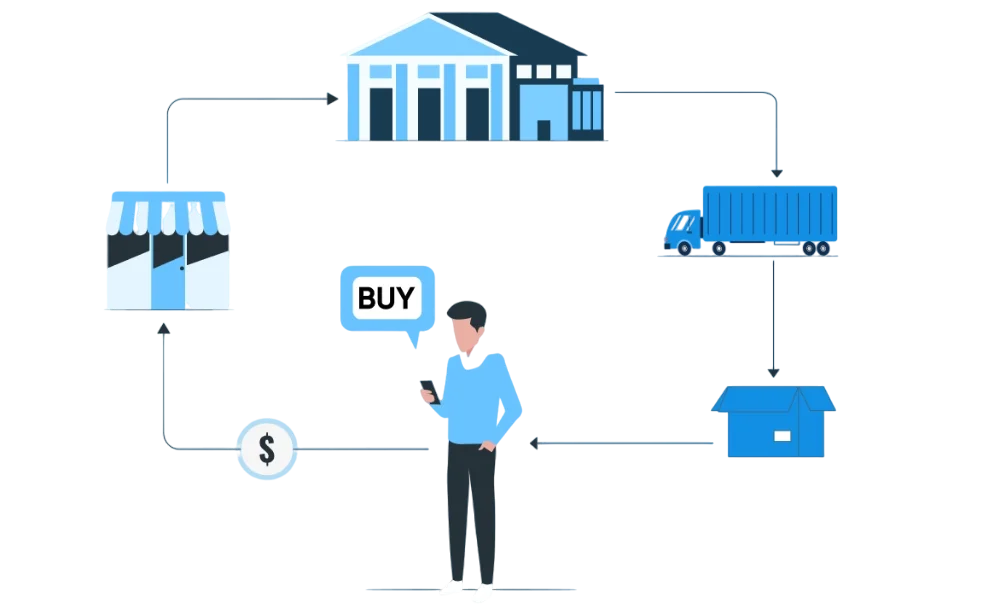
The order flow, end to end:
- A customer checks out on your Shopify store. Shopify captures the payment and creates the order.
- The order syncs automatically to your connected app or agent through the Shopify integration — no manual re-entry.
- Your supplier or agent picks, packs, and ships the item. (With an agent, this is also where quality control happens; with a marketplace app, it doesn’t.)
- The tracking number is pushed back into Shopify, which marks the order fulfilled and triggers the shipping-confirmation email to your customer.
Set up correctly, you touch none of this after the sale. But “set up correctly” hides a few Shopify-specific details that trip people up:
Connect through the Shopify App Store, not manually. Install your sourcing app or agent’s app from the App Store so it authenticates properly and gains the order and fulfillment permissions it needs. A proper integration is what makes steps 2–4 automatic; a manual setup means you’re copying orders by hand.
Don’t blindly enable full auto-fulfillment on day one. Shopify lets you “automatically fulfill the order’s line items,” and it’s tempting to switch everything to hands-off immediately. Early on, leave a verification step in: check the shipping address and flag high-risk/fraudulent orders before they forward to your supplier. A wrong address or a fraud order that auto-ships is money you don’t get back. Add full automation once your volume makes manual review impractical.
Map your variants carefully. The most common silent failure in Shopify dropshipping is a variant mismatch — a customer orders the blue, large version and the integration ships black, medium because the SKUs weren’t mapped cleanly. Check variant mapping when you import, and test one real order of a multi-variant product before you trust it.
Make tracking visible, not just present. A tracking number sitting in Shopify isn’t enough — the customer needs clear, branded updates, especially across the slower stretches of a cross-border shipment. This is where a dedicated tracking app earns its place; see our dropshipping tracking tools guide for which one fits your store.
Plan the returns path before you need it. With dropshipping you don’t hold stock, so returns run through your supplier. Agree the returns and refund process with your supplier up front, and publish a clear policy on your store — handling a return cleanly is often what turns a frustrated buyer into a repeat one.
The difference an agent makes here is quality at step 3: a marketplace app automates forwarding the order, but no one inspects it. An agent automates the same Shopify flow and checks the product and ships it in your branding — same automation, better box arriving at the customer.
What the 2026 tariff shift means for your Shopify margins
If your “Shopify dropshipping guide” doesn’t mention tariffs, it’s out of date — because the single biggest change to dropshipping economics in years happened in 2025. The de minimis exemption, which let imports under $800 enter the US duty-free, is gone: it ended for China and Hong Kong in May 2025, globally in August 2025, and the temporary postal grace period expired at the end of February 2026. Every low-value parcel now needs a customs entry and carries duty.
For a Shopify dropshipper, that lands directly on your margin. The old “buy it for $3, sell it for $20” math now has an extra line item, and once you stack it against Shopify’s own fees, the picture gets tight. Here’s the margin structure on a typical order — figures are illustrative, since duty rates vary by product category and destination:
- Product cost (what you pay your supplier)
- + Inbound shipping
- + Import duty (new since 2025 — varies by HS code and country)
- + Shopify payment processing (~2.9% + $0.30 on Basic)
- + App costs (spread across orders)
- + Ad cost per sale (often your single largest expense)
- = what’s actually left
The duty line is the new one, and on a cheap commodity product it can be the difference between a profitable order and a break-even one. This is why the strategy has to change, not just the spreadsheet:
1. Lower your base cost by sourcing direct. Duty is calculated on your product’s value, and you’re now paying it on top of whatever markup sits in your cost. If you’re buying at marketplace retail, you’re paying duty on the middleman’s margin too. Sourcing direct from the factory through an agent lowers the base the duty is applied to — which matters more now than it ever did. (This is the practical reason the sourcing decision earlier in this guide became more important in 2026, not less.)
2. Move up in price point and perceived value. The model hit hardest is thin-margin, $5-commodity dropshipping, where there’s no room to absorb a duty. Higher-value, branded products carry the duty far more comfortably. This is why building a real brand — your own packaging, your own product page — isn’t just marketing in 2026; it’s margin protection. (For the how, see our custom packaging guide; don’t try to compete on being the cheapest.)
3. Reprice with duty baked in — and never let it surprise the customer. Build the duty into your retail price rather than discovering it later. And make sure duties are handled before the parcel reaches your customer: a buyer hit with an unexpected customs charge at their door often refuses the parcel, leaving you with a chargeback and a lost product. A fulfillment partner that files customs properly keeps this invisible to your customer.
4. For proven bestsellers, consider warehousing locally. The per-parcel import model is the one tariffs punished. For a product selling consistently, importing in bulk once and fulfilling domestically spreads the customs cost across many units instead of paying it per order — the same move Temu and Shein themselves made when they opened local warehouses. (We offer overseas fulfillment from US and Germany warehouses for exactly this.)
The honest summary: the tariff shift made cheap, commodity, per-parcel dropshipping much harder, and rewarded well-sourced, branded, higher-value products. That’s not bad news for a serious store — it’s just a push toward the model that was always more durable anyway.
Where Shopify dropshippers actually fail
After fulfilling for thousands of Shopify stores, the failure patterns are remarkably consistent — and almost none of them are about the things beginners worry over (themes, logos, app choice). They’re about sourcing and fulfillment. Here are the ones that quietly kill stores:
They scale a winner on a testing setup. This is the big one. A store validates a product with a marketplace app, the product takes off, and they keep pouring ad spend into it while still sourcing from a random marketplace seller with no quality control, slow shipping, and generic packaging. Volume amplifies every weakness at once — returns climb, reviews drop, and the ad ROAS that made the product work collapses. The fix is the rule from earlier: test on an app, move the winner to a proper supplier before you scale the spend.
They price for the product cost, not the landed cost. They calculate margin as retail minus product cost, and forget duty, payment processing, app costs, and ad spend. The order looks profitable in the product page and loses money in the bank account. Price against your full landed and selling cost, including the post-2025 duty.
They trust full automation too early. Turning on hands-off fulfillment from day one means fraud orders and mistyped addresses ship automatically, and variant mismatches go out unnoticed. Keep a verification step until your volume forces you to automate, then automate deliberately.
They have no eyes on the product. In dropshipping you never see what ships — which means a defect, a wrong item, or a quality drop reaches your customer before you know it exists. One bad batch can tank a campaign. This is the single strongest argument for an agent that inspects orders: it’s the only point in the chain where someone checks the box before it reaches your buyer.
They ignore the shipping-time gap. Slow cross-border shipping with no proactive tracking updates produces exactly the WISMO emails, PayPal disputes, and chargebacks that drain a new store. Fast lines plus visible tracking aren’t a nicety — they’re what keeps your payment processor and your customers calm.
They compete on price for a commodity. Selling the identical catalog product as hundreds of other stores forces a race to the bottom, and ad costs swallow the margin. The escape isn’t a cheaper supplier — it’s a product and brand that aren’t interchangeable, which starts at sourcing.
Notice the through-line: every one of these is a sourcing or fulfillment problem wearing a marketing disguise. The stores that last get the back half of the business right — reliable sourcing, quality control, fast shipping, honest pricing — and then let their marketing compound on a foundation that doesn’t crack under volume.

 English
 Français
 Deutsch
 Nederlands
 Polski
 Español