Most dropshippers approach custom packaging the wrong way. They look at the per-unit cost — $0.50 for a printed mailer bag, $0.70 for a branded box — and treat it as overhead. Then they decide they’ll “get to it once sales are stable.”
That math has it backwards. Custom packaging is not a cost line; it’s a revenue lever. The dropshippers running on tariff-compressed margins in 2026 know this, because they’ve watched the easy money disappear from price-led competition. When you can no longer win on cheapest-in-market — and the end of de minimis means you can’t — brand is where the margin lives. And the cheapest, fastest-to-deploy piece of brand a dropshipper has is what arrives at the customer’s door.
This guide is written for sellers past the “is dropshipping still viable” question and into the “how do I make this defensible” one. It covers the five specific mechanisms by which custom packaging moves sales numbers — not vague “branding feels nice” benefits, but quantifiable levers backed by data. It also covers the real per-unit costs at three different tiers, the break-even math by AOV, and which product categories see the biggest lift. By the end, you’ll know whether your store is ready for Tier 1, 2, or 3 — and roughly how long the payback period will be.
The 5 Levers — How Custom Packaging Actually Moves Sales
“Custom packaging is good for branding” is the laziest sentence in dropshipping advice. It’s true and useless. To decide whether it’s worth your money, you need the actual mechanisms that connect a printed box to a higher number on your dashboard. There are five of them, and each is independently measurable.
Lever 1 — Higher perceived value justifies a higher price. A 2019 University of Wisconsin study found that an identical product in premium packaging beat its plainly-packaged version in 76% of head-to-head ratings, and was also judged a better value. Translated into a P&L: you can typically raise your price 10–20% on the same product without losing conversion, because customers anchor “is this worth $X” against what they see when it arrives. Higher AOV at the same product cost is direct margin lift.
Lever 2 — Lower return rate protects your existing margin. Dropshippers who switch to custom packaging consistently report 20–35% drops in return rate. Two mechanisms drive this: better physical protection cuts damaged-on-arrival refunds, and stronger first-impression presentation cuts “this feels cheap, sending it back” returns. Our returns guide calls the second one the “Ugly Grey Bag” problem — customers refunding perfectly functional products simply because the parcel looked cheap. Each prevented return is roughly $15–25 of direct loss avoided.
Lever 3 — Higher repeat purchase rate compounds LTV. A customer who receives a premium experience is materially more likely to come back. Roughly 45% of buyers report being more inclined to repurchase from a retailer whose packaging feels premium. Repeat customers carry near-zero CAC — every percentage point of improvement compounds across the next twelve months of orders from that buyer.
Lever 4 — Social shares reduce customer acquisition cost. About 40% of buyers will post a photo of unique packaging to social media, and unboxing content on TikTok alone has generated billions of views. Every organic share is paid acquisition you didn’t have to fund. For stores in visually-driven categories, those organic shares can pull CAC down by 15–20%.
Lever 5 — Packaging influences buyers before they buy from you. This is the lever most sellers miss. 62% of consumers who watch unboxing videos factor what they see into their buying decisions. Your packaging isn’t only seen by people who already bought — it’s seen by people deciding whether to buy. A package that ends up in a TikTok haul or an Instagram story does conversion work on prospects who will never know the influencer.
Each lever has its own dollar value, and they stack. The question isn’t whether custom packaging works — that’s measurable and resolved. The question is what it costs, which is Step 2.
The Real Costs — What Each Tier Actually Costs
Most articles about custom packaging skip the part that matters: what it actually costs. They talk about “investment” in branding and “tailored solutions” without ever quoting a number. Below is what you can actually expect, broken into three tiers — light, branded, and premium — with current per-unit prices and the minimum quantities required to start.
Tier 1 — Light Branding ($0.10 – $0.30 per order)
The starter tier. What you get: branded stickers on a plain mailer, custom shipping tape with your logo, and a printed thank-you card or care guide inside. The product itself is still in standard packaging — you’re personalizing the outside and the first thing the customer sees when they open.
This tier is genuinely cheap and almost always worth running. At DailyFulfill, stickers and printed cards start at around $0.10 per piece. Even at sub-$20 AOV, a $0.10 thank-you card pays for itself if it lifts repeat purchase even slightly. There is no excuse not to be running this tier from day one.
Tier 2 — Branded Container ($0.50 – $1.50 per order)
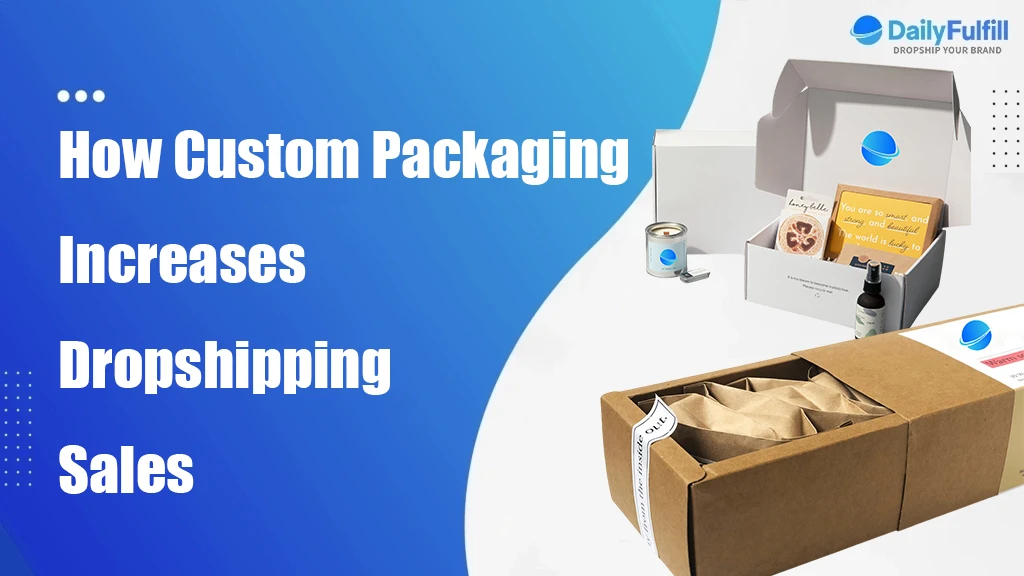
The sweet spot for most scaling stores. What you get: a custom-printed poly mailer bag or a basic logo-printed box that replaces the generic grey one entirely. This is the tier where customers actually notice the brand at the door, before they’ve even opened anything.
At DailyFulfill, custom mailer bags start around $0.50 per piece and printed boxes around $0.70 per piece. Tier 2 is where most stores at $25 AOV and above start seeing meaningful return on the spend.
Tier 3 — Premium Unboxing ($2 – $5 per order)
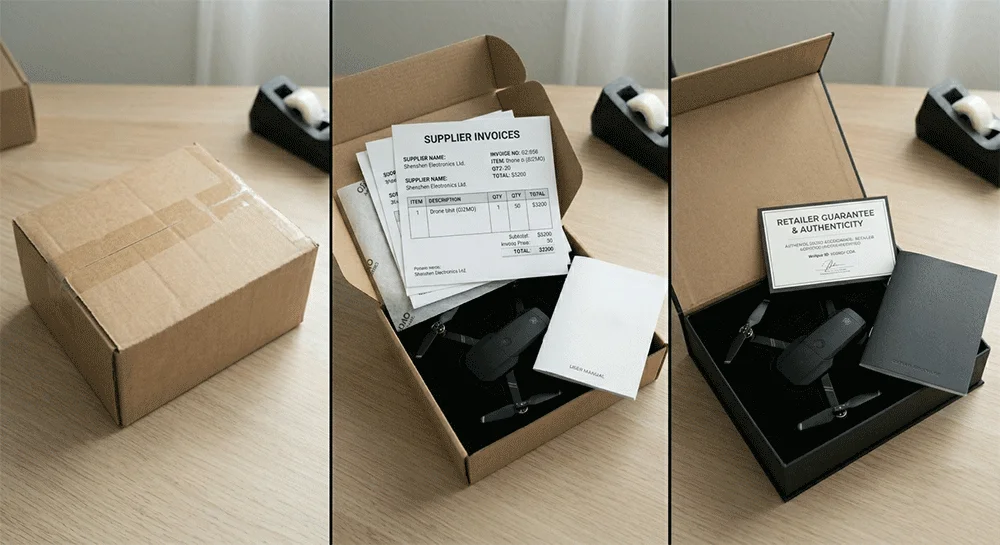
The “make it an experience” tier. What you get: a rigid box, custom tissue paper or void fill, a branded insert (product guide, founder note, QR code to a brand video), and optionally a ribbon or sleeve. This is what cosmetics, jewelry, and apparel brands use when they want the unboxing to be the content their customers post.
Costs vary widely here because rigid boxes and inserts are where customization compounds. As a rough rule, expect $2 – $5 per order for a full Tier 3 setup. For products at $50 AOV and above this tier almost always justifies its cost; at lower price points the math turns negative quickly, which is covered in Step 3.
The MOQ Reality (Why Most Sellers Misjudge This)
The single biggest reason dropshippers don’t start with custom packaging is a misconception about minimums. The 500–1,000-unit MOQs everyone assumes apply come from going directly to a packaging factory. Through a fulfillment agent that already runs print partnerships, the floor drops dramatically — at DailyFulfill, the minimum for a custom order is roughly 10 units.
That floor changes the strategic calculus. You can test a design on a small batch of real customer orders, see whether your dashboard actually moves, refine based on real feedback, and only scale the designs that work. The capital risk that scares most sellers away from this tier is largely a problem of which path you choose, not a problem of custom packaging itself.
When It Pays Back — The Break-Even Math
The reason most articles dodge the cost question is that the math seems intimidating. It isn’t. Here’s a worked example on a realistic mid-tier dropshipping store, using deliberately conservative assumptions.
The store: 200 orders per month at $40 AOV. Product cost $12. Current return rate 6%, current repeat purchase rate 12%. Tier 2 packaging: $0.80 per order ($0.70 printed box + $0.10 thank-you card).
Monthly packaging spend: 200 × $0.80 = $160.
Now the levers:
Lever 1 — Perceived value lifts AOV. A 10% price increase on the same product — well within what custom packaging supports — moves AOV from $40 to $44, a $4 gain per order. Net of the $0.80 packaging cost, that’s $3.20 per order × 200 orders = +$640/month.
Lever 2 — Lower returns. A 2-percentage-point drop in return rate (6% → 4%, conservative against the published 20–35% reduction range) avoids 4 returns per month. At roughly $20 of direct loss per return (refund + product + payment fees), that’s +$80/month.
Lever 3 — Repeat purchase compounding. A 4-point lift in repeat rate (12% → 16%) generates 8 additional orders per month from the existing customer base. At roughly $25 gross margin each, that’s +$200/month — and because repeat customers need essentially no fresh acquisition spend, the real contribution is higher, and the cohort effect grows every month as new buyers join it.
The total: roughly $900+ of monthly uplift on $160 of spend. Net benefit close to $750/month. Payback period: less than one month. And this ignores Levers 4 and 5 — the social-share CAC reduction and the pre-purchase UGC signal — both of which are real but harder to put a single dollar figure on.
When the Math Breaks
The model above assumes $40 AOV. The thresholds look like this:
- AOV under ~$20 → stick to Tier 1. A 10% perceived-value lift adds $2 or less per order, which can’t comfortably cover Tier 2 costs once you account for product cost and ad spend. Custom stickers and cards still earn their keep; printed boxes usually don’t.
- AOV $20–$50 → Tier 2 is the sweet spot, exactly as modeled above.
- AOV $50+ → Tier 3 almost always pays back inside 60 days. The absolute dollar lift from a 10% price increase ($5+ per order) easily covers $2–$5 of premium packaging.
If your store sits in the second or third band and you’ve never tested custom packaging, the question stops being “is this worth it” and becomes “what’s the smallest test I can run this week.”
Category Matters — Where Packaging Drives Sales Most
The break-even math in Step 3 assumes a typical product. Real-world ROI varies enormously by category, because packaging impact depends on three things: how visually shareable the product is, whether it’s bought as a gift, and how much premium pricing the category tolerates.
| Category | Packaging ROI | Why |
|---|
| Cosmetics & skincare | 🟢 Highest | Half the product is the packaging in this category. Indie beauty brands prove that Instagram-worthy unboxing can outperform formulation as a purchase driver. |
| Jewelry | 🟢 Highest | Almost always bought as a gift — even when bought for oneself. Premium presentation is a baseline expectation, not a delight. |
| Apparel & fashion | 🟢 High | Tissue paper, branded tags, and folded presentation translate directly into perceived garment quality, and apparel is one of the most-shared unboxing categories. |
| Home decor & gifts | 🟡 Medium–High | Strong gift-purchase share. Higher-priced decor especially benefits from sturdy, premium-feeling packaging. |
| Pet supplies | 🟡 Medium | Utility-driven, but engaged pet owners do share photos of their pets with packages. Light branding earns its keep here; premium tiers don’t. |
| Electronics & accessories | 🟡 Lower | Buyers prioritize function and protective packaging over experience. Heavy investment in unboxing rarely pays back unless the product is itself a lifestyle item (audio, smart-home aesthetics). |
If your store is in the first two rows — categories like makeup or jewelry — you should probably already be running Tier 2 or 3. Competitors who skip this are leaving real margin on the table.
If you’re in the bottom rows, hold off on Tier 3 unless your AOV is already above $60 — but Tier 1 still earns its keep across every category, because a thank-you card is a thank-you card regardless of what was in the box.
What to Include (and What's Just Noise)
There’s a meaningful difference between packaging that moves your metrics and packaging that just looks busy. Below is what actually earns its place — and what to leave out, even when Pinterest tells you it’s a good idea.
What actually works
- A branded outer mailer or box. The single highest-ROI element. It does the work of Levers 1, 4, and 5 simultaneously — perceived value, social-share appeal, and pre-purchase UGC presence. If you only do one thing, do this one.
- A printed thank-you card or care insert. Best per-cent investment in the entire stack. Costs almost nothing, and is one of the few elements that demonstrably nudges repeat purchase rate.
- Tissue paper or branded void fill. Stretches the unboxing by a few seconds, which is what turns a delivery into an experience. Customers register “this brand cares” without being able to articulate why.
- A product use guide or QR-coded insert. Cuts support tickets, drives Instagram or TikTok follows, and gives you a touchpoint for first-purchase follow-up. Cheap, evergreen, underused.
What’s overrated
- Ribbons and bows on anything that isn’t jewelry. They look great in product photos and add friction in real life. Almost nobody under $50 AOV gets enough payoff to justify the cost and packing time.
- Branded inner and outer packaging. One layer is enough. Putting your logo on the outer mailer and again on an inner box reads as effort theatre — the customer has already received the brand signal, and the extra layer just looks wasteful.
- Wax seals, foil envelopes, and other “luxury” gimmicks on non-luxury AOV. Below $80 AOV these feel mismatched — they signal a brand pretending to be something it isn’t. Save them for genuine premium positioning.
- Excessive multi-layer wrapping. In 2026 this reads as wasteful, not premium. Buyers increasingly notice it negatively.
The sustainability signal (don’t fake it)
Roughly 75% of consumers say they’re willing to pay more for sustainable packaging — which means a recycled or recyclable mailer is itself a sales lever now, not just an ethics box to check. Two cautions: customers can spot greenwashing, and “sustainable” claims printed on otherwise non-recyclable materials will hurt you more than help. If you make the claim, make it true.
How to Actually Do This — DIY vs Through a Fulfillment Agent
Once you’ve decided which tier makes sense, you have two practical paths to execution. They serve different stages of a business, and choosing the wrong one is how most sellers get stuck.
Path A — Direct to a packaging factory
You design the packaging, source it from a packaging supplier (Pakible, Packlane, or a Chinese factory via Alibaba), ship it to wherever your fulfillment happens, and pay for storage and integration there. You own the design files, you control the supplier relationship, and per-unit cost at scale is usually the lowest of the two paths.
The catch is the start-up friction. MOQs typically run 500–1,000 units per design, lead times stretch to 4–8 weeks from first sample to integration, and any change — new size, new SKU, refreshed design — restarts the cycle. This path makes sense for stable, proven products where you already know which packaging works and you’re scaling a single SKU.
Path B — Through a fulfillment agent (turnkey)
You give the agent your design files; they handle sourcing, storage, and packing inside the same operation that ships your orders. Per-unit cost is slightly higher than going direct, but entry friction drops to almost nothing — at DailyFulfill, the minimum quantity for a custom packaging order is around 10 units, and turnaround is typically 1–3 weeks.
This is the right path for testing designs, for multi-SKU stores, and for any seller who hasn’t yet validated which packaging concept actually moves their numbers. It’s also how most sellers progress into white-label or private-label dropshipping — those models almost always require coordinated custom packaging, and running it through the same partner that handles your fulfillment is the cleanest setup.
If you reach the volume where holding your own stock makes sense, warehousing custom packaging alongside your product inventory keeps everything in one place and caps your per-unit packaging cost.
Picking your path
| If you’re… | Use |
|---|
| Testing a packaging design, or running multiple SKUs | Path B (agent) |
| Scaling a stable single SKU past 1,000 orders/month | Either; Path A starts winning on per-unit cost |
| Selling at $50+ AOV and ready to invest in a real brand | Path B for design refinement, then Path A once frozen |
Brand Is Where the Margin Lives Now
The dropshipping margin model that worked in 2022 — cheapest possible product, cheapest possible shipping, compete on price — stopped working in 2025. Tariffs ate the bottom of it, and competition from sellers running the same playbook ate the rest. What replaces it isn’t a clever ad creative or a new product trend. It’s brand — and the cheapest, fastest-deployed piece of brand a dropshipper has is what arrives at the customer’s door.
The math says the same thing the data says: a $0.80 packaging upgrade returns somewhere in the $3–5 per-order range on a mid-tier store, with payback measured in weeks. The reason most sellers haven’t done it is misinformation about MOQs and lead times — both of which collapse when you run packaging through the same partner that runs your fulfillment.
That’s where we come in. At DailyFulfill, custom packaging starts at $0.10 per piece, the minimum order is around 10 units, and it’s produced and packed inside the same operation that ships your orders — no separate supplier relationship, no separate storage, no separate lead time. If you’d rather test a design next week than schedule it for next quarter, get a free quote for your store and we’ll cost it out for your AOV and product mix.

 English
 Français
 Deutsch
 Nederlands
 Polski
 Español