
 English
 Français
 Deutsch
 Nederlands
 Polski
 Español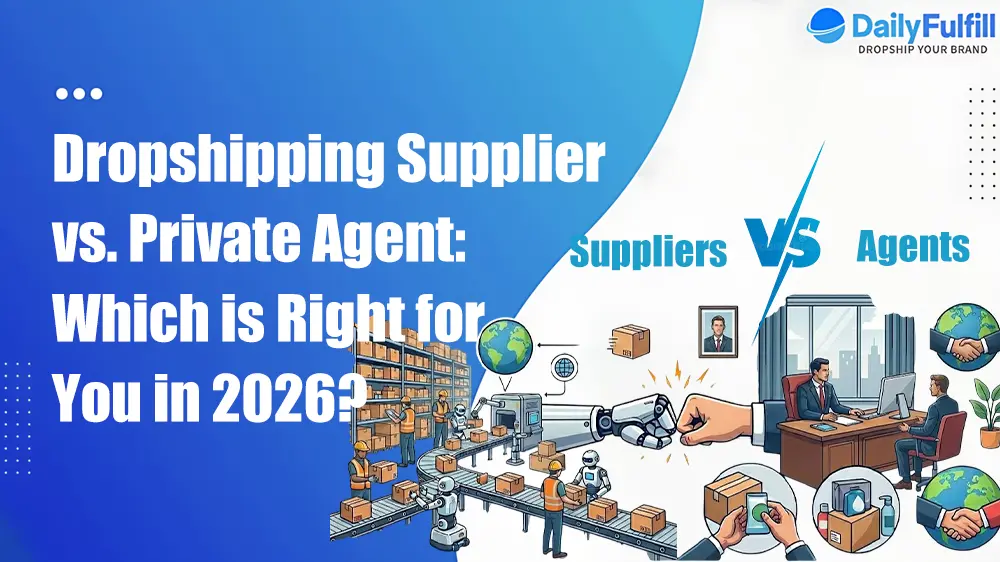
Dropshipping Supplier vs. Private Agent: Which Is Right For You In 2026?
Dropshipping Supplier vs. Private Agent: What is the difference? Discover which partner offers faster shipping, lower prices, and custom branding for your business in
VAT is the single biggest operational risk in German dropshipping — not because the rules are unclear, but because most sellers don’t realize how much of the compliance burden depends on their supplier rather than themselves. A €20 product shipped from China without IOSS handling generates a frustrated German customer who pays €4 in VAT plus a courier handling fee at the door, leaves a 1-star review, and tells three friends. The product was fine. The supplier set you up to fail.
This guide covers every VAT and tax compliance requirement that applies to dropshipping in Germany in 2026: standard VAT rates, IOSS for imports under €150, OSS for cross-border EU sales, when you need to register, and how the recent changes to VAT thresholds affect new sellers. More importantly, it covers the part most VAT guides skip — how your supplier’s setup determines whether your customer experience works or breaks at the customs counter.
If you’re evaluating suppliers, the questions in this guide are the ones you should be asking them before signing on. If you’re already running a German dropshipping store and customers are complaining about surprise charges, this is where the problem usually lives.
If you’re operating on assumptions about German VAT formed before 2021, those assumptions are wrong. Three rule changes have reshaped the compliance landscape, and most operational problems we see in German dropshipping trace back to one of them.
The €22 import VAT exemption no longer exists. Until July 2021, products imported into Germany worth €22 or less were exempt from VAT — which is why low-cost dropshipping from China used to work without paperwork. That exemption was eliminated EU-wide. Today, every product entering Germany is subject to VAT regardless of price. A €5 phone case, a €15 t-shirt, a €1 sticker — all of them now require VAT to be collected somewhere along the chain. If your supplier doesn’t handle it, your customer does, at the door.
IOSS handles imports under €150, but only if your supplier supports it. The Import One-Stop Shop (IOSS) is the EU’s system for collecting VAT at checkout instead of at customs, but it only applies to imports valued at €150 or less. For orders within this range, IOSS is the difference between a clean delivery and an angry customer. For orders above €150, IOSS doesn’t apply at all — those shipments are subject to import VAT and potentially customs duties at the border, paid by the recipient.
OSS handles intra-EU sales above €10,000 annually. If you ship from a German warehouse to customers in France, Italy, Spain, or any other EU country, the One-Stop Shop (OSS) lets you report all cross-border B2C sales through a single quarterly return in Germany. This becomes mandatory once your annual cross-border EU sales exceed €10,000. Below that threshold, you can still charge German VAT to customers in other EU countries, but most sellers register for OSS proactively because the alternative — registering for VAT in every EU country you sell to — is operationally impossible.
Germany applies two VAT rates to consumer products: 19% standard rate and 7% reduced rate. The 19% rate is what most dropshipping products fall under — clothing, electronics, accessories, home goods, beauty, pet supplies, and the broad majority of physical retail items.
The 7% reduced rate applies to a specific list of categories defined in §12 of the German VAT Act (Umsatzsteuergesetz). For dropshipping purposes, the most relevant ones are: printed books and e-books, magazines and newspapers, most food and beverage items, plants and seeds, certain medical products, and items for the disabled. If your store is in any of these niches, charging the wrong rate is one of the most common compliance errors — and it directly affects your margin calculations.
Display VAT-inclusive prices to consumers. German law requires B2C prices to be shown inclusive of VAT (Bruttopreis), not as an additional charge at checkout. Shopify, WooCommerce, and other major platforms handle this automatically once configured, but the configuration is your responsibility — getting it wrong creates legal exposure under the Preisangabenverordnung (Price Indication Ordinance).
Verify your product category before launch. If you’re not 100% certain whether a product falls under 19% or 7%, check the official BMF (Bundesministerium der Finanzen) classification or consult a Steuerberater. The cost of getting this wrong shows up either as compressed margins (you charge 19% and remit 19% on a 7% product) or as tax authority penalties (you charge 7% on a 19% product).
VAT registration in Germany is triggered by four different scenarios, each with different thresholds. Most dropshippers we see encounter at least two of them within their first year.
Domestic sales above €25,000 annually. If you operate as a German-based business and your annual revenue exceeds €25,000 (raised from €22,000 in 2025), you must register for VAT and apply 19% (or 7%) to all domestic sales. Below this threshold, you can opt for Kleinunternehmerregelung — the small business exemption — but most dropshippers cross €25,000 quickly and find the exemption isn’t worth the operational complexity it creates with cross-border sales.
Cross-border EU sales above €10,000 annually. Once your B2C sales to other EU countries (France, Netherlands, Belgium, Italy, etc.) exceed €10,000 in a calendar year, you must register for OSS or for VAT in each destination country. OSS is the practical choice; we cover it in the next section.
Storing inventory in any EU country, including Germany. This is the registration trigger most dropshippers don’t see coming. The moment your supplier stores your inventory in a German warehouse, you are legally required to register for German VAT — regardless of your sales volume, regardless of your business location. The same applies if your inventory is stored in any other EU country (a Czech warehouse, a Polish warehouse, a Dutch warehouse). Each storage country can require its own VAT registration.
Non-EU sellers shipping to Germany. If your business is registered outside the EU (US, UK, China, Hong Kong) and you sell directly to German consumers, you typically need an IOSS registration through an EU-based intermediary or fiscal representative — not a German VAT registration in most cases, but the compliance overhead is real.
The Import One-Stop Shop (IOSS) is the EU’s mechanism for collecting VAT on low-value imports at the point of sale, rather than at the customs border. For dropshippers shipping from China to Germany, IOSS is the difference between a smooth delivery and an angry customer paying surprise charges at their door.
When you have an active IOSS number and apply it correctly, three things happen:
VAT is collected at checkout based on the customer’s country (19% for Germany, 21% for Netherlands, etc.) — your store handles this automatically once configured
The IOSS number travels with the shipment through your supplier and the courier, signaling to customs that VAT is already paid
The package clears customs without delay or additional charges to the recipient
You then file a single monthly IOSS return through your home country’s tax authority, reporting all EU sales and remitting the collected VAT.
IOSS only applies to consignments valued at €150 or less. For orders above this threshold, IOSS cannot be used — those shipments are subject to standard import VAT and potentially customs duties at the border, paid by the recipient. If you sell products in this price range, you have three practical options: ship via DDP (Delivered Duty Paid) where the supplier handles customs, split orders into multiple sub-€150 packages where appropriate, or accept that the customer will face a customs invoice and prepare them clearly at checkout.
As an EU-based seller: Register directly with the tax authority in your home EU country. The process is straightforward and free; you receive an IOSS identification number that you provide to your suppliers and shipping partners.
As a non-EU seller (US, UK, China, Hong Kong): You must register through an EU-based intermediary or fiscal representative who handles IOSS reporting on your behalf. This typically costs €50-200 per month depending on the provider and order volume. Your supplier or fulfillment partner sometimes provides this service as part of their offering — worth asking explicitly during supplier evaluation.
Everything above covers VAT. But from 1 July 2026, a separate charge enters the picture that most VAT guides — and most suppliers — haven’t accounted for yet, and it changes the math on every low-value parcel you ship from China to Germany.
Until now, goods imported into the EU with a value of €150 or less were exempt from customs duty (VAT still applied, but duty didn’t). That exemption — the EU’s “de minimis” for customs duty — is being removed. From 1 July 2026, a flat €3 customs duty applies to low-value parcels (€150 or less) imported from outside the EU. It was formally agreed by the EU Council in February 2026 as an interim measure, ahead of the broader EU customs reform expected around 2028.
A few specifics that matter for how it hits you:
The single most important thing to understand is that the €3 charge is a customs duty, and it is completely separate from VAT. Your IOSS number tells customs that VAT has already been collected at checkout. It says nothing about this new duty. So even if your IOSS setup is flawless and your VAT is handled perfectly, the €3 duty still applies to your low-value imports.
This is a genuine shift. For years, “get IOSS right and your sub-€150 parcels clear cleanly” was true. From July 2026 it isn’t — IOSS keeps the VAT off your customer’s door, but the €3 duty (and later the €2 fee) is a new, separate cost on the parcel that IOSS compliance does not remove. Conflating the two is about to become the most common new mistake in German dropshipping.
In short: IOSS solves VAT. It does not solve the €3 duty. These are two different charges, with two different mechanisms, and from July 2026 a compliant low-value import carries both.
This lands almost entirely on direct China-to-Germany dropshipping, because that’s exactly the flow the rule targets — low-value parcels sent straight from a non-EU seller to an EU consumer. Three practical consequences:
This is the same global shift that removed the US de minimis exemption in 2025, now arriving in the EU. The era of cheap, duty-free, per-parcel imports from China is closing — and the stores that adjust their pricing and fulfillment model before July 2026 will be the ones it doesn’t catch off guard.
If IOSS handles imports from outside the EU, the One-Stop Shop (OSS) handles sales within the EU. The two systems solve different problems and apply to different shipment paths — confusing them is one of the most common compliance mistakes we see.
OSS becomes relevant when you ship from a warehouse inside the EU (German, Czech, Polish, Dutch, etc.) to consumers in other EU countries. Without OSS, you’d theoretically need to register for VAT in every destination country once your sales there exceed local thresholds — operationally impossible for any seller working across multiple EU markets. OSS lets you report all cross-border B2C sales through a single quarterly return filed in one EU country (typically the country where your business is registered), and the tax authorities forward the appropriate VAT to each destination country automatically.
A practical example: you operate from a German warehouse and sell €15,000 worth of products to French customers, €8,000 to Italian customers, and €5,000 to Dutch customers in a year. Without OSS, you’d need three separate VAT registrations. With OSS, you charge the correct local VAT at checkout (20% France, 22% Italy, 21% Netherlands), file one quarterly return in Germany, and Germany distributes the VAT to each country.
The €10,000 threshold matters less than you think. Once your combined cross-border B2C sales to all other EU countries exceed €10,000 in a calendar year, OSS registration becomes mandatory. For any serious German dropshipping operation expanding into neighboring markets, this threshold is reached within the first few months — most sellers register for OSS proactively before they need it, because retroactive compliance costs more than the registration itself.
Most VAT guides treat compliance as something the seller handles alone — register for OSS, configure IOSS, charge correct rates at checkout. That’s only half the picture. The other half is your supplier’s setup, which determines whether the rules you’ve configured at checkout actually translate into a clean delivery experience for your customer. Three common scenarios illustrate why supplier choice is itself a compliance decision.
Scenario 1: Direct Shipping from China without IOSS (Worst Case). Your supplier ships orders directly from China to your German customers, with no IOSS arrangement on either side. You charge VAT at checkout (because Shopify is configured correctly), but the IOSS number doesn’t accompany the shipment. The package arrives at German customs, the courier collects import VAT plus a handling fee from your customer at the door, and your customer effectively pays VAT twice — once at checkout to you, once at the door to the courier. You end up issuing refunds, collecting 1-star reviews, and explaining to confused customers what happened. This is the most common compliance failure we see, and it has nothing to do with your store setup. It’s entirely a supplier problem.
Scenario 2: Supplier-Managed IOSS Clearance. Your supplier accepts your IOSS number, applies it correctly to outgoing shipments, and provides documentation showing VAT was paid at checkout. The package clears German customs without recipient charges, and the customer receives exactly what they paid for. This requires your supplier to have operational infrastructure for IOSS — staff who know what an IOSS number is, shipping software that can attach it to consignments, and accountability when something goes wrong. Most marketplace platforms can technically support this, but execution quality varies dramatically. Dedicated agent services with mature European clientele typically execute it cleanly because they handle it daily.
Scenario 3: EU Warehouse Fulfillment. Your supplier pre-stocks inventory in an EU warehouse (Germany, Netherlands, Czech Republic, etc.) and ships from there to your German customers. IOSS becomes irrelevant — these are domestic or intra-EU shipments, not imports. The trade-off is that you (or your supplier on your behalf) become liable for VAT registration in the warehouse country the moment inventory is stored there. For high-volume sellers, this trade-off favors EU warehousing because the speed and customer experience benefits outweigh the registration overhead.
Before committing to a supplier for the German market, get clear answers to five questions:
Do you accept and apply customer-side IOSS numbers on outgoing shipments? A “yes” with operational specifics; vague answers mean no.
For orders above €150, do you offer DDP (Delivered Duty Paid) shipping? This determines whether your customer faces customs charges on higher-value orders.
If you operate EU warehouses, who is the registered importer of record? This affects which entity carries VAT registration obligations.
What documentation do you provide proving VAT was collected and remitted correctly? Required if German tax authorities audit you.
What happens if a shipment fails customs clearance — who handles the recovery? Tests whether they treat compliance as their responsibility or yours.
If a supplier can’t answer these clearly, you’ve already learned something important — they’re not built for serious German market operations.
The EU General Product Safety Regulation (GPSR) took full effect on December 13, 2024, and it changed the legal status of dropshippers significantly. Under GPSR, dropshippers are now classified as “distributors” — meaning you carry direct legal responsibility for the safety of products you sell to German consumers, even though you never physically handle them.
In practical terms, GPSR requires you to:
Verify product safety documentation before listing — CE markings where applicable, technical documentation, and conformity declarations.
Provide an EU-based contact for product recalls and safety inquiries (an Impressum contact alone may not be sufficient).
Maintain traceability to the manufacturer for any product, so authorities can track issues back to source.
This makes your supplier’s documentation capability a compliance issue, not just a quality issue. Suppliers who can’t provide CE certification, factory traceability, or EU-compliant return addresses are now a legal liability — not just an inconvenience. For German market operations, ask any supplier explicitly how they support GPSR documentation requirements before signing on.
Most VAT compliance failures come from a small number of recurring errors. Here are the five we see most often:
Assuming low-value orders are exempt. The €22 import VAT exemption was eliminated in July 2021. Every product entering Germany is now subject to VAT regardless of price. Sellers operating on outdated assumptions face surprise customer charges and review damage on every shipment.
Configuring Shopify to charge VAT but not registering for IOSS. Charging VAT at checkout doesn’t automatically mean it’s reported to authorities — without IOSS registration and a working IOSS number on shipments, you’ve collected tax without legal authorization to remit it, and customs still charges your customer at the door.
Skipping OSS registration after expanding to other EU markets. The €10,000 cross-border threshold is reached quickly once you sell beyond Germany. Selling to French or Italian customers without OSS or local VAT registration creates retroactive liabilities that compound monthly.
Storing inventory in an EU country without registering there. The moment your supplier stores your inventory in a German, Czech, or Polish warehouse, you owe VAT registration in that country — regardless of sales volume. This is the most-missed registration trigger.
Treating GPSR as paperwork, not compliance. Since December 2024, dropshippers are legal distributors. Selling products without verifiable safety documentation or an EU-based recall contact creates liability beyond VAT — into product safety law territory.
DailyFulfill is built specifically for sellers who treat European compliance as a structural requirement, not an afterthought. Our team operates with the documentation and process discipline that German market operations demand.
For orders under €150: We accept and apply seller-side IOSS numbers on outgoing shipments, with the IOSS identifier traveling with the consignment through to German customs clearance.
For orders above €150: We offer DDP shipping arrangements through our logistics partners, eliminating customer-side customs charges on higher-value items.
EU warehouse capabilities: Sellers using our EU warehouse capabilities receive guidance on the registration responsibilities that storage triggers, along with documentation showing storage location and inventory custody — required if German tax authorities audit your registrations.
Product compliance: We provide CE certification documentation, factory traceability records, and manufacturer information for products we source. This addresses the GPSR distributor requirements that took effect in December 2024.
We don’t pretend supplier-side compliance handling makes sellers fully compliant — your IOSS registration, OSS configuration, and Shopify VAT setup remain your responsibility. But the operational layer — the part that breaks at customs when suppliers cut corners — we handle with the seriousness it requires.
To evaluate fit, get a free quote from our team and ask the questions above. The answers will tell you whether we’re the right partner for your German operations.
VAT compliance in German dropshipping isn’t a single problem you solve once — it’s a structural alignment between your store configuration, your supplier’s operational capability, and the legal framework you both operate within. Most failures we see come from the second half of that equation, not the first.
If you’re evaluating whether your current setup actually clears German customs cleanly — or building a new operation and want to start with the right foundation — we can walk you through how DailyFulfill handles the supplier-side compliance layer for European sellers.
Get a free fulfillment and compliance review →
We work with sellers processing 5+ orders per day. The conversation will tell you whether we’re the right fit, and what your operational risks look like either way.
Not in most cases — but you typically need IOSS registration through an EU-based intermediary or fiscal representative if you’re shipping directly to German consumers. German VAT registration becomes mandatory only if you store inventory inside Germany. Non-EU sellers (US, UK, China, Hong Kong) shipping from outside the EU can usually operate with IOSS alone for orders under €150 and customs-cleared shipping for orders above €150. The compliance overhead is real, but it’s manageable with the right intermediary partner.
No. IOSS registration is tied to your business entity, not your supplier — it’s a tax registration that authorizes you to collect EU VAT on imports, and only your business can hold it. What suppliers can do is apply your IOSS number to outgoing shipments and provide documentation supporting your monthly IOSS returns. Some suppliers also partner with fiscal representatives who can handle the registration process on your behalf, but the registration itself remains in your business name.
You’ll need to refund the customer the customs-collected amount and update your supplier process to prevent recurrence. Double-charging happens when your store collects VAT at checkout but the IOSS number doesn’t accompany the shipment to customs — German customs then collects VAT again at delivery. The fix is operational, not regulatory: confirm with your supplier that IOSS numbers are correctly attached to shipments. Trustpilot reviews from this issue tend to be brutal, so address it quickly.
Yes, if the sample is shipped to an EU consumer it’s subject to VAT regardless of price or commercial intent. There’s no “test order” or “sample” exemption under current EU rules — the €22 exemption that previously covered low-value items was eliminated in 2021. If you’re sending samples to influencers or for product testing, treat them as standard B2C transactions for VAT purposes. The only exception is genuine B2B samples shipped to verified business recipients with valid VAT numbers.
You charge each customer’s local VAT rate at checkout (19% Germany, 21% Netherlands and Belgium, 20% France, 22% Italy) and report all cross-border B2C sales through OSS quarterly returns filed in your home country. Modern e-commerce platforms (Shopify, WooCommerce) handle the rate calculation automatically once configured. The operational complexity isn’t in the rates — it’s in ensuring your supplier can fulfill orders to multiple EU countries with correct VAT treatment for each destination.
IOSS handles imports into the EU from outside (China to Germany, US to France, etc.) for orders under €150. OSS handles intra-EU sales between EU countries (German warehouse shipping to French customers, etc.) regardless of value. They’re separate systems with separate registrations, separate returns, and separate rules. Most German dropshippers eventually need both — IOSS for direct China shipments, OSS for cross-border EU fulfillment from European warehouses.
Learn dropshipping tips, sourcing strategies and fulfillment insights from DailyFulfill
Dropshipping Supplier vs. Private Agent: What is the difference? Discover which partner offers faster shipping, lower prices, and custom branding for your business in
Hitting 300+ orders a day on CJDropshipping? See when a private dropshipping agent saves more money, ships faster, and gives you real control in 2026.
CJ Dropshipping claims 7–15 day shipping to the US and EU. Real seller data tells a different story. See actual delivery times, delays, and faster options.