
 English
 Français
 Deutsch
 Nederlands
 Polski
 Español
Best Dropshipping Suppliers in Germany 2026: Top 8 Compared
Compare 8 dropshipping suppliers for the German market — pricing, EU warehouse coverage, IOSS handling, and seller-stage fit. Honest review by a fulfillment operator.
Best for: First-test sellers at 0–5 orders/day exploring product-market fit with low commitment.
CJ Dropshipping is the default starting point for most new dropshippers. The catalog runs 400,000+ products, there’s no subscription fee, and the platform integrates with Shopify, WooCommerce, and most major store builders.
Pricing transparency. Pay-per-order, no monthly fee. Each product carries a CJ markup over factory cost — the price of a managed platform, not the cheapest sourcing.
Shipping to NL. CJ’s main EU warehouse is in Frankfurt. Products stocked there typically reach NL in 3–7 days. The catch: only a fraction of CJ’s catalog is pre-stocked in Frankfurt — most products ship from China in 10–20+ days, despite CJ’s marketing claim of 7–15. Always verify “DE Warehouse” stock before listing. From July 2026, CJ will also need to handle the new €3 EU customs duty per item; their current published policy doesn’t clarify whether duty is absorbed or passed through — worth confirming before scaling.
VAT and IOSS. CJ supports IOSS-compliant shipping for EU consignments under €150, which simplifies VAT handling for new sellers without their own IOSS registration.
Integrations. Native Shopify and WooCommerce. No direct Bol.com integration, which limits sellers planning to scale on the dominant Dutch marketplace.
Cons to know. Quality varies by sub-supplier. Support response times stretch during Q4 and Chinese New Year. Past 5 orders/day, the lack of dedicated agent attention starts to bite — CJ is built for breadth, not depth.
Verdict. Use CJ to test products and validate winners. Plan to migrate once volume forces you into faster shipping, tighter QC, and account-level service.
Best for: Growth-stage sellers at 5+ orders/day who’ve outgrown platform marketplaces and need transparent, line-item fulfillment with EU-routed shipping.
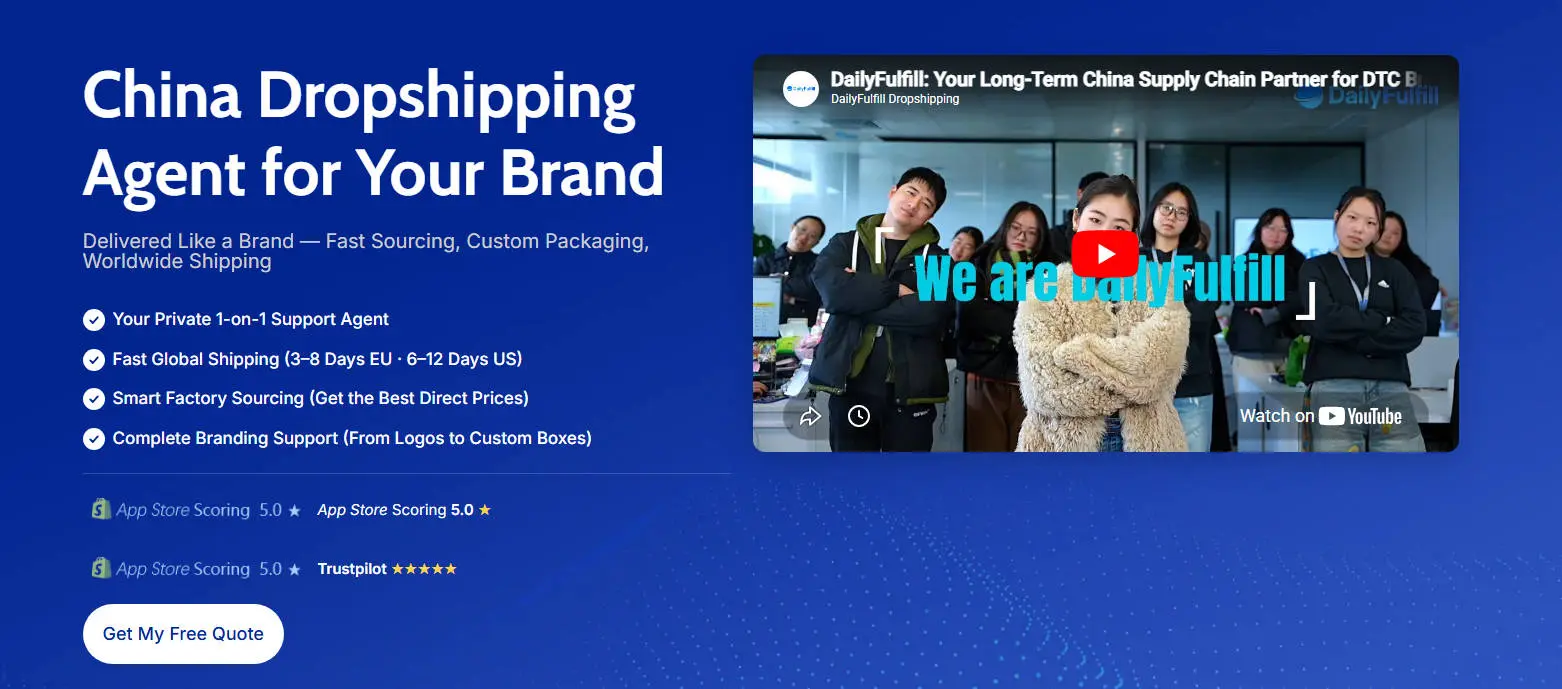
DailyFulfill is a fulfillment agent based in Yiwu and Guangzhou, working with 6,000+ active sellers across 50 countries. Unlike platform marketplaces, DailyFulfill assigns a dedicated agent to each account and quotes every order line by line — product cost, pick-and-pack, and shipping by lane — rather than bundling margin into a flat per-order rate.
Pricing transparency. Quotes break out product cost, pick-and-pack, and shipping by destination lane, so you see exactly where each cent goes. This matters most when you scale: at 50+ orders/day, hidden markup compounds into thousands of euros per month that line-item quoting eliminates.
Shipping to NL. DailyFulfill ships from Yiwu and Guangzhou warehouses through lanes optimized for EU entry, including Rotterdam-cleared routes when consolidation supports it. Typical China-to-NL transit runs 6–12 business days for standard lanes, with DDP shipping available for orders above €150 (covering VAT and, from July 2026, the new €3 EU customs duty). Storage in the China warehouses is free for active clients.
VAT and IOSS. IOSS handling is provided for EU consignments under €150. For higher-value shipments, DDP shipping settles VAT and duties before delivery, so your customer never sees a surprise bill at the door — directly addressing the most common cause of NL refusal-on-delivery.
Integrations. Native integration with Shopify and WooCommerce. Bol.com integration is not native; orders can be coordinated manually with your agent if Bol.com is part of your channel mix.
Cons to know. The 5+ orders/day threshold is a real filter — if you’re still validating your first product, one of the platforms in this article will serve you better. Sourcing happens through requests to your agent rather than browsing a catalog, which trades discovery speed for sourcing precision. Service is in English and Chinese; Dutch isn’t a default support language.
Verdict. Move to DailyFulfill once consistent volume makes platform markup and slow agent response your bottleneck. If you’re earlier than that, stay on CJ or AutoDS until the math forces the change.
Best for: Sellers prioritizing 2–5 day EU/US shipping and brand-quality presentation over China sourcing depth.
Spocket is a curated supplier directory connecting stores to vetted suppliers, roughly 80% of which are based in the US or EU. You pay a monthly subscription, browse the catalog, and orders route to local suppliers who ship in days rather than weeks.
Pricing transparency. Tiers run from $39.99/month (Starter, capped at 25 products) up to $99.99/month (Empire), with annual billing roughly halving the cost. Product cost and shipping are paid per order on top.
Shipping to NL. EU-based suppliers typically deliver to NL addresses in 2–5 business days via local couriers — meaningfully faster than any China-direct option. Catalog tilts toward fashion, home goods, and beauty.
VAT and IOSS. EU-resident suppliers handle VAT under their own registrations, simplifying compliance. No customs friction for intra-EU shipments — and the new €3 EU customs duty doesn’t apply, since stock is already inside the EU.
Integrations. Shopify, WooCommerce, Wix, BigCommerce, Squarespace. No native Bol.com integration.
Cons to know. Catalog is shallower than China-based platforms, especially for trending products. Product costs are higher (you’re paying for EU manufacturing). The Starter plan’s 25-product cap effectively forces upgrade to Pro for any real operation.
Verdict. Strong fit for brand-quality stores in evergreen niches. Skip if your strategy depends on testing trending winners weekly — the catalog won’t keep pace.
Best for: Mid-volume sellers comfortable with automation tooling who want EU/US/UK supplier coverage with deeper catalog than Spocket.
AppScenic is a more automation-heavy alternative to Spocket, with 1M+ products from vetted suppliers in the US, UK, EU, and Canada. The platform leans on AI for product listings, SEO copy, and image optimization — useful at scale, overkill at 5 orders/day.
Pricing transparency. Tiered subscription plans (free signup, Elite tier reported around $99/month). Specific tier features change frequently — verify on the pricing page before committing. Product cost and shipping paid per order on top.
Shipping to NL. Suppliers ship via DHL, FedEx, UPS, DPD, and GLS. Delivery to NL typically runs 2–5 business days for EU-stocked products. Catalog spans more categories than Spocket but skews toward gadgets, accessories, and home goods.
VAT and IOSS. EU suppliers handle VAT under their own registrations for intra-EU orders. Reviews flag inconsistent invoice configurator behavior with EU VAT IDs — verify your invoicing setup before scaling.
Integrations. Shopify, WooCommerce, Wix, Ecwid, Walmart, eBay. No native Bol.com integration.
Cons to know. Steeper learning curve than Spocket — the AI tooling is powerful but takes setup time. Mixed reviews on AI-generated listing quality (output depends heavily on supplier source data). Free tier is essentially a demo, not a usable plan.
Verdict. Worth considering if you’re running multiple stores or selling at volume where automation pays back the configuration time. For single-store operators just starting, Spocket’s simpler workflow may be a better entry point.
Best for: Sellers building luxury fashion stores who need authentic designer inventory and won’t compete on price.
BrandsGateway is a niche supplier focused entirely on authentic luxury fashion — 800+ designer brands including Armani, Versace, Dolce & Gabbana, Gucci, Prada, and Balenciaga, with 50,000 products in EU warehouses (Italy, Germany, Spain, Sweden). Reseller spots are capped at 300 globally to limit saturation.
Pricing transparency. Subscription required: roughly €295/month monthly or €141/month billed annually. Product cost paid per order on top; margins are built for high-ticket sales, not volume.
Shipping to NL. EU-stocked products ship via DHL and FedEx in 1–3 business days. Authenticity guaranteed with original tags — important for luxury, where customer trust is the value proposition.
VAT and IOSS. Intra-EU shipments avoid customs entirely. DDP available for non-EU destinations. Straightforward compliance for NL-based stores, and the new €3 EU customs duty doesn’t apply.
Integrations. Shopify, WooCommerce, Wix, Shift4Shop, BigCommerce. API and CSV options for custom stores. No native Amazon/eBay/Bol.com integration, though products can be cross-listed via marketplace plugins.
Cons to know. Highest subscription cost in this comparison. Niche is narrow — if you’re not building a luxury fashion store, BrandsGateway is irrelevant. Catalog is constrained by brand licensing, so you can’t add arbitrary SKUs.
Verdict. The right choice for serious luxury fashion operators in NL targeting affluent buyers. For everyone else, this card is informational — keep reading.
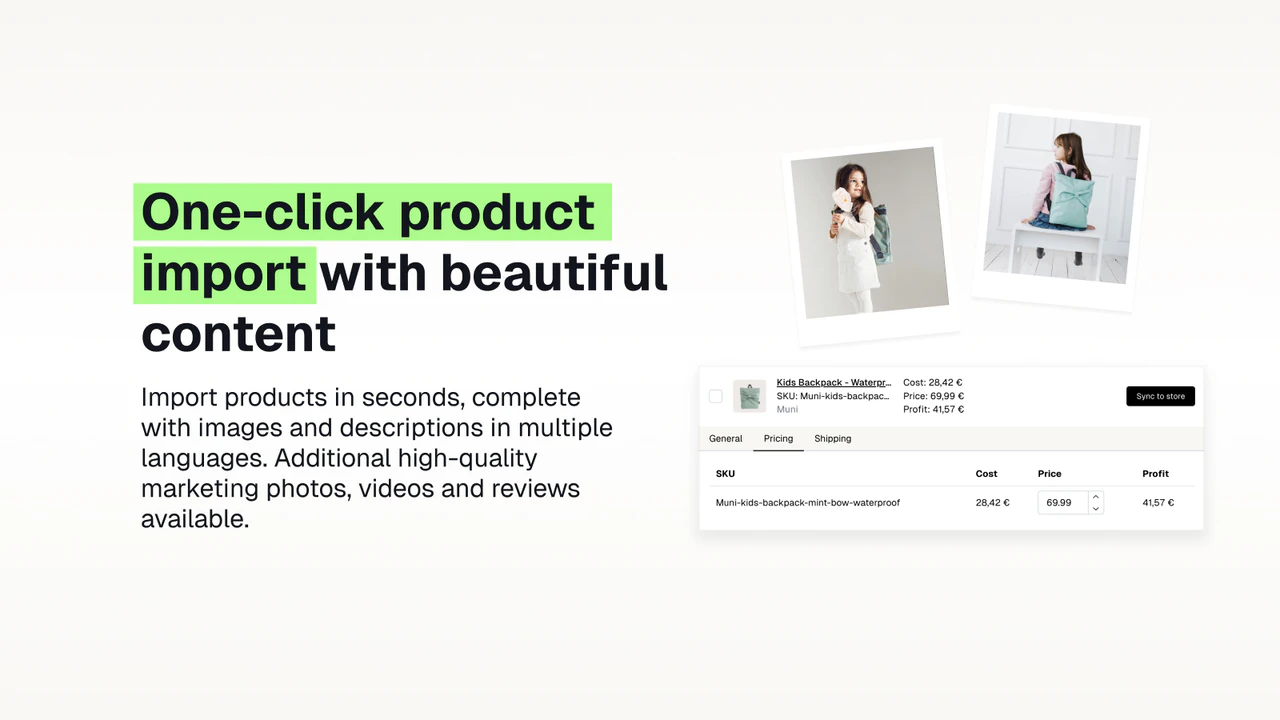
Best for: Sellers building sustainable or “made-in-Europe” lifestyle stores who want curated brands rather than commodity products.
Hertwill is a curated marketplace of exclusive European brands, with ~95% of products manufactured in Europe (Estonia, Latvia, Portugal, and others). All items ship from EU warehouses and come with a 2-year warranty — a meaningful trust signal for sustainability-focused stores. Categories cover clothing, kids’ toys, beauty, jewelry, and home goods.
Pricing transparency. Free plan available (10-product cap), with paid tiers up to ~$40/month for higher product limits and lower wholesale prices. Brands set their own wholesale pricing on the platform.
Shipping to NL. Products ship from EU warehouses (often Northern Europe) with delivery in 2–8 business days. Per-item shipping fees vary by brand and can be substantial — better suited to mid-to-high-ticket items.
VAT and IOSS. Intra-EU shipments avoid customs. Brands handle VAT under their own EU registrations. The new €3 EU customs duty doesn’t apply to EU-stocked goods.
Integrations. Shopify, WooCommerce. No native marketplace integrations.
Cons to know. Catalog is genuinely small compared to platform marketplaces — counted in dozens of brands, not thousands. Wholesale pricing varies by brand and isn’t always competitive against the brand’s own retail. Recent reviews flag occasional stock-sync issues and support delays during peak season.
Verdict. Strong fit for NL stores building a curated, story-driven sustainability or EU-made positioning. Skip if you’re optimizing for catalog breadth or competing on price.

Best for: Brand-builders selling custom-designed apparel, accessories, or wall art under their own label.
Printful is the established print-on-demand player for European sellers, with in-house production in Spain, Latvia, and the UK. The model is fundamentally different from every other supplier here: you upload designs, and Printful produces and ships each item one-off after a customer orders. No inventory, no SKU management.
Pricing transparency. No monthly subscription. You pay base product cost plus shipping per order. Margins are inherently tighter than commodity dropshipping — competitive on premium positioning, brutal on price-driven sales.
Shipping to NL. EU-fulfilled orders typically reach Dutch addresses in 5–10 business days end-to-end (2–5 days production + 2–5 days shipping). Faster than China-direct, slower than EU-stocked options.
VAT and IOSS. EU-fulfilled orders avoid customs entirely. VAT applies under the standard Dutch rate, and EU OSS handles cross-border reporting if you’re scaling to BE/DE/FR.
Integrations. 22+ platforms including Shopify, WooCommerce, Etsy, eBay, Amazon, and Wix — the broadest integration coverage in this comparison.
Cons to know. Production lead time adds 2–5 days to every order. Multi-product orders may split-ship from different facilities, raising costs. Note: Printful is sunsetting bulk warehousing at EU/UK facilities from March 2026 — POD continues unchanged, but the pre-stocked inventory option is ending.
Verdict. Strong fit for design-driven brand stores in NL. Skip if you’re selling commodity products or competing on price.
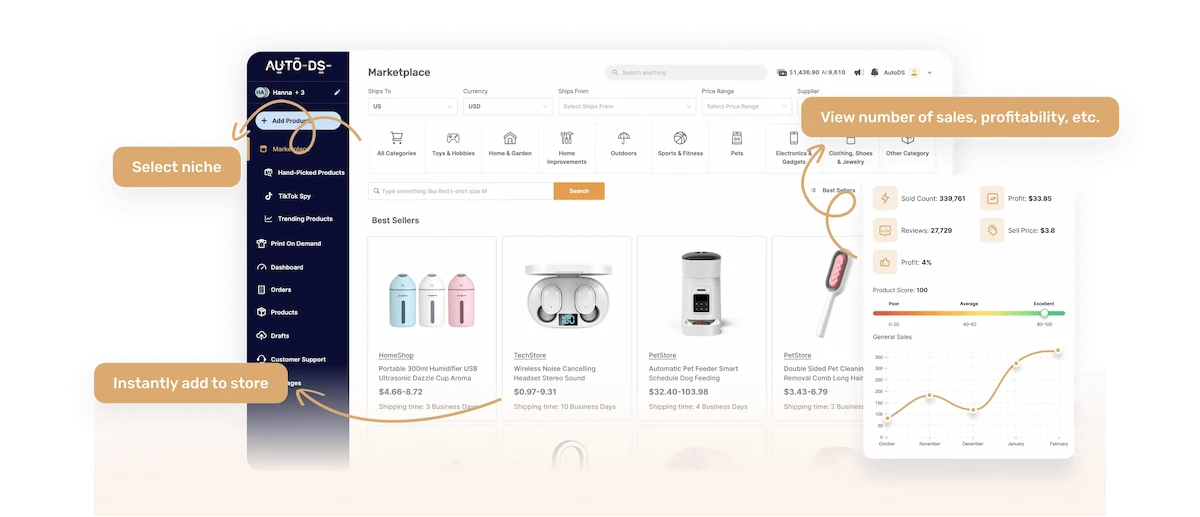
Best for: Multi-channel sellers running stores across Shopify, eBay, and Facebook Marketplace who want supplier aggregation and automation in one tool.
AutoDS is an automation layer rather than a single supplier — it aggregates products from 25+ marketplaces (AliExpress, Amazon, Walmart, CJ, Costco) and adds its own private warehouse network in the US and EU. The platform’s core value is back-end automation: price monitoring, stock syncing, order fulfillment, and product research.
Pricing transparency. Subscription tiers run roughly $19.90–$29.90/month (Starter, basic automation) up to $49.90–$66.90/month (Advanced, full automation and marketplace access). Annual billing saves 20–25%. Pricing scales by product volume.
Shipping to NL. Variable, depending on the underlying supplier. AutoDS-warehoused products ship to NL in 4–8 business days. AliExpress-fallback products fall back to 10–25 days. Filter product imports by source.
VAT and IOSS. Inherits from the underlying supplier. AutoDS-warehoused products are easier to handle compliantly; AliExpress-sourced orders depend on the individual seller’s IOSS handling. The new €3 EU duty applies on AliExpress-sourced shipments under €150 from July 2026.
Integrations. Shopify, WooCommerce, Wix, eBay, Amazon, Facebook Marketplace, TikTok Shop. Strongest cross-marketplace coverage among aggregator platforms.
Cons to know. Subscription cost compounds with platform fees. User reviews flag billing surprises (annual charges, cancellation friction) — read terms carefully. Stock-sync accuracy can lag when underlying suppliers update pricing or inventory unpredictably.
Verdict. Best fit for sellers already running multi-channel storefronts who can amortize the subscription across volume. Single-channel beginners get more direct value from CJ.
Compare 8 dropshipping suppliers for the German market — pricing, EU warehouse coverage, IOSS handling, and seller-stage fit. Honest review by a fulfillment operator.
Your complete overview of dropshipping in Germany in 2026 — market, legal and VAT basics, top niches, suppliers, shipping, and what German buyers expect.
A practical 8-step guide to starting a dropshipping business in Germany — from Gewerbeanmeldung and VAT setup to choosing the right supplier for your stage.