
 English
 Français
 Deutsch
 Nederlands
 Polski
 Español
Is Branded Dropshipping Better Than Traditional Dropshipping? (2026)
Branded vs traditional dropshipping, compared on real numbers: per-order margins, the 2026 tariff, repeat-purchase economics, and exactly when to switch.
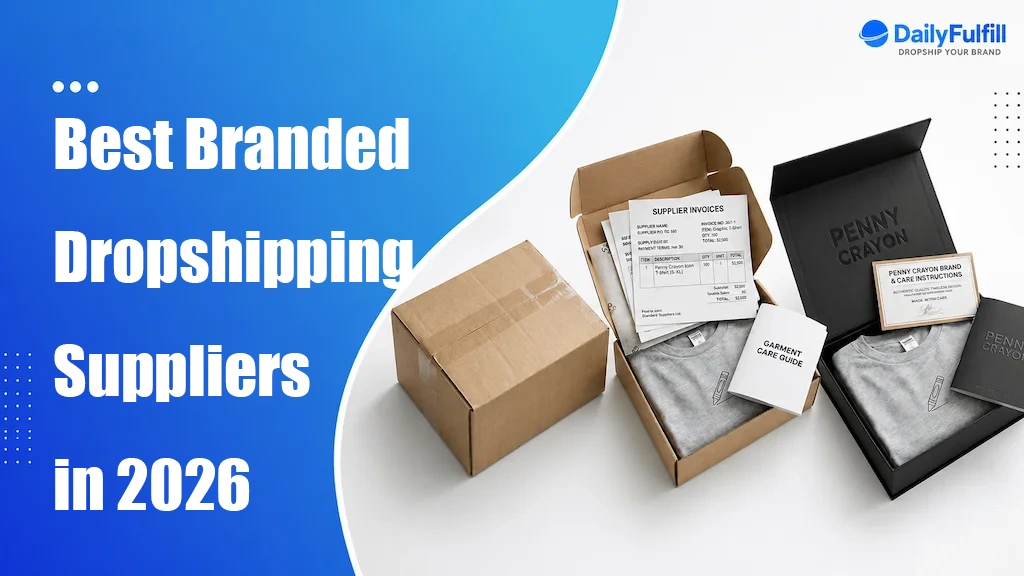
Choosing a branded dropshipping supplier sounds simple—until you ask one basic question:
For one supplier, it may mean adding your logo to an invoice or including a thank-you note. For another, it may include packaging inserts, custom neck labels, or printed products. A full-service partner may also help with custom packaging, private labeling, quality checks, inventory storage, and order fulfillment.
These are very different levels of service. For example, Spocket focuses on branded invoices, while Printify offers selected features such as inserts and neck labels. Zendrop separates basic branding from custom packaging and private labeling, which may require access to its higher-volume Private Agent Program.
That is why there is no single supplier that is best for every store.
A new seller testing an unproven product may need low commitment and fast setup. A print-on-demand brand may care more about design tools and product labels. A store with a proven bestseller may need private labeling, custom packaging, quality control, and reliable inventory management.
In this guide, we compare eight branded dropshipping suppliers based on what they actually offer—not simply how many features appear on their sales pages.
We will look at:
One disclosure before we begin: this comparison is published by DailyFulfill, and we include our own service. We will explain where DailyFulfill is a strong fit, where it is not, and when another supplier may be the better choice.
Let’s start with the quick comparison.
There is no single best supplier for every branded dropshipping store.
The right choice depends on three things:
The table below compares eight popular options. We do not treat a branded invoice, custom packaging, private labeling, and custom manufacturing as the same service.
There is no single best supplier for every branded dropshipping store. The right option depends on your product, your current order volume, and how deeply you want to customize your brand.
| Supplier | Supplier Type | Best For | Branding Depth | MOQ or Eligibility | Quality Control | Fulfillment | Main Limitation |
|---|---|---|---|---|---|---|---|
| DailyFulfill Official information | Sourcing and fulfillment partner | Sellers with a proven product who want sourcing, branding, storage, and fulfillment in one place. | Cards Stickers Custom bags Custom boxes Private label Product customization | Packaging can start from about 100 pieces for some items. Private-label MOQ depends on the product and factory. | Products can be inspected after arriving at the warehouse, based on the agreed QC requirements. | Product sourcing, inventory storage, store integration, and international order fulfillment. | Not built for sellers who want to import hundreds of public catalog products with one click. |
| CJdropshipping Official information | Large sourcing and fulfillment platform | Sellers who want a large product catalog, platform automation, and optional branded packaging. | POD Logo printing Inserts Labels Custom packaging | Some packaging options may start from one unit. The packaging normally has to be selected, purchased, and connected to the correct product. | Sourcing and inspection services are available. Sellers should confirm the exact standard for each product. | Warehousing, order syncing, product sourcing, packaging, and global shipping. | Packaging, products, and warehouses must be connected correctly. Performance may vary by product and route. |
| HyperSKU Official information | Personal sourcing and fulfillment platform | Growing stores that want one-to-one sourcing support and several levels of customization. | POD Private label Branded packaging Custom products | Requirements vary by customization level, product, material, and factory. Confirm the MOQ before approving a project. | Sourcing and inspection support is available. The QC standard should be agreed before production. | Sourcing, customization, warehousing, store integration, and international fulfillment. | Final pricing, production time, and MOQ normally require a project-specific quotation. |
| Zendrop Official information | Automated dropshipping platform | Sellers who value store automation and may upgrade to deeper branding after reaching higher order volume. | POD Thank-you cards Custom packaging Private label | Deeper packaging and private-label options may require higher order volume, program eligibility, bulk purchasing, or upfront payment. | Sellers can order samples, but should confirm whether a product-specific QC plan is available. | Automated order processing with access to US and international supply options. | Advanced custom packaging and private labeling are not automatically available to every new account. |
| Printful Official information | Print-on-demand supplier | Apparel, accessories, and design-led POD brands. | White-label shipping Inside labels Outside labels Packing slips Inserts | Standard POD products do not require bulk product inventory. Some branding extras have separate fees or availability conditions. | Printful manages production quality inside its own POD production and fulfillment system. | On-demand production and shipping through its fulfillment network. | Best suited to products inside Printful’s POD catalog, not broad factory sourcing or general custom manufacturing. |
| Printify Official information | Print-on-demand supplier network | Sellers who want to compare multiple print providers and launch designs without buying bulk inventory. | Packaging inserts Gift messages Neck labels Sleeve prints | Standard POD does not require a bulk product order. Branding features only work with supported products and providers. | Production quality and consistency depend partly on the selected Print Provider. | Products are manufactured and shipped by the selected provider. | Providers do not all offer the same products, branding options, quality, or delivery speed. |
| Spocket Official information | Supplier directory and store integration platform | Sellers testing existing catalog products from US, European, and other regional suppliers. | Branded invoice Logo Personal note | Product and order conditions depend on the individual supplier. Branded invoicing depends on the account plan. | Product quality and inspection depend mainly on the individual supplier. | Orders are processed and shipped by suppliers in the platform’s network. | A branded invoice is not the same as custom packaging, private labeling, or product manufacturing. |
| Alibaba Official information | B2B factory marketplace | Established sellers who want direct factory access, OEM, ODM, or higher-volume private labeling. | Logo printing Custom packaging Private label OEM ODM | MOQ, sample costs, development fees, and production time are set by each manufacturer. | Buyers normally arrange factory verification, inspections, or third-party quality control themselves. | Some factories offer direct shipping, but service is not standardized across the marketplace. | Requires more supplier verification, negotiation, sample review, QC management, and logistics coordination. |
When a supplier says it supports branding, that does not always mean it can put your logo on the product.
In practice, branded dropshipping has several levels. You need to know exactly which level a supplier offers before you compare prices or place an order.
This is the most basic level.
The supplier ships the order without its own promotional cards, invoices, or visible company logo. The customer receives a generic package, but they may not see your brand anywhere either.
Neutral packaging can help hide the original supplier. However, it does not create a branded unboxing experience.
Always order a sample first. “No supplier invoice” does not automatically mean the parcel will look professional.
At this level, the product may still be generic, but the package includes a small branded item.
This could be:
For example, Spocket’s branded invoice can include the retailer’s logo and a personal note. Printify also offers packaging inserts for eligible orders.
This is an easy way to add some branding, but it should not be confused with custom packaging or private labeling.
Custom packaging means the shipping materials carry your brand.
This may include:
CJdropshipping, for example, allows sellers to choose or design packaging, purchase it, store it in a CJ warehouse, and connect it to the correct product before orders are fulfilled.
This level creates a stronger unboxing experience, but it also introduces new questions:
Private labeling puts your brand directly on the product or its permanent labels.
Examples include:
Zendrop clearly separates private labeling from custom packaging. Its deeper private-label options are offered through its Private Agent Program, which is aimed at higher-volume sellers and may require a bulk order and upfront payment.
Printify offers custom neck labels and other product-level branding, but availability depends on the product and Print Provider you choose.
This is the deepest level of branding.
Instead of adding your logo to an existing product, you change the product itself.
You may customize:
HyperSKU separates its services into printing on ready-made products, adding branding to an existing product, and developing a fully custom product from scratch. CJdropshipping also offers ODM services for sellers who need deeper product and packaging customization.
This level usually requires more development time, samples, product testing, and a higher MOQ.
The key lesson is simple:
Do not ask only, “Do you support branding?” Ask, “What exactly can you brand, and what conditions apply?”
A supplier that is good for branded invoices may not be able to produce custom packaging. A supplier that offers custom boxes may not be able to change the product itself.
A supplier may advertise “branding” while offering only a logo on an invoice. Another may help with private labeling, packaging, quality checks, inventory storage, and fulfillment.
To make the comparison fair, we reviewed each supplier’s official website and help center. We focused on what sellers can actually use, not only what appears in marketing headlines.
We evaluated each supplier using eight criteria:
These details matter because the word “branding” is used very differently across platforms. Spocket’s branded invoice, for example, lets sellers add a logo and personal note to an invoice. HyperSKU describes several deeper options, including private labeling and custom product development. Zendrop states that some advanced packaging and private-label services require access to its higher-volume Private Agent Program.
Packaging also creates an operational issue. CJ explains that sellers must select, purchase, store, and connect custom packaging to the correct product before it can be used for fulfillment.
Our goal is not to find the supplier with the longest feature list. It is to identify which supplier best matches your product, order volume, and current branding stage.
Full-service partners do more than connect your store to a product catalog. They can help coordinate sourcing, branding, inventory, quality checks, and order fulfillment under one working relationship.
Best for: Sellers who already know which product they want to scale and need help turning it into a more complete branded offer.
DailyFulfill combines product sourcing with custom packaging, private labeling, inventory storage, store integration, and international fulfillment. Available branding options include custom boxes, mailer bags, thank-you cards, stickers, hang tags, and product labels. Deeper product changes may also be arranged with the factory, depending on the product, order quantity, and technical requirements.
Products and branded packaging can be stored together in DailyFulfill’s warehouse. When an order enters the system, the team can apply the correct packaging, ship the parcel, and return the tracking information to the connected store. DailyFulfill currently supports platforms including Shopify, TikTok Shop, WooCommerce, Amazon, eBay, and Etsy.
The main advantage is coordination. Instead of managing a factory, packaging supplier, inspection company, warehouse, and shipping carrier separately, the seller works with one fulfillment team.
However, DailyFulfill is not designed for sellers who want to import hundreds of random catalog products with one click. It is a better fit when you have a clear product direction and are ready to discuss samples, packaging, expected volume, and quality requirements. Private-label and custom-product projects may also require an MOQ, which varies by product and factory.
Choose DailyFulfill if: Your product has shown real demand and you want sourcing, branding, inventory, and fulfillment managed together.
Skip it if: You are still testing many unrelated products and need a large self-service catalog.
Best for: Sellers who want a large product catalog, automated store connections, and optional branded packaging inside one platform.
CJdropshipping combines product sourcing, warehousing, order fulfillment, print-on-demand, and custom packaging. Sellers can choose packaging such as boxes, mailers, and inserts, upload a logo or design, purchase the packaging, and connect it to the correct product before orders are fulfilled.
Its main advantage is convenience. A seller can test products from CJ’s catalog, request sourcing for products that are not listed, store private inventory, and later add branded packaging without building a separate factory and warehouse workflow. CJ also states that products shipped through its warehouses undergo quality inspection before dispatch, although sellers should still confirm what the inspection covers for each product.
The main limitation is operational consistency. Custom packaging must be purchased, stored in the correct warehouse, and linked to the right product variation. If the product and packaging are stored in different locations, or the packaging connection is set incorrectly, it may not be applied as expected. Product quality, shipping performance, and sourcing results may also vary between products and routes.
CJ is therefore a practical option for sellers who value a large catalog and built-in tools. It is less suitable for brands that want a highly controlled, product-specific development process with one dedicated team managing every detail.
Choose CJdropshipping if: You want catalog access, sourcing, packaging, and fulfillment inside one platform.
Skip it if: You need deep product development and close, project-by-project supply-chain management.
Best for: Growing stores that want one-to-one sourcing support and a clear path from simple branding to a fully customized product.
HyperSKU offers several levels of product customization. Sellers can start with print-on-demand on ready-made products, add branding to an existing product, or develop a new product from scratch. Its official comparison currently lists POD from one piece, private-label projects from about 100 pieces, and fully custom products from about 200 pieces. Actual requirements can still change based on the product, material, and factory.
HyperSKU also combines customization with warehousing and fulfillment. Its warehousing service includes incoming inventory inspection, relabeling, custom packaging, inserts, and light assembly. Products can be stored before orders are packed and shipped to customers.
For Shopify sellers, products and orders can be synced through the integration, and tracking numbers are returned automatically after an order is processed. HyperSKU also provides sourcing requests and access to a dedicated agent, which can be useful when a seller needs help comparing factories or preparing a custom project.
The main limitation is that deeper customization is not an instant, fixed-price service. Final MOQ, sample cost, production time, and unit price depend on the project. Sellers should ask for a finished sample and a written QC plan before approving bulk production.
Choose HyperSKU if: You want personal sourcing support and may move from basic branding to private label or custom product development.
Skip it if: You only need a large self-service catalog with instant prices and no project discussion.
Best for: Sellers who want automated fulfillment now and may move into deeper branding after reaching stable order volume.
Zendrop offers two different branding paths. Its print-on-demand service lets eligible users add custom designs to catalog products without buying inventory in advance. Paid users can also enable branded thank-you cards for fulfilled orders.
Custom packaging and private labeling for ordinary non-POD products work differently. These services are mainly available through Zendrop’s invite-only Private Agent Program. The program is designed for higher-volume sellers and may include dedicated account support, custom sourcing, warehousing, product logos, and branded packaging. Eligibility is reviewed using recent order and revenue information. Advanced projects may also require a minimum order volume and upfront payment.
This makes Zendrop useful for sellers who prefer a software-led workflow. They can begin with catalog products or POD, automate fulfillment, and apply for deeper customization once the store has proven sales.
The main limitation is that the strongest branding features are not automatically available to every new account. A seller should confirm eligibility, MOQ, packaging costs, storage terms, and production time before building a launch plan around private labeling.
Choose Zendrop if: Automation is your priority and your growing order volume may qualify you for managed branding support.
Skip it if: You need custom packaging or private labeling immediately, before your store has established sales.
Best for: Apparel, accessories, and design-led brands that want branded products without purchasing finished inventory in advance.
Printful is a print-on-demand supplier rather than a general sourcing agent. You choose products from its catalog, upload your designs, and Printful produces each item after a customer places an order. There is no minimum order for standard POD products, which makes it practical for testing new designs without committing to bulk stock.
Its branding options go beyond printing a design on the front of a shirt. Depending on the product, sellers can add custom inside or outside labels, personalized packing slips, packaging inserts, and custom packaging. Inserts and packaging must be created or purchased by the seller, approved by Printful, and sent to a supported fulfillment center for storage.
The main advantage is control within the POD model. Printful handles production, packing, and shipping, while the customer sees the seller’s brand rather than Printful’s. This is especially useful for clothing and accessories where the artwork, label, and unboxing experience are central to the offer.
The limitation is product scope. Printful is strongest when your brand fits its existing POD catalog. It is not the right option when you need to source an unrelated factory product, modify its materials or structure, or develop a completely new item. Some branding options also add per-order and storage fees, so they should be included in your landed-cost calculation.
Choose Printful if: You are building a POD brand and want product labels and branded unboxing options without bulk product inventory.
Skip it if: You need general product sourcing, factory negotiation, or deep product development.
Best for: Sellers who want to launch a print-on-demand brand without buying bulk inventory and prefer choosing between multiple production partners.
Printify works as a network of print providers rather than one single manufacturer. Sellers choose a product, upload a design, select a provider, and publish the item to their store. Standard POD orders are produced only after a customer buys, so sellers do not need to purchase finished inventory in advance. Printify currently lists more than 1,300 customizable products across apparel, accessories, and home goods.
Its branding options include packaging inserts, custom gift messages, neck labels, and sleeve prints. However, these features are not available for every product or provider. Sellers must check the product page and provider details before building a branding plan around them. Packaging inserts can be designed inside Printify and added to eligible orders without storing a bulk supply of printed cards.
The main advantage is flexibility. A seller can compare providers by product range, production location, cost, and available branding features. This can make Printify easier to enter than a traditional private-label project with a factory MOQ.
The limitation is consistency. Different providers may use different blanks, print methods, packaging, production times, and shipping routes. An item that performs well with one provider may not produce the same result with another. Ordering samples from the exact provider you plan to use is therefore essential.
Choose Printify if: You want a broad POD catalog, no bulk product commitment, and the ability to compare providers.
Skip it if: You need one team to control sourcing, factory production, packaging, QC, and fulfillment across non-POD products.
Best for: Sellers who want to test existing products from regional suppliers and value a simple store-integration workflow.
Spocket is mainly a supplier directory and order-management platform. Its catalog focuses heavily on suppliers from the United States and Europe, although suppliers from other regions are also available. Sellers can browse products, import them into a store, process orders, and receive tracking updates through the platform.
For branding, Spocket’s clearest platform-wide feature is its branded invoice. This allows a retailer to add a company logo and a personal note to the invoice placed inside the customer’s package.
That can make an order feel more professional, but it is still a limited form of branding. A branded invoice does not automatically mean the supplier can provide:
Those options may depend on the individual supplier and should be confirmed before listing the product.
Spocket’s main strength is speed and convenience for catalog testing. Its model can suit sellers who want to find products from regional suppliers and avoid managing factories, packaging production, or bulk inventory at the beginning.
Its main limitation is branding depth. Sellers building a strong private-label product may eventually need a sourcing partner, manufacturer, or fulfillment company that can coordinate custom packaging and product-level branding.
Choose Spocket if: You want to test existing US or EU catalog products and a branded invoice is enough for your current stage.
Skip it if: You need consistent custom packaging, private labeling, or product development across your catalog.
Best for: Established sellers who are ready to manage factory communication, samples, bulk production, quality control, and international logistics.
Alibaba is different from the other suppliers in this list. It is a B2B marketplace that connects buyers with individual manufacturers and trading companies. Many suppliers offer logo printing, custom packaging, private labeling, OEM, and ODM services, but the exact capability depends on the factory you choose.
Alibaba gives sellers more control over product development. With ODM, you normally customize an existing factory design. With OEM, you provide your own specifications and ask the manufacturer to produce the product for you. OEM usually requires more development work and a larger upfront commitment, while ODM can be faster because the basic product already exists.
The main advantage is supplier choice. You can compare factories, request samples, negotiate materials, change packaging, and build a more unique product than most catalog platforms allow.
The main limitation is management responsibility. Alibaba is not one standardized fulfillment partner. MOQ, sample fees, production time, QC, packaging, and shipping terms are agreed with each supplier. Buyers can use Trade Assurance for eligible orders, and Alibaba also provides access to inspection services, but the buyer still needs to define clear product specifications and inspection requirements.
Alibaba is therefore strongest when you already understand your product and can manage a direct factory relationship.
Choose Alibaba if: You want direct factory access and are ready for OEM, ODM, or higher-volume private labeling.
Skip it if: You need one team to manage sourcing, QC, packaging, warehousing, and individual order fulfillment for you.
The best supplier for your store may change as your business grows.
A platform that works well for product testing may become too limited when you need private labeling. A direct factory may offer more customization, but it may create unnecessary risk if the product has not yet proven that it can sell.
Use your current stage—not the longest feature list—to narrow the options.
What you need: Low commitment, fast product listing, and no large packaging order.
Better fit: Spocket or CJdropshipping.
Spocket is useful for testing existing catalog products, especially when you prefer suppliers based in the US or Europe. CJ offers a larger product catalog, sourcing requests, store integrations, and optional packaging tools. At this stage, a branded invoice or neutral package may be enough.
What you need: Custom designs without buying finished inventory.
Better fit: Printful or Printify.
Both platforms produce products after an order is placed. Printful offers white-label fulfillment and selected labels, inserts, and packaging options. Printify provides a wider network of Print Providers, but branding features can vary by product and provider.
What you need: Custom cards, bags, boxes, inventory storage, and reliable fulfillment.
Better fit: DailyFulfill, CJdropshipping, or HyperSKU.
These options can combine product sourcing with branding and fulfillment. The right choice depends on whether you prefer a dedicated team, a large self-service platform, or a sourcing agent supported by software.
What you need: Your logo on the product, labels, tags, or permanent product packaging.
Better fit: DailyFulfill, HyperSKU, or CJdropshipping.
At this stage, ask separately about the product MOQ, packaging MOQ, sample cost, production time, and QC plan. “Private label available” does not mean every product has the same requirements.
What you need: Automated fulfillment plus dedicated support for sourcing and branding.
Better fit: Zendrop’s Private Agent Program or a full-service fulfillment partner.
Zendrop reserves custom packaging and private labeling for its higher-volume program. Access is not automatic, and projects may require an MOQ and advance payment.
What you need: Direct factory access, OEM, ODM, material changes, or custom product features.
Better fit: Alibaba, usually combined with independent QC or fulfillment support.
Alibaba gives you access to factories offering OEM, ODM, and private-label manufacturing. However, you must manage supplier checks, samples, product specifications, inspection, and shipping more actively.
Brand the winner, not the test.
Prove that customers want the product before committing to custom packaging, private-label inventory, or product development.
A supplier’s sales page will rarely show every condition. Before paying for samples, packaging, or inventory, ask the following questions in writing.
Ask whether branding means an invoice, insert, package, product label, logo on the product, or a fully customized item.
Do not accept a simple answer such as “Yes, we support branding.”
Confirm whether the factory’s logo, Chinese labels, promotional cards, barcodes, and original packaging will be removed or covered.
Ask to see a finished package, not only a digital design.
The minimum order quantity may change by product, color, size, material, or logo method.
Ask whether different colors and sizes can be combined to meet the MOQ.
Products and packaging often have different minimum quantities.
You may be able to order 100 products but need to purchase 500 custom boxes. Ask for both numbers before calculating your budget.
The sample should include the real product, logo, labels, inserts, and final packaging.
Printify recommends ordering a sample to check the finished product and print quality before selling it.
Ask for a written checklist.
It may include:
Also ask whether the inspection is a sample check or a full inspection.
Confirm whether the factory will remake, replace, repair, or refund defective goods.
The answer should appear in the quotation, purchase agreement, or written order confirmation.
Custom packaging usually needs to be produced and stored before it can be used. CJ, for example, explains that packaging may need to be purchased in advance and connected to the correct products in its system.
Ask whether you can view the stock of boxes, bags, cards, labels, and inserts.
Also ask who will notify you before one item runs out.
A supplier may perform well in one country and poorly in another.
Place real test orders to your main markets and check:
Ask what evidence is required, how long a claim takes, and whether the supplier offers a refund, replacement, or partial compensation.
Do not wait for the first serious problem to learn the policy.
Ask whether the quote includes:
Pro Tip: Send the same 12 questions to every shortlisted supplier. Comparing written answers is more useful than comparing homepage feature lists.
A supplier may have attractive prices and still be a poor partner for branded dropshipping. Watch for these warning signs before paying for samples, packaging, or inventory.
Ask whether branding includes an invoice, insert, box, product label, logo, or custom product.
A supplier that keeps repeating “yes, we can brand it” without giving details may not understand your requirements.
A digital packaging design is not enough.
You need to inspect the real product, logo position, labels, inserts, and packaging. Printify also recommends sample orders as a way to check the finished product and print quality before selling it.
The product and packaging may have separate MOQs.
Ask for written confirmation of:
Your customer should not receive factory advertising, another company’s logo, or an unexpected Chinese invoice.
Ask for photos of the final packed order before launch.
“Quality checked” is too vague.
The supplier should explain what will be checked, how many units will be inspected, and what happens when a product fails.
Custom boxes, bags, cards, and labels can run out separately from the products.
The supplier should know how much packaging remains and which SKU uses it. CJ’s official process, for example, requires packaging to be purchased, stocked, and connected to the correct product before fulfillment.
Some branding options work only with selected products, providers, account plans, or order volumes.
For example, Printify’s branding features depend on the chosen product and Print Provider.
Reliable suppliers explain limits.
Be careful when a supplier promises any product, any packaging, any MOQ, and any delivery time without checking the details.
Red flag rule: If a promise affects your money, launch date, or customer experience, ask for it in writing before paying.
There is no single best branded dropshipping supplier for every store. The right choice depends on your product type, sales stage, required branding depth, and how much supply-chain work you want to manage.
Best for print-on-demand brands: Printful or Printify. Printful offers white-label fulfillment, product labels, inserts, and custom packaging options within its POD system. Printify offers a wider network of print providers, with features such as neck labels, packaging inserts, and personalized messages on supported products.
Best for testing regional catalog products: Spocket. It is useful when access to US and European suppliers matters more than deep customization. Its branded invoice can add your logo and a personal note, but this should not be confused with private labeling or custom product packaging.
Best for platform-led sourcing and branding: CJdropshipping or HyperSKU. CJ combines sourcing, custom packaging, warehousing, and platform tools. HyperSKU offers a clearer path from ready-made product printing to private label and fully customized products.
Best for direct factory access: Alibaba. It gives experienced buyers access to suppliers offering private label, OEM, and ODM services. However, the seller remains responsible for supplier verification, samples, specifications, inspection, and logistics coordination.
Best for higher-volume sellers who prioritize automation: Zendrop. Its strongest custom packaging and private-label services are tied to its managed Private Agent Program rather than being automatically available to every beginner.
Best for a proven DTC product that needs sourcing, QC, branded packaging, inventory, and fulfillment together: DailyFulfill. It is a stronger fit for sellers building around a clear product than for beginners importing hundreds of unrelated catalog items. DailyFulfill combines product sourcing, custom packaging, private labeling, inventory storage, ecommerce integrations, and global fulfillment.
The practical rule is simple:
Use a low-commitment supplier to test demand. Move to deeper branding only after the product has proved that customers want it.
The best branded dropshipping supplier is not necessarily the one offering the most features. It is the one that supports the level of branding your business is ready to manage.
Start with low commitment when the product is still unproven. Order samples and test real customer demand. Once a product sells consistently, you can invest in better packaging, private labeling, inventory, and deeper product customization.
Before committing, confirm the product MOQ, packaging MOQ, QC process, storage terms, fulfillment fees, and claims policy in writing.
Already have a product that sells? DailyFulfill can help coordinate sourcing, quality inspection, custom packaging, private labeling, inventory storage, and global fulfillment under one working relationship.
There is no single best option for every store.
Printful or Printify may suit a print-on-demand brand. Spocket can work for testing existing catalog products. CJdropshipping and HyperSKU provide platform-based sourcing and branding. DailyFulfill is better suited to sellers with a proven product who want sourcing, quality checks, branded packaging, inventory, and fulfillment managed together.
CJdropshipping offers custom packaging that sellers can purchase, store, and connect to specific products. Zendrop offers advanced custom packaging through its higher-volume Private Agent Program. DailyFulfill also supports branded boxes, bags, cards, labels, and other packaging options based on the project.
POD suppliers may offer branding too, but availability depends on the product and fulfillment setup.
Yes, but this is different from adding a logo to an invoice or shipping box.
Depending on the supplier and product, your logo may be printed, embroidered, engraved, attached as a label, or included on a hang tag. HyperSKU separates simple product printing, private labeling, and fully customized product development into different service levels.
Always request a finished sample before approving production.
You can start some forms of branding without a bulk product order.
Print-on-demand services produce eligible products after a customer orders, so you do not need to purchase finished inventory first. Printify also offers selected inserts and labels without requiring a bulk stock order.
Private labeling, custom packaging, and product development usually work differently. They may require separate product and packaging MOQs, upfront payment, or minimum sales volume. Zendrop, for example, applies these conditions to advanced branding through its Private Agent Program.
A branded invoice adds your logo and message to paperwork placed inside the parcel. The product itself may remain completely generic. Spocket’s branded invoicing feature follows this model.
A private-label product carries your brand on the product, permanent label, tag, or retail packaging. It usually requires closer coordination with a manufacturer and may involve an MOQ.
Use a sourcing and fulfillment partner when you want one team to coordinate factory communication, samples, quality checks, packaging, inventory, and individual order fulfillment.
Contact factories directly when you understand the product well, can manage specifications and inspections, and are ready for larger production commitments. Alibaba gives buyers access to manufacturers offering private label, OEM, and ODM, but buyers still need to verify suppliers and evaluate samples carefully.
Learn dropshipping tips, sourcing strategies and fulfillment insights from DailyFulfill
Branded vs traditional dropshipping, compared on real numbers: per-order margins, the 2026 tariff, repeat-purchase economics, and exactly when to switch.
Why is branding essential for dropshipping in 2026? Because a brand is trust — and trust now decides your repeat sales, chargeback risk, and margins.
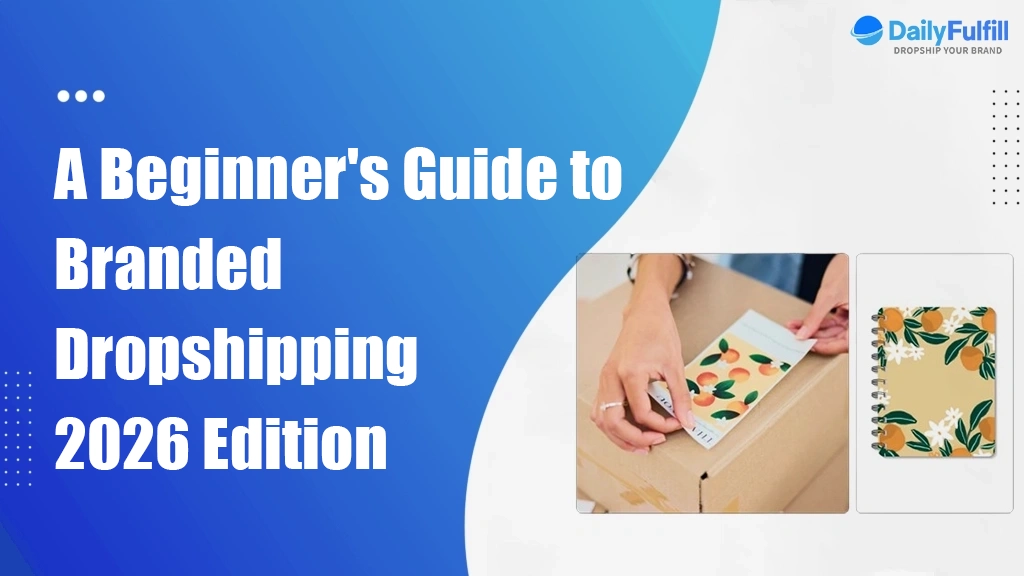
Branded dropshipping explained: what it is, the 3 levels (custom packaging, private label, custom manufacturing), and where each one fits — without holding inventory.