
 English
 Français
 Deutsch
 Nederlands
 Polski
 Español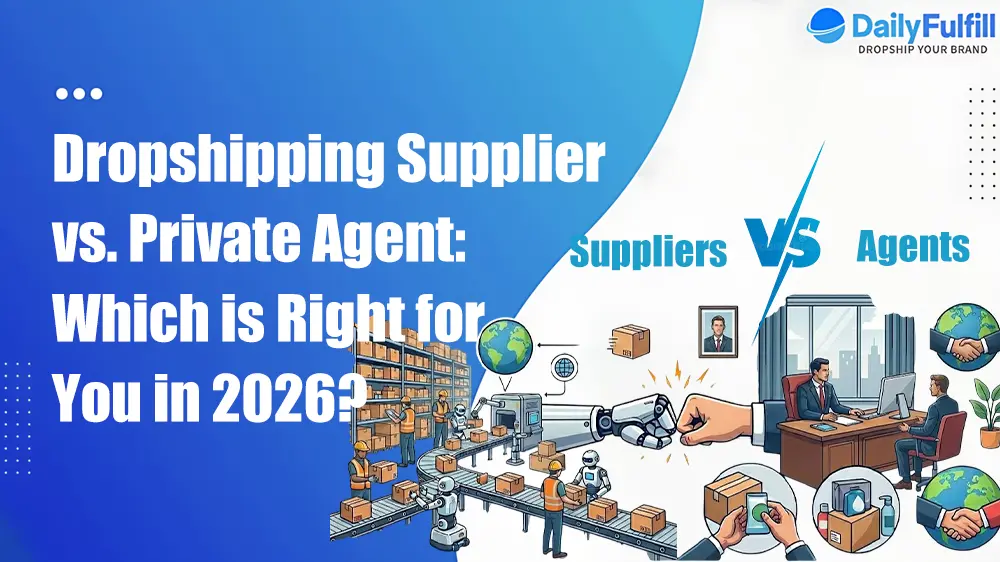
Dropshipping Supplier vs. Private Agent: Which Is Right For You In 2026?
Dropshipping Supplier vs. Private Agent: What is the difference? Discover which partner offers faster shipping, lower prices, and custom branding for your business in
If you’ve reached the point where you’re searching for CJ Dropshipping alternatives, you already know the platform. You’ve probably used it for a year or two, validated some products, and watched your operation outgrow what a marketplace platform can support — rotating agents who don’t know your store, QC that varies by source factory, and Q4 support delays that hit exactly when you need help most.
This guide is for sellers ready to migrate. We’ll cover what CJ does well (genuinely) and where its model breaks down at scale, then walk through five alternatives suited to different next stages — for sellers serving the German and broader European market specifically.
The goal isn’t to convince you CJ is bad — it’s to help you choose the right replacement for where your business is now.
Most sellers don’t leave CJ Dropshipping because of a single dramatic incident. They leave because the daily friction of marketplace operations starts costing more than the platform saves them. The signs accumulate slowly until a Q4 peak season finally exposes how brittle the setup actually is.
Agent rotation that erodes context. Every interaction starts from zero. The agent who handled your last shipment doesn’t remember your packaging requirements, your custom inserts, or the SKU issues you flagged a month ago. You spend hours re-explaining context instead of solving new problems.
Quality control variance between source factories. CJ aggregates products from many factories, and quality depends on which one fulfilled your order. The same listing can produce excellent products one month and disappointing ones the next, with no warning. Your German customers — who are disproportionately quick to leave negative reviews — notice immediately.
Q4 peak season support breakdown. When order volume triples and customer questions double, response times stretch from hours to days. CJ’s support team is genuinely overwhelmed during peak — not because they’re lazy, but because the marketplace model can’t scale per-account attention.
Margin compression as you grow. CJ’s pricing includes markup over factory cost (typically 15-30%) plus pick-and-pack fees. At low volume, this is invisible. At higher volume, the math shifts — you’re paying meaningful money for capabilities you’ve outgrown.
If two or more of these symptoms are familiar, you’re past the right time to evaluate alternatives. Most sellers wait too long because migration friction feels worse than current pain — until peak season makes the comparison clear.
Before evaluating alternatives, it’s worth being honest about what CJ does well — because the right replacement depends on which CJ capabilities you actually need to preserve.
Massive catalog — over 400,000 listed products covering nearly every dropshipping niche, ideal for fast product testing
Berlin and Rotterdam warehouses — enable 2-3 day delivery to German customers when products are pre-stocked, a real operational asset
Self-serve simplicity — sign up, install Shopify app, start importing products within minutes; no onboarding friction
Zero minimum order requirements — pay per order, no commitment, perfect for sellers under 5 orders per day still validating products
No dedicated account management — every interaction is with a different chat agent who has no context about your store
Quality variability — products are sourced from many factories with inconsistent QC, creating review risk that compounds with volume
Markup over factory price — typically 15-30% built into product cost, which is invisible at low volume but compresses margins as you scale
Limited custom packaging and private label — branded packaging exists in a basic form, but real private label production requires direct factory relationships CJ doesn’t facilitate
CJ’s sweet spot is sellers in the 0-5 orders per day range who need catalog breadth and zero-commitment testing capacity. The platform was built for that stage and serves it well. The mismatch starts when your business outgrows that profile but your supplier doesn’t.
The right alternative depends on which CJ capability you most need to upgrade. The five options below cover the most common migration paths — from dedicated agent services for sellers ready to scale, to specialized platforms for sellers pivoting to specific niches.
DailyFulfill is a China-based dedicated agent service built for the exact migration scenario most CJ users face: validated products, growing volume, and operational pain that marketplace platforms can’t fix. Every store gets a single account manager who learns your products, packaging, and customer expectations.
Best for: Sellers processing 5 or more orders per day, especially those building a brand for the European market.
Pricing model: Quote-based with line-item breakdown — product cost, pick-and-pack, shipping by lane, custom packaging. No subscription fees, no markup hidden in product price.
Pros:
Dedicated account manager replaces rotating chat agents
Factory-direct sourcing across 2,000+ partner factories — no marketplace markup
Custom packaging, branded inserts, and private label without minimum-order penalties
IOSS-compliant shipping and EU return address handling for German operations
Cons:
Onboarding takes 1-2 weeks vs. CJ’s instant signup
Not viable for sellers under 5 orders per day still validating products
Verdict: The most direct replacement for CJ when your business has outgrown marketplace operations. The trade-off is onboarding friction in exchange for operational consistency that pays for itself within the first month at consistent volume.
Spocket aggregates dropshipping suppliers based primarily in the EU and US — a different model from CJ’s China-aggregation approach. About 70% of vendors are in the EU, enabling 2-7 day delivery to Germany without IOSS or customs complexity.
Best for: Sellers who want to pivot to a “ships from Europe” or sustainability-focused brand position rather than continuing China-direct sourcing.
Pricing model: Subscription-based with tiered monthly plans. Product costs are set by individual suppliers, typically retail-adjacent rather than wholesale.
Pros:
EU-based suppliers eliminate customs and IOSS complications entirely
Curated supplier vetting reduces the QC variability common with marketplace platforms
Strong Shopify integration and branded invoicing
Cons:
Catalog significantly smaller than CJ — limited variety for trend testing
Pricing is closer to retail than factory cost, compressing margins
Subscription fees apply on top of product costs
Verdict: A meaningful change in business model rather than a like-for-like CJ replacement. Best for sellers willing to reposition around EU sourcing as a brand differentiator. Not the right fit if you need broad SKU variety or factory-direct pricing.
AutoDS isn’t a supplier — it’s an automation platform that connects to existing supplier networks (AliExpress, Amazon, Walmart, CJ Dropshipping) and handles product imports, automated price markup, order placement, and tracking sync. You still source from external suppliers; AutoDS removes the manual operational layer.
Best for: Sellers running AliExpress-based dropshipping who want to automate operations without changing supplier relationships.
Pricing model: Subscription-based with tiered monthly plans, plus product cost paid separately to source suppliers.
Pros:
Automates manual order placement on AliExpress and similar platforms
Price monitoring catches supplier price changes before they erode margins
Mature integrations with Shopify, eBay, and Facebook Marketplace
Cons:
Doesn’t solve the underlying issues of marketplace sourcing (shipping speed, IOSS, QC, branding)
Adds a subscription layer on top of supplier costs
Verdict: Useful if AliExpress sourcing is genuinely your business model. Not a real alternative to CJ if your problem is the supplier rather than the manual workflow.
AppScenic is a B2B dropshipping marketplace focused on high-ticket items ($100+) — furniture, premium home decor, designer goods — sourced primarily from EU, US, UK, and Australian suppliers with vetted quality standards.
Best for: Sellers ready to pivot from low-ticket trending products to a high-ticket store targeting affluent German buyers.
Pricing model: Subscription-based with tiered monthly plans plus optional transaction fees.
Pros:
Vetted suppliers meeting German CE and safety requirements
EU-based fulfillment with 2-5 day delivery to Germany
High-margin categories support profitable unit economics
Cons:
Subscription fees plus higher product costs require significant capital
High-ticket dropshipping requires longer sales cycles and higher CAC than trending product flips
Verdict: Not a like-for-like CJ replacement. Choose AppScenic only if you’ve decided high-ticket is your new business strategy and have the marketing budget to support it.
Zendrop is a China-sourced dropshipping platform with US warehouses and Shopify-first integration, positioned as a more polished alternative to CJ for sellers focused primarily on the US market. EU operations exist but aren’t the core focus.
Best for: Sellers whose primary market is the US, with Germany and EU as secondary markets.
Pricing model: Free tier plus paid subscriptions (Plus, Pro) that unlock features like priority sourcing and branded packaging.
Pros:
Cleaner Shopify-first interface than CJ
Branded packaging and inserts available on paid tiers
US warehouses enable fast US delivery for sellers serving both markets
Cons:
EU and German fulfillment is functional but not specialized — IOSS handling, EU return addresses, and German market compliance receive less operational attention than China-direct dedicated agents
Subscription fees on top of product cost
Verdict: A reasonable upgrade from CJ if you operate primarily in the US. For sellers focused on the German and broader European market, dedicated agent services with EU operational depth are a stronger fit.
The decision becomes clearer when you see the six options side-by-side on the dimensions that matter most:
| Dimension | CJ Dropshipping | DailyFulfill | Spocket | AutoDS | AppScenic | Zendrop |
| Best for | 0-5 orders/day testing | 5+ orders/day scaling | EU brand pivot | AliExpress automation | High-ticket pivot | US-focused hybrid |
| Service model | Self-serve marketplace | Dedicated agent | EU supplier marketplace | Automation layer | Vetted B2B marketplace | Shopify-first marketplace |
| Catalog access | 400,000+ products | Custom sourcing via agent | Curated EU catalog | External (AliExpress, etc.) | Curated high-ticket | Pre-vetted catalog |
| Pricing model | Free + markup over factory | Quote-based, line-item | Subscription + product cost | Subscription + supplier cost | Subscription + transaction fees | Free tier + paid plans |
| EU warehouse | Berlin + Rotterdam | Available for established sellers | EU-native | Depends on source supplier | EU suppliers | Limited EU focus |
| IOSS handling | Marketplace-level | Configurable per-store | Not needed (EU sourcing) | Depends on source supplier | Not needed (EU sourcing) | Functional |
| Custom packaging | Limited templates | Full custom + private label | Branded invoicing | Depends on supplier | Limited customization | On paid tiers |
| Best market focus | Global | Europe + global | Europe-only | Wherever AliExpress reaches | Europe high-ticket | Primarily US |
The pattern is clear: most CJ users migrating because of operational pain need either DailyFulfill (scale up to dedicated agent) or Spocket (pivot to EU sourcing) — those two cover the dominant migration scenarios. AutoDS, AppScenic, and Zendrop fit narrower use cases: automation, niche pivot, or US-primary operations.
The biggest mistake CJ migrants make is switching everything at once. A staged migration protects your operations and lets you catch problems before they affect customer-facing orders.
Document your actual requirements before talking to suppliers. Make a list of what CJ currently does that you genuinely need (catalog access, EU warehouse, custom packaging, IOSS handling) and what you’ve been wishing for. This prevents choosing a new supplier that’s “different but not better.”
Audit your active SKUs and pick the migration set. You probably don’t need to migrate every product. Start with your top 10-20 SKUs by revenue — the products that drive most of your business. Trending or low-volume SKUs can stay on CJ until proven worth migrating.
Run the new supplier in parallel for 2-4 weeks. Send your top SKUs through the new supplier while keeping CJ active for everything else. Monitor delivery times, packaging quality, IOSS handling, and customer service responsiveness. Real operations reveal what supplier evaluation calls can’t.
Run controlled test orders before mass cutover. Place test orders to your own German address (or to a friend’s) to verify the actual customer experience — tracking, packaging, customs handling, and delivery time. Suppliers that look great in conversation can fail at customs.
Manage customer communication during the transition. Update your shipping policy temporarily if delivery times will fluctuate. Most customers don’t notice supplier changes; the ones who do appreciate transparency.
After parallel testing proves the new supplier works, transition the remaining SKUs progressively rather than all at once. Most successful migrations take 4-6 weeks end-to-end.
The right answer depends on where your business actually is — not where you wish it was. Three stages cover most CJ users:
Tier 1: 0-5 orders per day, still validating products. Stay with CJ. The marketplace model is built for this stage; switching now creates onboarding friction without solving real problems. Your bottleneck is product validation, not fulfillment.
Tier 2: 5-100+ orders per day, scaling validated products. This is where the migration decisions in this article apply. Dedicated agent services (DailyFulfill) for sellers prioritizing operational consistency and brand-building; Spocket for sellers pivoting to EU sourcing as a brand position; AppScenic if pivoting to high-ticket. Most migrations fit here.
Tier 3: 100+ orders per day, building serious brand operations. Dedicated agent services still work, but at this scale you should also evaluate direct factory partnerships independently. Supplier strategy becomes part of your overall business strategy.
The mistake to avoid: choosing a Tier 2 supplier while still in Tier 1, or staying in Tier 1 setup while operating at Tier 2 volume.Match the supplier to your stage, not your ambition.
Migrating from CJ Dropshipping isn’t a sign that something failed — it’s a sign your business has reached a stage where the marketplace model is the limiting factor. The right next supplier depends on which CJ capability you most need to upgrade and which direction your business is heading.
If you’re a Tier 2 seller (5+ orders per day, scaling validated products) and want to evaluate whether a dedicated agent fits where your business is now, request a migration assessment from our team. We’ll review your current setup, identify the specific operational gaps you’re facing, and tell you honestly whether we’re the right fit — the same setup behind 6,000+ stores at a 4.9★ Trustpilot rating. If you’re earlier in your journey, the alternatives above will serve you better while you validate your products.
CJ isn’t bad — it’s a marketplace platform optimized for the 0-5 orders per day testing stage, and it works well for that. Most “CJ is bad” complaints come from sellers who outgrew the platform but didn’t migrate. The structural limits (rotating agents, factory variance, Q4 support delays, markup over factory price) become genuinely painful at higher volume but are non-issues for early-stage sellers. The right framing is “CJ for testing, dedicated agent for scaling” — not “CJ is bad.”
It depends on your stage. For sellers under 5 orders per day still validating products, CJ is the better fit — its self-serve catalog and zero-commitment model match early-stage needs. For sellers above 5 orders per day building a brand, DailyFulfill is typically the better choice — dedicated account management, factory-direct pricing, and IOSS-compliant shipping address the operational pain points marketplace platforms can’t solve. The question isn’t which is “better” but which fits where your business is now.
Most successful migrations take 4-6 weeks end-to-end. Plan for 1 week of supplier evaluation and onboarding, 2-4 weeks of parallel running (top SKUs on the new supplier while CJ handles the rest), and 1-2 weeks of progressive cutover for remaining products. Migrations attempted in less than 2 weeks typically expose problems mid-flow that affect customer-facing orders. The slower path is the safer path.
For most CJ users serving Germany, dedicated agent services with EU operational depth (DailyFulfill is one example) are the strongest fit — they handle IOSS-compliant shipping, EU return addresses, and German market documentation that marketplace platforms can’t consistently deliver. Spocket fits sellers willing to pivot to EU-only sourcing. AppScenic fits sellers pivoting to high-ticket. Zendrop is functional but optimized for the US market rather than Germany.
Yes, and most experienced operators do. Running multiple suppliers in parallel is standard during migration (2-4 weeks of running CJ alongside the new supplier) and increasingly common in steady-state operations — for example, using a dedicated agent for top-volume SKUs while keeping a marketplace platform for trending product testing. Just ensure your storefront, customer service, and inventory systems can handle multi-supplier order routing without confusion.
Learn dropshipping tips, sourcing strategies and fulfillment insights from DailyFulfill
Dropshipping Supplier vs. Private Agent: What is the difference? Discover which partner offers faster shipping, lower prices, and custom branding for your business in
Hitting 300+ orders a day on CJDropshipping? See when a private dropshipping agent saves more money, ships faster, and gives you real control in 2026.
CJ Dropshipping claims 7–15 day shipping to the US and EU. Real seller data tells a different story. See actual delivery times, delays, and faster options.