For years, hiding the Chinese origin of your shipments was almost an afterthought. You shipped cheap parcels under the $800 de minimis threshold, left a note asking your AliExpress supplier to skip the invoice, renamed a couple of tracking statuses, and moved on.
That playbook is now broken.
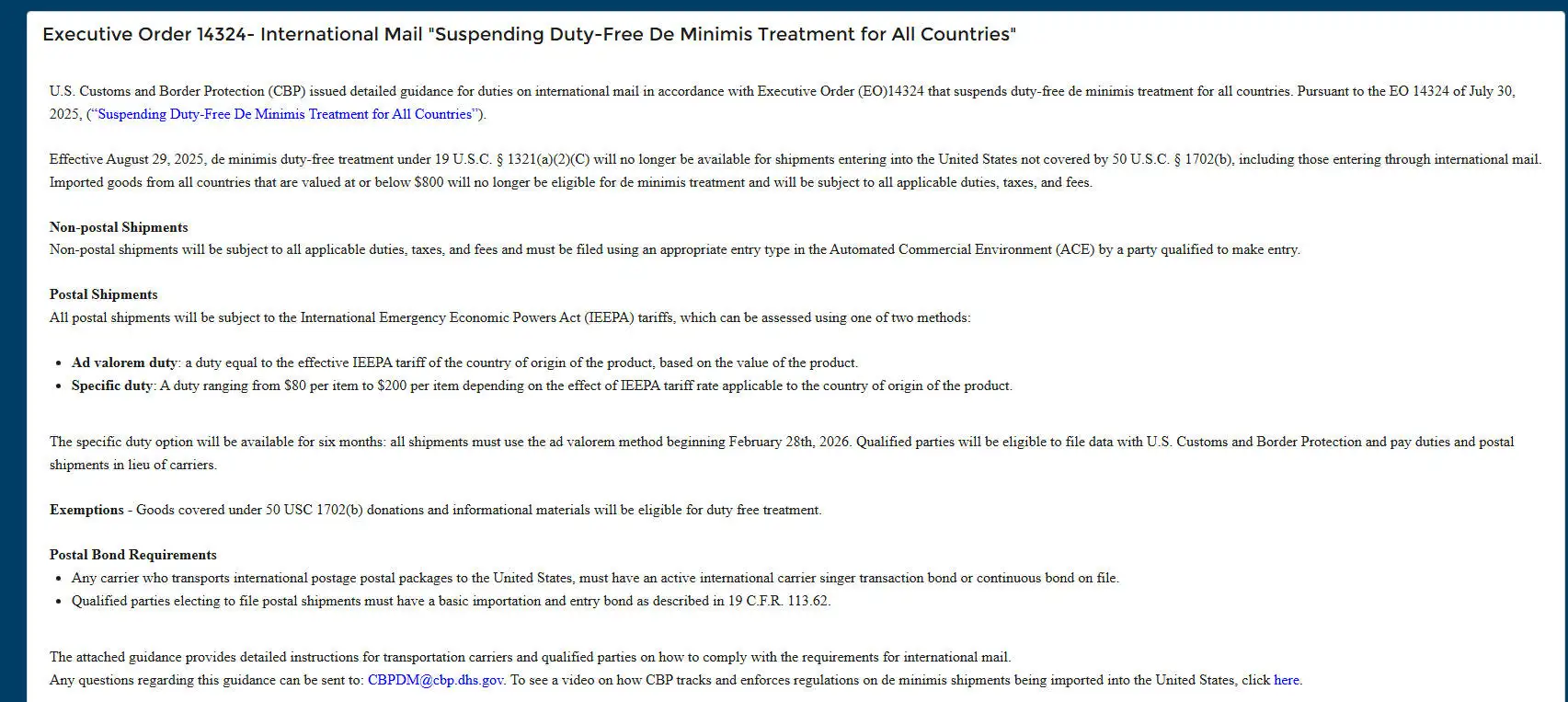
In 2025, the United States ended the de minimis exemption — first for China, then for every country. Parcels entering the US now clear customs formally and carry duties regardless of their value. At the same time, your customers have never been more aware of where their products actually come from. Tariff headlines, the scrutiny around Temu and Shein, and endless “is this just dropshipping?” threads have made buyers far more suspicious of any package that visibly originates from China.
So the problem hasn’t disappeared. It has become harder to solve — and more expensive to ignore. A visible Chinese origin now costs you conversions, trust, and chargebacks at a higher rate than it did two years ago.
This guide is written for sellers already moving real volume, not for beginners looking for a quick trick. It covers the five steps that still work in the post-de-minimis era: what to fix on your tracking page, why “leaving a note” is dead, how last-mile relabeling actually works now, how to present your origin without lying to Stripe or PayPal, and when hiding isn’t even the right call for your brand.
The 2025 Reality — What Actually Changed for Cross-Border Sellers
Before the tactics, it’s worth understanding why the old methods stopped working, because it changes which steps still matter.
The de minimis exemption let any shipment under $800 enter the US duty-free with minimal customs inspection. For dropshippers sourcing low-cost goods from China, it was the quiet foundation of the entire model. That foundation is gone. The exemption was first scrapped for Chinese and Hong Kong goods, taking effect in early February 2025, then extended to shipments from all countries on August 29, 2025. Today, every package requires formal customs processing regardless of value.
That single change creates four practical consequences for anyone trying to control how “Chinese” their shipments look:
1. Customs paperwork is now unavoidable. Formal entry means a commercial invoice and customs declaration travel with every shipment. A declaration form or commercial invoice referencing a Chinese shipper can end up visible on — or inside — the parcel if your fulfillment isn’t handled carefully. This is a new failure point that didn’t exist under de minimis.
2. Relabeling still works, but the economics changed. The last-mile relabeling method (Step 3) still produces a clean local label on the box your customer receives. What it no longer does is avoid duty — that is now assessed at the border regardless of how the final label looks. As an illustration, a $50 item can pick up duty plus brokerage fees that materially change your landed cost. A typical example is a $50 phone case facing 7.5% duty plus brokerage fees. Your pricing math has to absorb this.
3. Third-party trackers reveal more than before. With formal customs processing, aggregators like 17track are more likely to surface a “customs clearance” or origin-country node in the journey. Hiding the origin on your own tracking page is still necessary — but it is no longer sufficient on its own. We’ll address this directly in Step 1.
4. Local fulfillment shifted from psychological to practical. Before 2025, a US or EU warehouse mainly bought you the feeling of being local. Now it can also reduce per-parcel customs friction and give you cleaner compliance. For higher-volume sellers, the calculation behind holding stock closer to the customer has genuinely changed.
The takeaway is simple. The goal is no longer to make a Chinese parcel vanish through a duty-free loophole — that loophole is closed. The goal is to deliver a clean, professional, locally-presented experience while staying fully compliant with the new customs reality. Every step below is built for that environment.
Step 1 — Clean Up Your Tracking Page (and Why That's Only Half the Job)
The order tracking page is where most origin leaks happen, simply because it’s the one place customers check repeatedly between purchase and delivery. A raw carrier feed will happily display “Departed Guangzhou” or “AliExpress Standard Shipping,” and a single glance is enough to trigger a worried email — or a chargeback.
Every serious order-tracking app now includes a “dropshipping mode” that rewrites or suppresses these signals. The four most widely used on Shopify:
| Tool | Free plan | Hide-origin feature | Where to set it | Best for |
|---|
| ParcelPanel | Yes | Dropshipping mode hides China/AliExpress keywords, carrier name and logo | Settings → Dropshipping mode → Enable | The default choice — largest install base, deepest options |
| 17TRACK | Yes | Hides Chinese characters, locations, carrier info, and sender address on the map | Tracking Page → Customize → Tracking section → hide carrier info | Sellers already inside the 17TRACK ecosystem |
| Tracktor | Trial | “Location Substitution” plus carrier mapping — replace any location string with custom text | Tracking Page menu → Location Substitution | Granular control over specific status wording |
| Parcelous | Yes (50 orders/mo) | One-click hiding of Chinese origin and carrier info | Dropshipping Features tab | Lighter setup, lower-volume stores |
App pricing and tier limits change frequently — confirm the current plan before you commit.
The mechanics are similar across all four. Using ParcelPanel as the example, you enable Dropshipping mode in Settings, which activates a new batch of controls on the Trackings Page tab.
- Install the app and open Settings.
- Enable Dropshipping mode. This unlocks the hide-origin controls.
- Add the keywords to suppress — at minimum China, Guangzhou, Guangzhou, AliExpress, and your carrier’s Chinese name.
- Replace origin statuses with neutral language. “Departed Guangzhou” becomes “In transit” or “Departed partner facility,” and the sender address is hidden from the map.
- Point your store’s tracking link at the branded page, so the customer sees your clean version — never the raw carrier feed.
Done correctly, the customer’s experience goes from a transparent China-origin trail to a neutral journey that simply ends with a local delivery.
Here is the part most guides skip — and it matters far more after 2025. Your branded tracking page only controls what the customer sees on your page. If they copy their tracking number into the carrier’s own website or a third-party aggregator, they can still reach the original origin and customs nodes. With formal customs processing now applied to every parcel, those origin and carrier details are exactly what apps like 17TRACK are built to hide — but only on the surfaces you control.
This is why the most reliable setups use a two-tracking-number structure: a first-mile number for the international leg, and a separate last-mile number (USPS, Royal Mail, and so on) that is the only number ever shared with the customer. We break down exactly how that works in our guide to tracking packages from China when dropshipping. Cleaning up the tracking page is Step 1; controlling which number reaches the customer is what makes it hold up.
Step 2 — Why "Just Leave a Note on AliExpress" No Longer Works
The most common advice for hiding origin is also the weakest: message your AliExpress supplier and ask them to skip the invoice. It feels free and easy. In practice it fails far more often than it works — and the 2025 customs changes have made it less reliable still.
There are three reasons it breaks down.
The outer label is not optional. A supplier can leave the paper invoice out of the box, but the shipping label on the outside is a legal requirement for export — it has to carry sender details and a country of origin. The seller cannot remove it, which means you have no control over how the parcel physically looks when it lands. And now that every parcel clears customs formally, that documentation is scrutinized more, not less.
You’re not talking to the person who packs the box. Many AliExpress sellers are resellers themselves, sourcing from an upstream factory that handles the actual fulfillment. Your note often never reaches whoever tapes the box shut. Compliance is inconsistent at best — and you usually find out it failed only when a customer emails you a photo of a Chinese invoice.
The carrier field gives you away regardless. AliExpress Standard Shipping and similar services display their own name, or a Chinese carrier’s, in the tracking feed by default. Even a physically clean parcel still carries a digital trail pointing straight back to China — the exact leak Step 1 is trying to close.
The reliable alternative is blind dropshipping: a fulfillment model where the package carries no supplier branding, no invoices, and no identifying origin marks, so the customer sees only your brand — or nothing at all. The shift is that you stop relying on a stranger’s goodwill and start working with a private dropshipping agent whose entire job is controlling what leaves the warehouse.
A proper agent does what a note never can. They receive your goods from the factory, strip the original packaging, and repack into clean, neutral boxes — with zero factory flyers, wholesale invoices, or QR codes inside. They control the export declaration itself, so the paperwork travelling with the parcel isn’t a giveaway. And because the product is already in their hands, you can go further: adding your own custom packaging, logo, and inserts is the foundation of white label dropshipping.
At DailyFulfill this is the core of what we do — we discard the cheap grey plastic bags, pack in clean boxes, and make sure your customer never finds a Chinese invoice inside. That is what separates true blind dropshipping from simply hoping the origin stays hidden.
Step 3 — How Last-Mile Relabeling Actually Works (Updated for 2026)
This is the step that does the heavy lifting, and it’s the one most guides explain badly. Done right, the package that reaches your customer’s door carries a domestic label — a USPS slip in the US, Royal Mail in the UK — with no Chinese carrier name anywhere on it. Here is the mechanism behind that, without the hand-waving.
Your orders don’t fly individually. A dedicated-line carrier consolidates many parcels into a single bulk shipment, flies that container to the destination country, clears it through customs as commercial cargo, and then injects the individual parcels into the local postal or courier network for final delivery. At that handoff, a domestic tracking number is generated, and a domestic carrier handles the last mile to the customer’s address.
Two details are worth being precise about, because this is where most explanations get muddy:
- The international carrier and the last-mile carrier are not the same company. YunExpress, CNE, or 4PX move the parcel across borders; USPS, Royal Mail, DPD, or Australia Post deliver the final leg. Your customer only ever interacts with the second one.
- “Relabeling” is not a sticker slapped over a Chinese label. It means a fresh domestic tracking number is issued for the last leg — and that is the only number your customer should ever receive. On the carrier’s own website, that number resolves to a domestic regional facility, not Guangzhou.
In practice the routing depends on the destination, which is exactly why the carrier choice matters:
| Destination | International line | Final-mile carrier |
|---|
| United States | YunExpress (or 4PX for heavy / electronics) | USPS / UPS |
| UK & Europe | CNE Express (strong on fashion), YunExpress | Royal Mail / DPD / local post |
| Australia | 4PX | Australia Post |
| “Hard” markets (Brazil, Mexico, Russia) | 4PX | local carrier |
These are the dedicated lines DailyFulfill routes through, with published transit times of 6–12 business days to the US and 3–8 business days to core EU markets. Avoid China Post and ePacket for this entirely — they expose the origin at nearly every node and defeat the whole purpose.
Now the 2025 caveat, because this is where outdated guides will steer you wrong. The relabeling method still produces a clean local label; that part is unchanged. What it no longer does is let you skip duty. Every parcel now clears customs formally, and duties are assessed at the border regardless of how the final label looks. In other words, relabeling controls perception — it does not control cost. Your landed price has to absorb the duty, and for higher-value items it is often smarter to consolidate shipments or rethink your fulfillment model than to ship each order individually.
Getting the label right is what makes the delivery itself look local. But your customer forms an impression long before the box arrives — on your product page and your shipping policy. Get the wording wrong there and you don’t just lose trust; you can lose your payment processor. That’s Step 4.
Step 4 — Fix Your Store Without Lying to Stripe or PayPal
There is a line between hiding your origin and lying about it, and crossing it is how sellers lose their payment processor overnight. The good news: you can stay firmly on the safe side and still look completely professional.
Start with the most common leak on your own store — the “Ships From” variant on your product pages. When you import products, apps often pull in a “Ships From: China” option that sits right next to Size and Color. Remove it:
- In Shopify, open Products and select the product.
- Go to the Variants section.
- Delete the “Ships From” option entirely, so the customer only sees real choices like Size and Color.
- Repeat for any affected product, or fix it at the source in your Shopify fulfillment and import settings so it never appears again.
Next, rewrite your shipping policy in neutral, honest language. Don’t claim a false origin — simply don’t volunteer the Chinese one. A clean, compliant template you can adapt:
Orders are processed within 1–2 business days and shipped from our global fulfillment network. Estimated delivery is 6–12 business days depending on your destination, with tracking provided on every order. Any applicable import duties or taxes are calculated at checkout or collected by the carrier on delivery, in line with current regulations.
That last sentence matters more after 2025. With duties now applied to incoming parcels, a customer hit by an unexpected charge they were never warned about is a refund and a chargeback waiting to happen. Naming the possibility up front protects you.
On the product page itself, the rule is simple: never write “Made in USA” or “Ships from USA” if it isn’t true. That isn’t hiding — it’s fraud, and it’s exactly what gets funds frozen. If your registered business address, your stated origin, and your actual shipments don’t line up, a single customer dispute alleging deception can trigger a Stripe or PayPal hold, or a Shopify suspension. Lean on service-led language instead — “Fast worldwide shipping,” “Dispatched within 24 hours” — which describes how well you operate rather than making a false claim about where you are.
These fixes are written for Shopify, where you control the storefront directly. If you also sell on marketplaces, the constraints tighten: Amazon and TikTok Shop in particular police tracking validity hard, so the last-mile number from Step 3 must be a real, scannable domestic number — never a placeholder.
The principle throughout is one line: omission is allowed, fabrication is not. Hold that line and your store stays both clean-looking and safe. Once the store is handled, one scenario can still unravel all of it — a return request. That’s the final step.
Step 5 — Returns: The Decision That Protects (or Destroys) Your Margin
Returns are the quietest way a dropshipping business bleeds money, and they are the one area a clean tracking page can’t fix. The instinct is to treat every return the same way — and that’s the mistake. The right move depends entirely on the item’s value and where it has to go.
First, separate two cases. If an item arrives lost, damaged, or defective, that’s a fulfillment-side problem: a good partner reships or refunds it, and you shouldn’t be absorbing reverse logistics for their error. (DailyFulfill, for example, reships lost packages free or refunds them, and sends quality defects back to the factory.) The hard case is the buyer’s-remorse return — wrong size, changed mind, simply didn’t love it. Most marketplaces won’t back you on those, so the cost lands on you. Here is how the three options compare:
| Return path | Typical cost | Speed | When it makes sense |
|---|
| Ship back to China | ~$15–30 reverse shipping, often store-credit only | 2–4 weeks | Almost never for items under ~$30 |
| Refund without recovery (“returnless”) | Lost COGS + ~$0.30–1.00 unrecovered processing fee | Instant | Cheap items where return shipping exceeds the product’s value |
| Local return + restock | Small per-item handling + storage | Days | Higher-value or high-repurchase items worth restocking |
The numbers point to a counter-intuitive truth: for low-cost items, the cheapest and fastest “return” is often no return at all. Sending a product from the US or Europe back to a China warehouse runs roughly $15–30, and many platforms issue store credit rather than a cash refund — so on a $12 item, you refund the customer, let them keep or discard it, and skip the reverse shipping entirely. The buyer is satisfied, chargeback risk disappears, and your only real loss is the cost of goods.
The threshold to watch is your average order value against reverse-shipping cost. Below roughly $30 AOV, returnless refunds usually win. Above that — or in high-repurchase categories like apparel and beauty — a local restock arrangement starts to pay for itself, and it’s worth pricing one out once you’re past steady daily volume. We go deeper on building a margin-protecting return policy in our full guide to dropshipping returns and refunds.
You now have the complete mechanical playbook — tracking, packaging, relabeling, storefront, and returns. But underneath all of it sits a strategic question worth asking before you invest in any of this: should you be hiding your origin at all?
When Hiding Isn't the Right Strategy
Everything above assumes hiding your origin is the goal. For most dropshippers it is — but not for all, and a mature seller should know which camp they’re in before investing in any of it.
Three types of brand are often better off owning their China connection than concealing it:
- Design-led, higher-priced brands. If you sell on a designer story — niche jewelry, craft goods, premium beauty — customers are buying the design and the brand, not scrutinizing the shipping label. Origin becomes a footnote, not an objection.
- B2B and wholesale sellers. Your buyers already understand the supply chain. Hiding it reads as naïve; transparency reads as competent.
- “Factory-direct” positioned brands. Some stores make sourcing the entire pitch — cutting out middlemen and passing the savings on. Here, “ships directly from the manufacturer” is an asset you would be foolish to bury.
A fast way to decide is to ask three questions:
- Is your AOV above roughly $40? Below that, buyers tend to be price-sensitive and origin-anxious, so hiding almost always helps. Above it, your brand and product can carry the sale on their own.
- Is your audience origin-sensitive? Some demographics and categories react strongly to “made in China”; others genuinely don’t care. Know which one is yours.
- Does your brand story depend on the origin staying invisible? If yes, hide it. If your story is strong enough to stand beside the origin, you have room to be open.
For the roughly nine in ten dropshippers selling competitively-priced products to origin-conscious buyers, hiding remains the correct call — and the five steps above are how you do it cleanly. But if you landed in one of the three camps here, your money is better spent on branding and custom packaging than on concealing a label nobody was going to hold against you.

 English
 Français
 Deutsch
 Nederlands
 Polski
 Español